
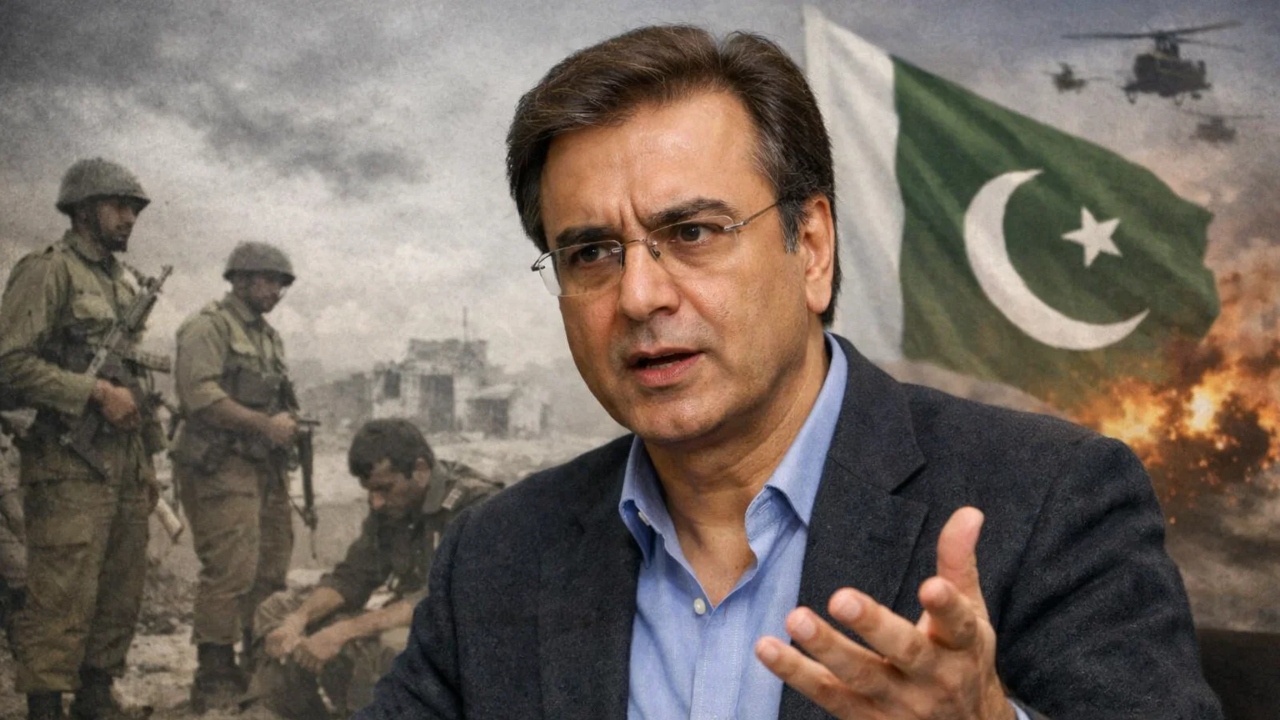
Who is Pakistani journalist Moeed Pirzada, who gave rebellious statement against his own army? Called 1971 as India’s ‘stab in the back’

Pakistan Well-known journalist Moeed Pirzada is once again in the news for his outspoken statements. This time he has launched a scathing attack on his own country’s army and government, describing the events of 1971 as “stabbing India in the back”. Referring to the Bangladesh Liberation War, he put Pakistan’s policies and leadership in the dock, which has sparked a new debate within the country.
Who is Moeed Pirzada?
Moeed Pirzada is a famous journalist, TV anchor and political analyst of Pakistan, who is known for his outspoken and anti-establishment comments. He studied at London School of Economics (LSE) and worked on many big news channels of Pakistan. His show “Tonight with Moeed Pirzada” was very popular. At present, he openly expresses his opinion on international politics, internal situation of Pakistan and military-political equations through YouTube and social media.
Why is Peerzada in discussion?
In recent days, Moeed Pirzada made a sharp attack on Pakistan’s army and government and made such a statement regarding 1971, which sparked debate. He said that Pakistan “stabbed India in the back” in 1971 and it all happened because of wrong policies and leadership. His statement came in the context of Bangladesh Liberation War, where he pointed out that the political and military strategies of that period became the reason for the disintegration of the country.
What is his argument regarding 1971?
Pirzada says that after the defeat in 1971, there was an understanding between India and Pakistan that the disputes would be resolved bilaterally, but later Pakistan tried to back out of that understanding by raising the Kashmir issue on international forums, which he described as a “betrayal”. He also said that after the war, India treated about 90,000 Pakistani prisoners of war with respect, while Pakistan did not reciprocate the same trust.
Why get angry at the army and power?
In his statement, Moeed Pirzada directly targeted Pakistan’s military system. He linked the military action in East Pakistan (now Bangladesh) in 1971, the hanging of Zulfikar Ali Bhutto and the current situation of Imran Khan as a “pattern”. He alleges that the power structure in Pakistan has repeatedly stood against its own leaders and citizens.
What did you say on the issue of Imran Khan?
Peerzada also expressed concern about Imran Khan’s deteriorating health in jail. He appealed to his family to raise their voice at the international level and demand an investigation by an independent medical board. He called it not just a matter of one person but a bigger issue of human rights and political behavior in Pakistan.
Is this statement changing the narrative in Pakistan?
In Pakistan, the events of 1971 are usually presented from a different perspective, where external factors are held more responsible. In such a situation, Moeed Pirzada’s confession points towards a big change. He clearly said that instead of blaming India, Pakistan should honestly consider its mistakes.
Why is this whole controversy important?
Pirzada’s statement is being considered important because it reflects the voice raised from within Pakistan, which questions both history and power. This may not only intensify the 1971 debate again, but may also impact the narrative regarding India-Pakistan relations.

Comments are closed.