
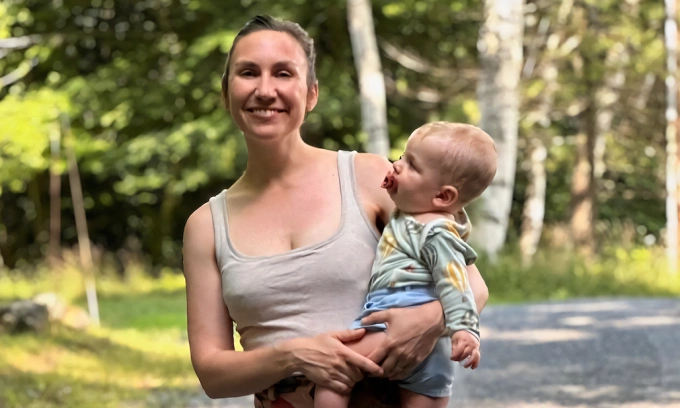

Holden came up with the idea for her business in February 2024 when she and her husband observed that their newborn son, Maxime, drifted off faster when his eyes were lightly covered with a burp cloth or small towel, according to CNBC Make It.
Julia Holden and her baby. Photo courtesy of Julia Holden |
As a first-time mother “in survival mode,” Holden searched for a product she could buy – a soft eye covering that would remain in place even if he moved – but says she could not find one she liked.
Having long harbored dreams of becoming an entrepreneur, Holden says her immediate instinct was to create and sell the product herself.
She designed a baby hat with an attached eye covering, called her side venture Sleepy Hat, and over the next year invested nearly US$16,000 from her personal savings to bootstrap the business, she says.
Since June 2025, Sleepy Hat has generated five-figure monthly revenues, including more than $90,000 in December and over $69,000 in January.
The company is profitable, says Holden, who initially launched it while working full-time as a senior relationship manager at an advertising firm and caring for her baby.
She carved out time for the business in 20-minute intervals between breastfeedings at her home in Lawrence Township, New Jersey, she says. “I had no outside funding, no team and no child care beyond family help,” says Holden, 34.
In October, Holden left her job – which paid US$95,000 annually – to run Sleepy Hat full-time. Most profits have been reinvested into the company, including payroll for two part-time contractors who assist with inventory management and running advertisements on Google and Amazon, she says.
“I also recently took on an advisor, [who has] a little bit of equity,” Holden says.
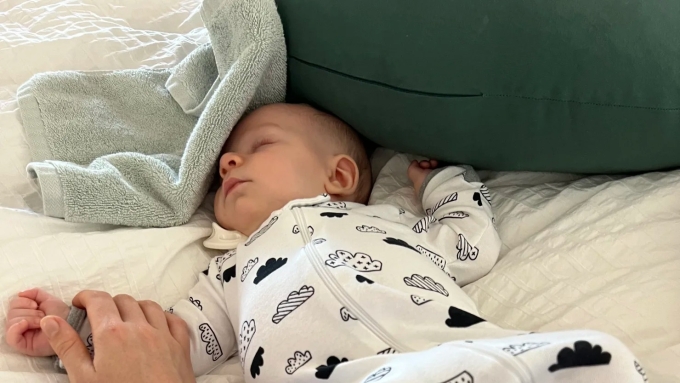 |
Before creating the “Sleepy Hat,” Holden would use a cloth to limit visual distractions during nap time for her son, Maxime. Photo courtesy of Julia Holden |
She paid herself $2,500 from the business in 2025 and has been relying on her remaining savings and her husband’s income as an assistant director at Princeton University. She works between 30 and 60 hours a week, including weekends, she says.
Balancing the business with caring for her now two-year-old is demanding, she says. However, setting her own schedule allows her to spend more daytime hours with her family than she could in a traditional 9-to-5 role.
“I’m still stressed, but for a more meaningful reason,” says Holden. “It feels more important. It’s much more satisfying.”
‘My first sale from a stranger was life-changing’
Holden says she did not have “proof of market fit” when she decided to launch Sleepy Hat. Instead, she shared the idea with other mothers in her circle, who she says described it as “genius.”
She initially planned to spend about $10,000 to launch the business, but exceeded that budget due to “product development, creating patterns, creating prototypes and samples … and then all the tiny little things that add up, like purchasing a domain, a trademark [and] building a website,” she says.
Without a design background, Holden says the first pattern she created with her mother produced a hat that was “completely the wrong size.”
A friend in the entrepreneurial space connected her with a factory in China that sent prototypes. However, her description lacked sufficient detail at first, resulting in about $1,500 worth of defective products.
After finalizing the design and placing an order for 1,500 units, Holden says she “splurged” on a photographer to populate Sleepy Hat’s website with professional images.
The website launched in September 2024 but saw limited sales until December, when she listed the product on online marketplace Grommet, she says.
In August 2025, Holden joined Amazon as a third-party seller. Around the same time, posts on Sleepy Hat’s TikTok account began gaining traction, with some attracting hundreds of thousands of views and thousands of likes.
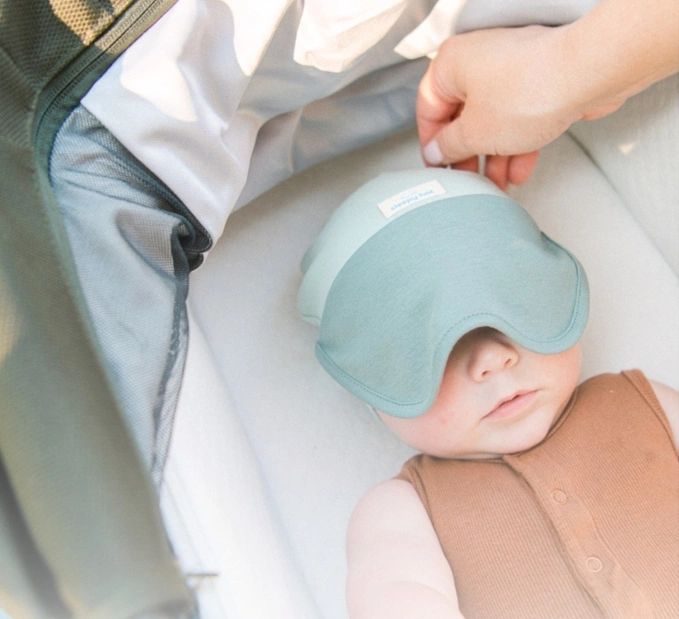 |
A Sleepy Hat product. Photo courtesy of Sleep Hat |
The road to ‘six-figures plus’
Holden says most of her sales now come from paid online advertising. She is developing new patterns and materials for Sleepy Hats, refining her social media strategy and updating the product’s packaging, she adds.
“The goal is to increase my own salary on a quarterly basis this year,” says Holden. “I hope to double what I pay myself in the second quarter in April … I hope next year to be able to pay myself actually more than what I was making at my full-time job, so six-figures plus.”
Although Holden previously launched a short-lived T-shirt brand and website for women runners, she says she is still building her financial knowledge and organizational skills.
“You need to understand every dollar that’s coming out and every dollar that’s coming in,” she says.
“And I’m not particularly finite. I just don’t gravitate towards spreadsheets … So it’s definitely been a learning curve to force myself to take the time and understand the balance sheet and where every dollar is going, and it’s still a work in progress.”
Holden says she has also learned to trust her instincts. She recalls her sister, who runs a PowerPoint tutorial business, advising her against launching a startup as a new mother.
“She was like, ‘I would not start a business right now. You’re postpartum,’” Holden says. “And I was like, ‘OK, I hear you. I’m going to do it anyway.’”

Comments are closed.