
More than 70 countries signed the declaration in AI Summit, formal conclusion of the conference today

New Delhi. Union Information Technology Minister Ashwini Vaishnav said that all the major countries playing an important role in the field of artificial intelligence have signed the joint manifesto of India AI Impact Summit-2026. More than 70 countries have already signed the declaration and the number is expected to cross 80, Vaishnav said. He said, the world considers India a reliable partner in the semiconductor sector.
Vaishnav told the media at the summit, the declaration of the last summit was signed by about 60 countries. We have already crossed the 70 mark. Several foreign ministers are discussing this with the Indian government and the final numbers and content of the manifesto will be shared transparently on Saturday, he said. Describing the summit as a huge success, he said, more than 5 lakh visitors participated in the AI exhibition. The event saw commitments for infrastructure-related investments worth more than US$250 billion.
Vaishnav said, the world looks at India as a reliable partner for the semiconductor supply chain, and semiconductors will emerge as the key sector in the country. Innovation in AI will also benefit the semiconductor sector. Vaishnav was answering a question about the Pax Silica agreement with the US.
Cost will reduce in innovation sector
On the discussion regarding cost cutting in the field of innovation, Vaishnav pointed to the ongoing innovations aimed at reducing manufacturing expenses. He said, people are looking to reduce the cost of electricity by 50 percent. There will be a similar change in the cost of the chip. There is a lot of innovation happening. India stands to benefit greatly from this wave of technological advancements, especially as the country builds its semiconductor capabilities. We are starting our design and semiconductor field journey from a point where we can harness all the benefits we know about AI and adapt the design of our chips to the new era.
Army showcases many AI-powered defense equipment, Rajnath visits the pavilion
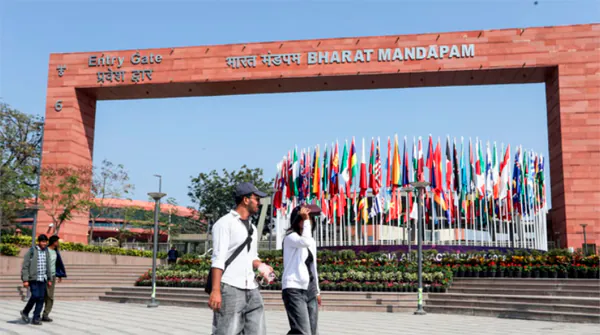
From climate science and disaster forecasting systems to tools to detect driver fatigue to prevent accidents, the Indian Army showcased a number of applications at the AI Impact Summit. Defense Minister Rajnath Singh visited the Army pavilion on Friday. The Indian Navy has also set up a pavilion as part of the summit exhibition. The Army has showcased several AI-based applications in its pavilion located in Hall No. 4. Defense Minister Singh interacted with military officials who took him on a tour of the pavilion, which has attracted visitors both young and old. The Defense Minister said in a post on social media, I am very happy to participate in the AI Impact Summit organized at Bharat Mandapam today.
India is rapidly emerging as a global leader in the field of AI and advanced technologies. This summit showcases the immense talent of our innovators, researchers, startups, armed forces and industry leaders. Rajnath further wrote, India’s AI vision expressed by PM Modi in the summit takes humanity towards a safe and future-ready world.
Strong data management, defined operational boundaries and clear accountability are important
The roundtable on Agentic AI focused on how this transformation is redefining security, accountability, cybersecurity and public trust, drawing from global technology industry, policy and legal arenas, and business-industry and policy perspectives. While also uncovering new benefits to productivity and innovation. The first panel presented real-world scenarios from a variety of areas, including payments, cloud infrastructure, cybersecurity, and intelligent product design. Austin Mayron, Director of the United States Patent and Trademark Office (USPTO), highlighted the role of standards-based collaboration in enabling responsible innovation.
Strategic partnership is necessary, not self-reliance in AI
Real AI sovereignty means protecting our country’s interests by using the best technology. He said that instead of complete technological self-reliance, countries should partner with the US so that they can quickly adopt AI and take advantage of advanced technology while keeping sensitive data within their country. This was said by Michael Kratsios, Director of the Science and Technology Policy Department of the White House. He has supported a national sovereignty-based model while criticizing centralized international AI regulatory frameworks.
US initiative to increase AI exports
Under the National Champions Initiative, AI companies from partner countries will be connected to the US AI stack. Technical experts will be deployed under the US Tech Corps initiative. A new fund will be created at the World Bank to reduce financial barriers to AI adoption. Apart from these, agencies like Export-Import Bank of the United States, US International Development Finance Corporation and Small Business Administration will also cooperate.
AI in healthcare, education, energy and agriculture
Kratsios said the US is the leader in AI innovation and he wants to help partner countries adopt AI while maintaining control over their technological future. He said, it is necessary to accelerate the use of AI in healthcare, education, energy, agriculture and government services.
India-US partnership important in providing benefits to all people
The US-India partnership has an important role in bringing the benefits of AI to everyone and everywhere. Before the signing of the Pax Silica declaration by India and the US, Sundar Pichai, CEO of Google and its parent company Alphabet Inc., said that this agreement, along with the recently signed interim trade agreement, will lay the foundation for a strong US-Indian technology partnership for many years to come. Pichai said that Google has recently announced the India-America Connect Initiative, under which new subsea cable routes will be built to connect America and India.
India’s digital policies form the basis of global AI development
Pichai said that India has the potential to lead the world in the field of AI. India’s digital public infrastructure and visionary government policies are the foundation of global development. The country’s digital model has become exemplary at the global level. Initiatives like Aadhaar, UPI and DigiLocker have connected crores of people to digital services and this strong framework will help in accelerating AI based innovations.
Emphasis on employment and skill development
Pichai said, AI will create new employment opportunities and for this it is necessary to equip the youth with future skills. The government and the private sector will have to jointly focus on skill development so that India’s huge youth population can be prepared for the needs of the AI era.
The goal is to provide affordable computing capacity to all.
India is focusing on a model in which the government, philanthropic organizations and the private sector work together to ensure affordable computing capabilities are available to all. The role of philanthropic organizations in particular will be decisive in this, as their focus is on making the benefits of AI universally accessible. Dr Saurabh Garg, Secretary, Ministry of Statistics and Program Implementation, said this during a session at the AI Impact Summit on Building AI in the Public Interest: Financing for Equitable Access to Computing Resources. Garg said, our focus is not on distribution of computing capacity, but on intelligent priority setting. Our focus will be on building computing capabilities into an enabling platform.
be used to achieve public welfare goals
The real measure of progress amid global AI transformations will be its alignment with public objectives. The main question is whether it will be equitable, inclusive and in line with the public interest. This is the main topic of current global discussion. It is important to ensure that resources are used to achieve public welfare goals in sectors like health, education and agriculture.
“I’m worried that in two years we could reach a situation where we succeed in developing computing capacity in many countries, including the Global South, but the data centers remain underutilized,” said Martin Tisne, CEO of the AI Collaborative.
Patrick J. Vilas Dhar, President of the McGovern Foundation, stressed the need for new institutional mechanisms linking policy, capital and large-scale deployment, saying that access cannot be left to market forces alone.
Indigenous AI necessary to avoid digital dependence
India will have to develop its own core AI technologies to avoid becoming a digital colony dependent on foreign systems. Vivek Raghavan, co-founder of indigenous AI startup company Sarvam AI, said that AI is a technology that impacts every aspect of human life. A country like India has to understand this from the basic level. Otherwise, we will become a digital colony dependent on other countries for this vital technology. He said that this is a fundamental technology that will shape every aspect of life. Therefore, for India, developing it from scratch is not an option but an essential responsibility.
Linguistic and cultural diversity is India’s strength
India’s strength lies in its linguistic and cultural diversity, large population and demanding economy, and cost-conscious innovation, which helps in creating affordable AI solutions. Sarvam,AI is building an indigenous AI platform. This includes speech recognition and handwriting-to-voice models built specifically for Indian languages. Shawn Seo, CEO of Philanthropy Asia Foundation, described demand aggregation, subsidized access models, as a key way to expand access to advanced computing.

Comments are closed.