
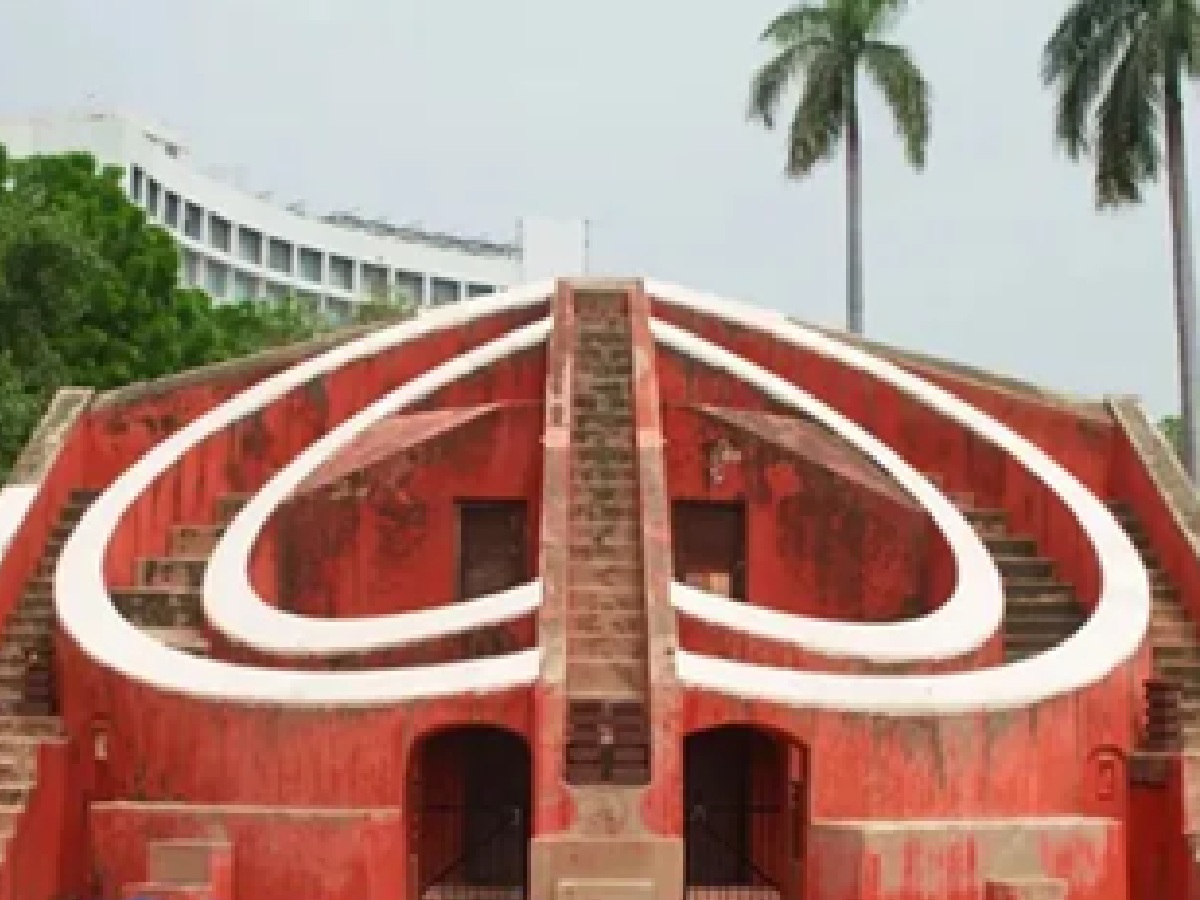
Mughal-Era Astronomical Marvel To Epicenter Of Indian Democracy: The Unseen Evolution Of Delhi’s Jantar Mantar:

Nestled in the bustling heart of Central Delhi near Connaught Place and Parliament Street, Jantar Mantar frequently echoes with the impassioned slogans of protestors, students, and activist movements. Positioned just steps away from the corridors of power, this iconic landmark has firmly established itself as the nation’s premier stage for democratic expression. However, long before becoming the epicentre of civil rights demonstrations, this 300-year-old architectural complex stood as an extraordinary testament to India’s cutting-edge scientific prowess, astronomical mastery, and mathematical genius during the 18th century.
Commissioned In 1724 By Maharaja Sawai Jai Singh II: The Scientific Heritage Behind The Stone Instruments
Built in 1724 by Maharaja Sawai Jai Singh II of Jaipur under the reign of Mughal Emperor Muhammad Shah, Jantar Mantar derives its name from the Sanskrit words yantra (instrument) and mantra (calculation). Dissatisfied with the inaccuracies of small brass celestial tools of his era, the scholar-king designed 13 massive stone architectural instruments to precisely track planetary movements, predict solar eclipses, and construct flawless astronomical calendars. Among these structures stands the famous Samrat Yantra, recognized as the world’s largest stone sundial. Recognizing the paramount importance of celestial study, Maharaja Jai Singh built four additional observatories across India in Jaipur, Ujjain, Mathura, and Varanasi, with the Delhi site now protected under the Archaeological Survey of India (ASI).
The Historic Transition From 18th-Century Astronomy To Modern Democracy’s Unofficial Citadel
Over the centuries, Jantar Mantar underwent a remarkable transformation from a quiet scientific sanctuary into a bustling public square of political resonance. Designated in 1993 as Delhi’s official site for public gatherings and protests, the monument has hosted landmark national movements that reshaped Indian policy and governance. From Anna Hazare’s anti-corruption crusade in 2011 and the historic Nirbhaya justice marches in 2012 to recent nationwide student demonstrations and athlete protests, Jantar Mantar seamlessly fuses India’s rich scientific heritage with the vibrant, enduring spirit of modern democratic expression.

Comments are closed.