
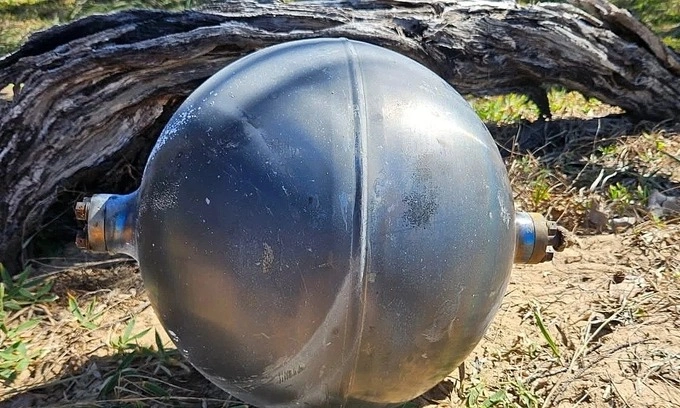

The large chrome-colored balls began washing up at Forrest Beach, a small coastal community about 80 km north of Townsville, on the afternoon of July 3.
Queensland Fire Department crews recovered a total of six by July 5, the Australian Broadcasting Corporation reported.
Responders sealed off a 50-meter exclusion zone and shut part of the beach. Teams in protective suits placed the spheres in hazmat drums under police guard over fears they held hazardous chemicals.
The fire department told anyone who found a suspicious object not to touch it, to move away and to call the Triple Zero (000) emergency line, warning that more could surface in the days ahead.
The Australian Space Agency said on July 6 that the objects appeared to be pressure vessels from a space launch vehicle, and that their location and characteristics matched debris from a foreign rocket body that recently re-entered the atmosphere from orbit.
Pressure vessels are among the most structurally robust parts of a rocket, which is why they reach the ground or ocean intact rather than burning up.
The agency is working with international authorities to confirm the exact launch vehicle and the country that launched it, and has not named one. Queensland crews assessed and recovered the spheres and determined them to be safe.
One of the metallic spheres that washed up on Forrest Beach in Queensland, Australia, on July 3, 2026. Photo courtesy of Queensland Fire Department |
Alice Gorman, a space archaeologist at Flinders University, told the ABC the objects were a classic example of what specialists call “space balls.”
Rockets store propellant under high pressure in vessels built from titanium alloy and similar sturdy materials, she said, and those tanks often survive re-entry because their melting points sit higher than the heat of the descent.
The spheres showed no scorching, Gorman told The Guardianwhich pointed to a first or second stage that fell away while the rest of the rocket carried its payload onward.
Empty pressure vessels are buoyant and drift ashore, though they can still hold traces of hydrazine, a highly toxic propellant that is dangerous on direct contact.
A crab fisherman found the first sphere and was told to leave the area. Local resident Trevor Kyle guided police to the remote spot and was present as three more washed in, telling ABC Australia the objects seemed to leap out of the water.
More than 30,000 tracked pieces of debris, from working satellites to spent rocket parts, now orbit the planet, according to The Guardian. Most fall over the ocean, though Australia’s size means it catches a share.
India confirmed in 2023 that a large metal dome found near Perth in Western Australia came from one of its Polar Satellite Launch Vehicles, the BBC reported.
A SpaceX Dragon trunk turned up in New South Wales in 2022, and Skylab fragments fell over Western Australia in 1979. A similar sphere found in Namibian grassland in 2011 was thought to be a hydrazine fuel tank from an unmanned rocket.
Comments are closed.