
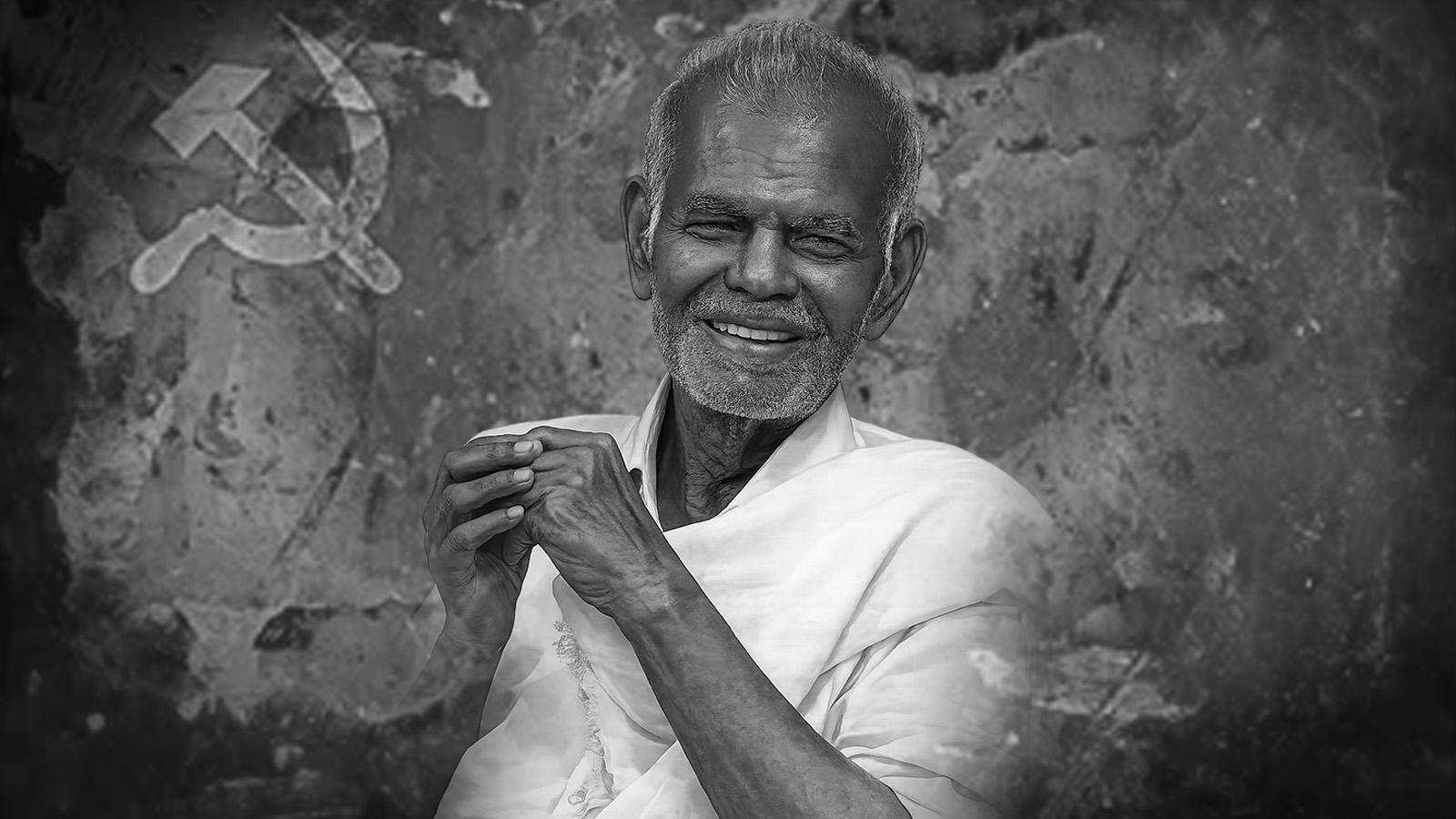

In today’s era, where there’s a thin line between politics and business, politicians seem capable of selling refrigerators to Eskimos. While a few amass wealth, others act as their advocates — this is the wide belief that people hold about politicians. Youngsters largely view politics as corrupt and often stay away from it.
Amid this cynicism, there was one figure whose life defied such perceptions. Even at an age when he walked with faltering steps, he gave hope by fighting against those mining sand in the Thamirabarani river and securing a stay order from the court. That was Comrade R Nallakannu.
Early life and activism
Veteran Communist leader, freedom fighter, lifelong people’s warrior, and one of Tamil Nadu’s most respected political and social figures, R Nallakannu (affectionately known as RNK or Ayya Nallakannu), passed away in Chennai on Wednesday (February 25) at the age of 101.
Nothing can be achieved without sacrifices — he lived by these words for over eight decades, placing the struggles of the working class, agricultural labourers, Dalits, minorities, the environment, and the oppressed above everything else.
Also read | Mukul Roy obit: ‘Chanakya of Bengal politics’, a Test cricket connoisseur
Born on December 26, 1925, in Sri Vaikundam, Thoothukudi district (then Tirunelveli district), into an agricultural family to father Ramasamy and mother Karuppaiyammal, Nallakannu began his journey in activism at 15. While still in school, he opposed a play staged in support of the British during the Second World War, in line with Mahatma Gandhi’s call against aiding the British war effort. When police attacked the protesting students, he was undeterred; the very next day, he was back in school, leading the agitation again.
Socialist principles
Initially associated with the Congress, the young Nallakannu was more powerfully drawn to the public-ownership and socialist ideas of Jawaharlal Nehru. In 1943, at the age of 18, he joined the Communist Party of India when its Srivaikundam branch was formed and became its branch secretary.
In 1946, he moved to Chennai and worked for the party newspaper Janasakthi. During the wartime famine, he exposed large-scale rice hoarding at Pathinikottai through his writings in Janasakthi.
The report led to the recovery of thousands of sacks of paddy that fed starving people. Even 80 years later, locals in the region still say, “If this entire area is eating today, it is because of Nallakannu.”
Champion of mass struggle
After Independence, when the government launched a crackdown on Communists, Nallakannu was implicated in the historic Nellai Conspiracy Case (Tirunelveli Conspiracy Case) in 1950. In 1952, at the age of 27, he and other leaders were sentenced to life imprisonment for allegedly conspiring to overthrow the government through armed revolution.
The sentence was later altered, but under the Explosive Substances Act, the Rajaji government refused to release him (unlike others) and awarded him seven years of rigorous imprisonment. He was only around 22 when first arrested and spent his prime years in prison.
Also read | Ajit Pawar obituary: A perpetual CM-in-waiting, a leader Maharashtra loved to fear
He endured brutal torture in custody. The police hung him upside down and burned his moustache with a cigarette. Years later, he recalled with characteristic humility, “I had no great attachment to the moustache. I had grown it mainly to cover a mark on my cheek.”
Prison reforms
He fought inside the prison for the rights of fellow inmates, particularly the right to education, and registered some victories. Outside, massive people’s movements demanded the release of Communist leaders. He was released on December 13, 1956 after serving the full seven years.
Subsequently, he became a full-time party worker and organiser of agricultural labourers, holding responsibilities at both state and national levels. He served as the Communist Party of India’s Tamil Nadu state secretary from 1992 to 2005, a term of 13 years.
He contested elections in the 1967 and 1977 Tamil Nadu Assembly elections from Ambasamudram constituency in Tirunelveli district, and the 1999 Lok Sabha elections from Coimbatore. He never won, yet remained unfazed; he always believed that alongside legislatures there exists the far more important “Makkal Mandram” (people’s forum) of sustained mass struggle.
Fight for environment, justice
Nallakannu was also a fearless environmental warrior. He personally fought the powerful sand-mining mafia that was destroying the Thamirabarani river and the livelihoods of dependent communities. He appeared in person before the Madurai Bench of the Madras High Court and secured a landmark ban on sand mining in the river. He also filed cases against illegal dredging in the Srivaikundam dam under the guise of desilting.
Also read | Madhav Gadgil obit: An ecologist who refused easy binaries
During the Chennai floods, Comrade Nallakannu’s house too was submerged. When rescuers arrived to save him from being trapped in the floodwaters, he declared, “I will not board the boat until every single person in this area is rescued.”
The same situation prevailed at Comrade Sangaraiya’s house. He too stood steadfastly with the people. Both were well past 90 years of age. Both had held state-level responsibilities in the party. Neither had built a house of his own, and both relied on auto-rickshaws for travel.
Modest life, generous deeds
His personal life was a model of communist simplicity and sacrifice that even critics admired. He never owned a house or a car. From 2007, he lived in a Tamil Nadu Housing Board flat in Chennai, paying ₹4,500 in rent every month even though the authorities had offered it for free; later, he moved to a rented house in KK Nagar.
When the party collected ₹1 crore as a gift for his 80th birthday, he immediately returned the entire amount to the party fund. When the Tamil Nadu government conferred the Ambedkar Award with a cash prize of ₹1 lakh, he divided it equally between the party and the agricultural workers’ union. In 2022, on Independence Day, Chief Minister MK Stalin presented him the prestigious “Thagaisal Tamilar Virudhu” (Distinguished Tamilian Award) along with ₹10 lakh; Nallakannu added his own ₹5,000 and donated the entire sum to the Chief Minister’s Public Relief Fund.
He was married to Ranjitham Ammal (daughter of CPI leader Annasamy from Nellai) for 58 years, till her death in 2016. With deep emotion, he often said, “She is the one who understood me completely”. The couple had two daughters: Kasi Bharathi and Aandal.
Politics with unwavering honesty
Even past 90, Nallakannu continued to participate in protests, both big and small, proving that age is merely a number for true people’s fighters. Leaders across the political spectrum, including those critical of the Left, always addressed him with respect as “Ayya Nallakannu”.
To the younger generation disillusioned with politics, he remained an eternal example: principled politics, ideological clarity and a life free of corruption are possible.
With his passing, Tamil Nadu and the Indian Communist movement have lost one of their brightest moral beacons, a man whose clean hands and pure heart proved that politics can be practised with integrity and total dedication to the proletarian cause. The Tamil working class has lost its centenary light, but the flame he ignited will burn forever in the hearts of the toiling millions.

Comments are closed.