
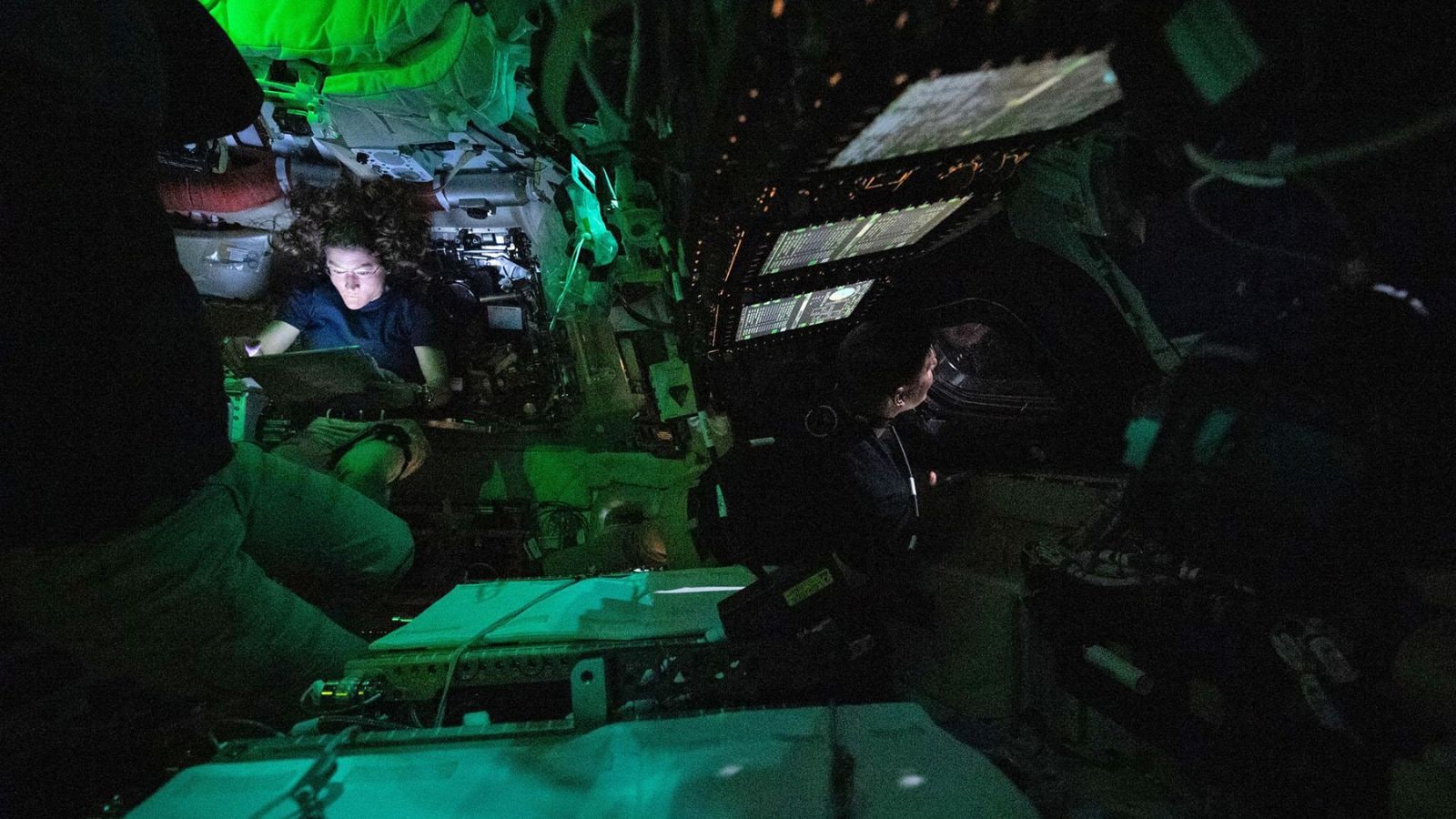

Early on Monday morning Eastern time, the astronauts of Artemis II will enter the lunar sphere of influence, when the pull of the moon’s gravity becomes stronger than Earth’s.
That is when their spacecraft will start speeding up for the main event of the 10-day mission, swinging around the moon for a first close-up look by astronauts in more than 53 years.
“We’re really gearing up now for what’s going to be an exciting lunar flyby tomorrow,” Lori Glaze, acting associate administrator for NASA’s Exploration Systems Development Mission Directorate, said during a news conference Sunday evening.
At 1:56 p.m., the four astronauts — Reid Wiseman, Victor Glover and Christina Koch of NASA along with Jeremy Hansen of the Canadian Space Agency — will have traveled farther than any other human being, surpassing the record of 248,655 miles set by Apollo 13. That mission had to make an emergency swing around the moon to return to Earth.
Less than an hour later, the Artemis II crew will begin hours of methodical observations of the moon, targeting about 35 features on the lunar surface.
On Saturday night, they had a small preview, pointing their cameras at the moon. Wiseman, the commander of the mission, gushed, rattling off a list of sites he saw through a telephoto lens.
“You know, I’m not one for hyperbole, but it’s the only thing I could come up with,” he said. “Just seeing Tycho. There’s mountains to the north. You can see Copernicus, Reiner Gamma. It’s just everything from the training, but in three dimensions and absolutely unbelievable. This is incredible.”
Story continues below this ad
In mission control, Jacki Mahaffey, relaying messages to the astronauts, chuckled. “Copy, moon joy,” she said.
At 6:47 p.m. on Monday, the Orion spacecraft, which the Artemis II astronauts named Integrity, will pass behind the moon, and communications will fall silent, because radio waves cannot pass through the moon. At its farthest point, Artemis II will be 252,760 miles from Earth — 4,105 miles farther than Apollo 13.
Twenty minutes later, the astronauts will regain communications with mission control.
That moment will be the 21st century answer to “Earthrise,” when Apollo 8 astronaut William Anders snapped a photograph of Earth emerging from behind the moon.
Story continues below this ad
“For those in Asia, Africa and Oceania, know that the crew will be smiling down on you around Earthrise and Earthset,” said Kelsey Evans Young, the lunar science lead for the mission.
An hour later, the Artemis II astronauts will experience another astronomical delight: a solar eclipse, as the moon blocks the sun for 53 minutes.
A couple hours later, the crew will start sending images back to Earth.
For the astronauts, Easter Sunday was relatively quiet.
Shortly after they woke up Sunday, the astronauts heard a voice from NASA’s past speaking optimistically about the future.
Story continues below this ad
“Hello, Reid, Victor, Christina and Jeremy, this is Apollo 16 astronaut Charlie Duke,” he said in a recorded message. “John Young and I landed on the moon in 1972 in a lunar module we named Orion,” Duke said. “I’m glad to see a different kind of Orion helping return humans to the moon, as America charts the course to the lunar surface.”
The Artemis II astronauts practiced putting on their orange spacesuits. Two of them — Glover and Wiseman — tested donning the spacesuits at an accelerated pace, what would be needed in an emergency if the hull of Integrity were breached.
On Sunday night, Orion is scheduled to fire its thrusters for 14 seconds, a small nudge to get on the desired path. NASA mission managers had skipped two earlier course corrections because the trajectory had been on track.
Engineers continue to do some troubleshooting with the Orion spacecraft.
Story continues below this ad
After experiencing intermittent problems the first few days, the astronauts are able to use the toilet without restrictions. However, engineers still do not understand why wastewater is not quite flowing out into space as designed.
“It’s kind of a complex engineering issue,” said Rick Henfling, one of the flight directors. “When you expose a liquid to vacuum, it’s a pretty chaotic environment.”
They also still do not know what caused a burning odor reported by the astronauts Saturday.
“Right now, there isn’t any root cause identified as to what that source is,” Henfling said.
Story continues below this ad
On Monday, the astronauts and mission control will focus on the moon.
Young said as a geologist, she was looking forward to the data and descriptions from astronauts.
But, she said, the flyby would also bring the moon closer for everyone.
“And so as a scientist and as a mom and as a citizen of this planet, I’m really looking forward to tomorrow,” Young said. “I hope all of you are as well.”

Comments are closed.