
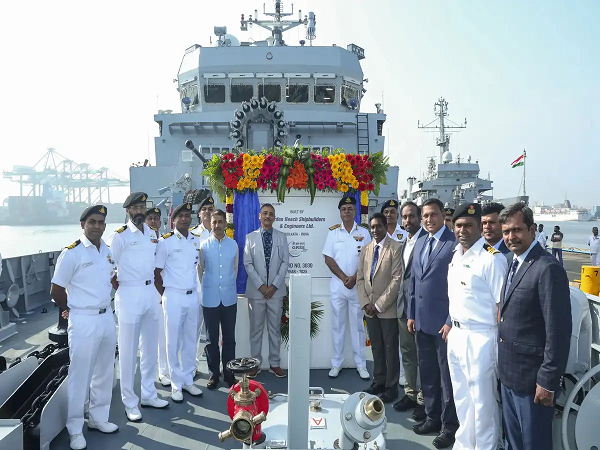
Navy’s strength increased with INS Anjdeep, India’s enemy will not be left anywhere in water

New Delhi. In order to further strengthen maritime security, the Indian Navy is continuously adding indigenous warships to its fleet. In this sequence, on February 27, the state-of-the-art anti-submarine warfare shallow water craft INS Anjdeep is going to become a part of the Navy. This warship has the ability to detect and destroy enemy submarines from the surface to the depth of the sea.
Navy Chief Dinesh K at the ceremony organized at Chennai Port. It will be formally commissioned in the presence of Tripathi. Earlier, INS Arnala, INS Androtta and INS Mahe of the same category have been inducted into service.
Special operations capability in shallow sea areas
INS ‘Anjadeep’ is specifically designed for anti-submarine operations in coastal and shallow water areas.
It is fitted with modern weapons and sensors, including:
anti-submarine rocket launcher
light torpedo
30 mm naval gun
asw combat suit
hull-mounted sonar
Low-Frequency Variable Depth Sonar
This warship can move at a speed of about 25 nautical miles per hour and is capable of covering a distance of about 3,300 kilometers at a time. It can detect enemy submarines up to 100–150 nautical miles from the coast.
This approximately 77 meter long ship can operate effectively even in areas with a depth of 30 to 40 meters and will play an important role in making the sea route safe for large warships.
Special emphasis on indigenous manufacturing
This warship has been built by Garden Reach Shipbuilders and Engineers Limited (GRSE). About 80 percent indigenous material has been used in it, which is considered a big step towards self-reliance in the defense sector.
This ship is part of the Anti-Submarine Warfare Shallow Water Craft project, under which a total of 16 warships are to be built.
Historical and geographical significance behind the name
The name ‘Anjadeep’ is derived from Anjadeep Island, located off the Karwar coast. The name also carries forward the legacy of the former Petya-class frigate of the Indian Navy, which was decommissioned in 2003.
Increased importance amid regional security challenges
The need for such warships has increased further amid increasing strategic competition in the maritime domain. Pakistan is strengthening its submarine capability with the help of China and has purchased eight Hangar-class submarines from China.
In such a scenario, this project of the Indian Navy is being considered strategically important for surveillance and anti-submarine operations in shallow water areas.

Comments are closed.