
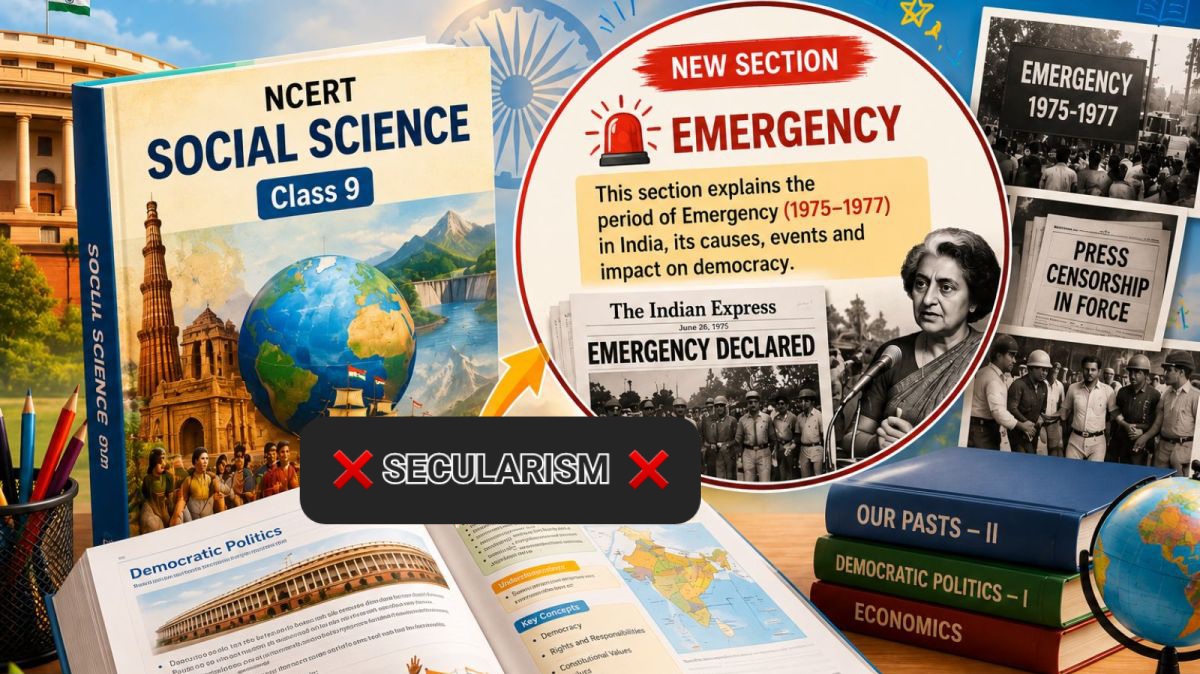

The National Council of Educational Research and Training (NCERT) has released a revised Class 9 Social Science textbook that introduces a detailed chapter on the 1975-77 Emergency while omitting the Preamble to the Constitution and references to the terms “secular” and “secularism.”
The changes, introduced under the National Education Policy (NEP) 2020 and the National Curriculum Framework for School Education (NCF-SE) 2023, have sparked a fresh political debate between the Bharatiya Janata Party (BJP) and the Congress.
Emergency Introduced in Class 9 Curriculum
For the first time, the revised Class 9 curriculum includes a section titled “Challenges to Democratic Practices in India”, which discusses the Emergency imposed in June 1975.
The textbook states that during the Emergency:
- Fundamental Rights were largely suspended.
- Press censorship was imposed.
- Several political leaders and activists were arrested.
- Democratic institutions faced severe strain.
- Citizens’ freedoms were restricted.
It also notes that the lifting of the Emergency in 1977 and the subsequent general election demonstrated the resilience of India’s democratic system and highlighted the importance of constitutional safeguards and civil liberties.
Preamble and ‘Secularism’ Omitted
Unlike the previous Class 9 Political Science textbook Democratic Politics-Ithe new integrated Social Science textbook does not reproduce the Preamble to the Constitution.
Earlier editions described the Preamble as the foundation of constitutional philosophy and explained key constitutional terms such as:
- Sovereign
- Socialist
- Secular
- Democratic
- Republic
The revised textbook discusses constitutional values like liberty, equality, justice and fraternity but does not explain the meaning of “secular” or “secularism.” A review of the text shows that neither term appears anywhere in the new volume.
Integrated Social Science Textbook
The newly released 220-page textbook, Understanding Society: India and Beyond – Part 1replaces separate textbooks for History, Geography, Political Science and Economics.
Prepared under the NEP 2020 framework, the book contains two chapters from each discipline and will be introduced from the 2026-27 academic session.
Political Reactions
The textbook revision has triggered sharp political reactions.
Union Education Minister Dharmendra Pradhan defended the inclusion of the Emergency chapter, saying future generations should understand what he described as the “dark deeds of the Emergency.”
Congress leader Sachin Pilot criticised the move, accusing the BJP of attempting to present history and educational content according to its political ideology. He argued that democratic institutions currently face significant challenges.
Shiv Sena (UBT) leader Sanjay Raut also commented on the issue, stating that the Emergency remains a constitutional provision and should be studied in its constitutional context.
Election Commission Chapter Revised
The revised textbook also changes how students are introduced to the Election Commission of India.
Earlier editions highlighted the Commission’s extensive powers and independence, including its authority to enforce the Model Code of Conduct and order re-polls.
The new textbook focuses primarily on the Election Commission’s constitutional role in supervising and conducting elections without extensively discussing its institutional independence.
Comments are closed.