

Rohit Kumar
NEW DELHI, Feb 26: The Prime Minister Narendra Modi is learned to have asked his government officials to fix the accountability in the row over the National Council of Educational Research and Training (NCERT) Class 8 textbook chapter on “corruption” in the judiciary, even as the Supreme Court on Thursday objected to the reference in the text book and issued a show-cause notice to the Secretary of School Education in the Ministry of Education and the Director of NCERT.
The top court sought an explanation as to why action should not be initiated against them under the Contempt of Court Act or other applicable laws. “We would like to have a deeper probe. We need to find out who is responsible… heads must roll! We won’t close the case,” the court said as it questioned Solicitor General Tushar Mehta, arguing for the NCERT.
In a big order, the bench-led by Chief Justice Surya Kant also banned the book, in India and abroad, and directed seizure of all copies. It also issued a blanket ban on sharing the book online, in whole or in parts and issued notices to the center and the NCERT Chairman, Professor Dinesh Prasad Saklani.
“Who is watching all this? (Who is looking after all this),” Mr Modi, currently on visit to Israel, queried from some concerned government officials.
The NCERT Director has been ordered by the top court to submit a comprehensive list and details pertaining to members of the National Syllabus and Teaching Learning Material Committee, who approved the offending chapter. It has also sought specific names and credentials of the Textbook Development Team responsible for drafting the controversial chapter.
“The original records of the minutes of all meetings, where the offending chapter was deliberated and finalized, shall be produced on the next date of hearing,” the court said. The NCERT, on its part, has termed it “an error of judgment” and apologized for the same.
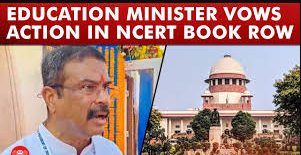
The Union Education Minister Dharmendra Pradhan also expressed regrets over the inclusion of the controversial chapter. “We hold the judiciary in the highest regard… There was absolutely no intention on the part of the government to disrespect the judiciary. We are taking this matter very seriously… We will fully comply with the judiciary’s decision. I am deeply saddened by what happened and express my regret,” Pradhan told reporters.
He also said an inquiry would be conducted and accountability fixed. Action would be taken against those involved in drafting the chapter. As soon as we got to know (about it), the circulation of the textbooks was put on hold,” the Union Minister said in Jamshedpur. “We have taken the issue very seriously. The court’s directives will be complied with,” he added.
“They have fired the gunshot. The judiciary is bleeding,” the Bench headed by Chief Justice Surya Kant and also comprising Justices Joymalya Bagchi and Vipul M. Pancholi, said, a day after the NCERT apologized for “inappropriate content” and said it would be rewritten in consultation with appropriate authorities.
The Solicitor General Tushar Mehta told the court that an unqualified and unconditional apology would be published, adding that the individuals who prepared the chapter would not be associated with any preparation of any chapter or any work in any ministry. This comes after NCERT on Wednesday issued a statement of apology and said the directions to stop the distribution of the book in question “had been complied with.”
The CJI also thanked the media for bringing the issue out. “Getting hundreds and hundreds of calls. Even before (Kapil) Sibal mentioned it yesterday, I had taken cognizance, CJI Kant says. He thanks the media “for bringing this out.” “We all must stand together and defend the independence of the judicial institution,” he stated.
The NCERT had introduced a section on “corruption in the judiciary” in its new Class 8 Social Science textbook, marking a significant shift from earlier editions that largely focused on the structure and role of courts. The revised chapter, titled “The Role of the Judiciary in Our Society” went beyond explaining the hierarchy of courts and access to justice and addresses challenges faced by the judicial system, including corruption and case backlogs.
In the section on corruption, the textbook stated that judges were bound by a code of conduct that governs not only their behavior in court but also their conduct outside it. It also highlighted the judiciary’s internal accountability mechanisms and referred to the established procedure for receiving complaints through the Centralized Public Grievance Redress and Monitoring System (CPGRAMS). The chapter added that efforts were being made at both the state and Union levels to strengthen transparency and public trust, including through the use of technology and swift action against instances of corruption. It also quoted the former CJI BR Gavai who in July 2025 said instances of corruption and misconduct within the judiciary have a negative impact on public confidence.

Comments are closed.