
Nearly 300 hospitalized by Salmonella from Vietnamese banh mi shop’s third mass poisoning case

Testing by the Pasteur Institute in Ho Chi Minh City found Salmonella in 25 of 36 samples taken from patients who fell ill after eating at the Hong Ngoc 37 outlet in Dong Thap Province, the local ward authority said on June 20.
As of the afternoon of June 19, 290 people had been hospitalized across several facilities in the Mekong Delta and in Ho Chi Minh City. Twenty-eight have been discharged, and the others are in stable condition.
The outbreak emerged on June 16, when patients began arriving with abdominal pain, vomiting, diarrhea, fever, fatigue and numbness in the hands. Case numbers climbed from 22 that first day to 93, then past 200 within 48 hours.
An epidemiological report found that every patient had eaten banh mi from the same shop, on Ly Thuong Kiet street in My Tho Town.
Hong Ngoc, a chain that advertises more than 100 outlets across the Mekong Delta, has been linked to a mass poisoning three times, and the previous two were traced to the same source.
Another branch, Hong Ngoc 12 in Dong Thap, sickened 149 people in August 2024 in a case lab tests pinned on Salmonella in liver pâté the shop made in-house, leading to about VND380 million (US$14,400) in compensation.
In February 2026, barely a year after reopening, the same outlet sickened 86 more, drawing a VND90 million, a four-month suspension and about VND175 million in compensation. Inspectors again found Salmonella in its self-made pâté, along with violations that included a display case left open to insects and a production line that let raw ingredients mix with finished food.
Whether pâté is to blame again may never be confirmed. By the time an inter-agency food-safety team inspected Hong Ngoc 37, the shop had sold out of its house-made pâté, leaving no sample to test, and inspectors could not trace the specific batch of cold cuts and sausage used.
Rapid tests on the pork roll, ham and garlic sausage they could examine found no borax, a banned firming agent. The shop has suspended operations pending the official findings.
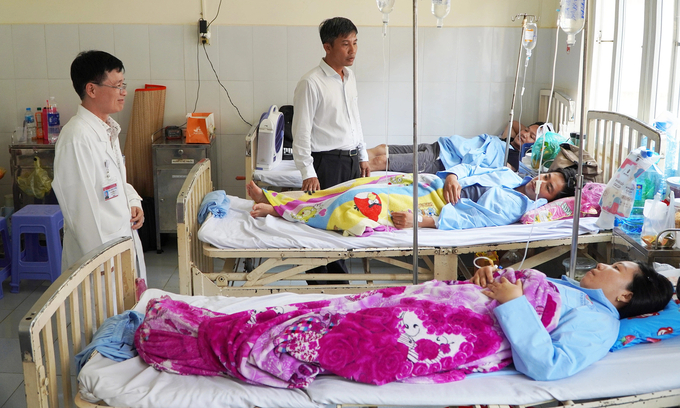
Officials from Military Hospital 120 in Dong Thap Province visit patients suffering from food poisoning after eating banh mi from a local shop, June 19, 2026. Photo by Read/Hoang Nam |
The case adds to a run of banh mi-linked Salmonella outbreaks across Vietnam. In November 2025, more than 300 people in Ho Chi Minh City were sickened by sandwiches from a chain, and in May a banh mi shop in Gia Lai Province hospitalized more than 120, both also tied to the bacteria.
The sandwich’s standard fillings, room-temperature pâté, cold cuts and pork roll, are an ideal medium for Salmonella when hygiene slips.
Salmonella is among the most common causes of foodborne illness worldwide. The rod-shaped bacteria live in the intestines of animals and spread to people through contaminated water or food, especially meat, eggs, dairy and undercooked produce.
Once swallowed, they inflame the lining of the gut, causing fever, cramping, vomiting and diarrhea that usually clear within a few days. For young children, the elderly and people with weakened immune systems, the resulting dehydration can turn dangerous and require emergency care.
Comments are closed.