
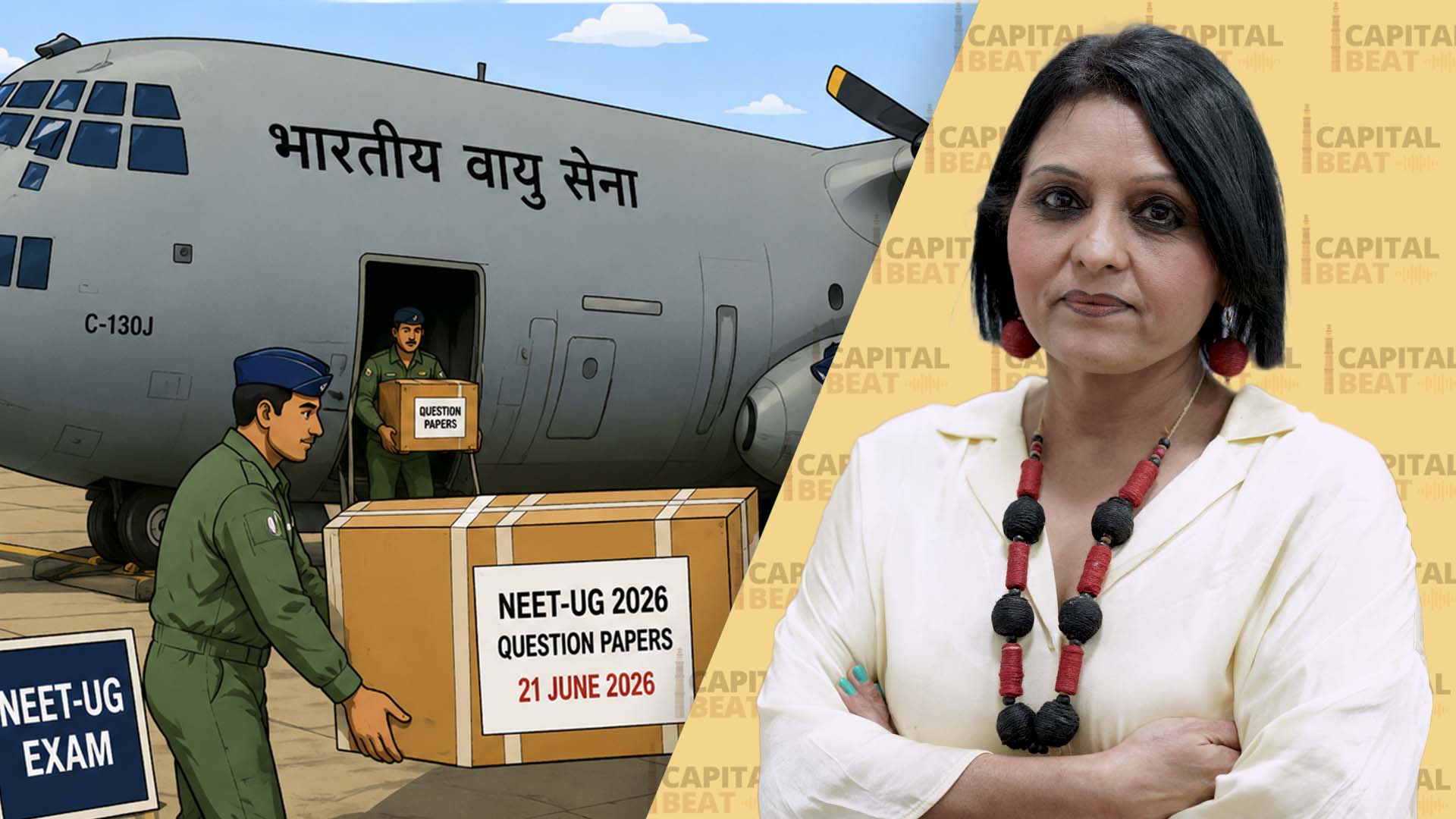

The Centre’s decision to reportedly use Indian Air Force (IAF) aircraft to transport NEET UG 2026 re-examination question papers triggered a fierce debate over the collapsing credibility of the country’s examination system, with critics calling it a “military bandage” for systemic failures.
In the latest episode of Capital Beat, The Federal spoke to Anuma Acharya, Congress spokesperson and former armed forces officer, Anchal Gupta of Yuva Halla Boland political analyst Ayushman Pandey on whether India’s education system has reached a stage where entrance examinations now require military-style security arrangements. The debate comes amid mounting outrage over repeated NEET paper leak allegations, criticism of the National Testing Agency (NTA), and fresh scrutiny over CBSE’s controversial on-screen marking (OSM) system.
Military optics
Opening the discussion, the panel was questioned whether exam papers were now being treated like “defence assets”, drawing comparisons with China’s highly monitored Gaokao examination system.
Also read: NEET-UG paper leak: SC asks Centre, NTA how breach occurred despite monitoring
The discussion centred around reports that Prime Minister Narendra Modi was personally monitoring security arrangements for the NEET UG 2026 re-examination scheduled on June 21.
Acharya strongly criticised the reported move to use Indian Air Force aircraft for transporting question papers, saying the armed forces were being assigned responsibilities outside their constitutional role.
“There is no logic to anything which this government is doing,” she said, arguing that the primary role of the Indian Air Force was safeguarding India’s skies during wartime, not transporting examination papers.
Acharya said the government had increasingly used the Armed Forces for symbolic political messaging. Referring to post-Pulwama developments and election-period air shows, she alleged that the military was being repeatedly brought into civilian and political domains.
Also read: ‘NEET-UG 2026 cancellation after paper leak shows commitment to exam integrity’: NTA to SC
She further questioned why a digitised system could not prevent paper leaks without involving defence infrastructure.
“If paper leaks happen through WhatsApp, Telegram or Signal, then what exactly are Air Force aircraft going to achieve?” she asked.
China comparison
The panel repeatedly referenced China’s Gaokao examination system, known for extreme surveillance and tight state control.
When asked whether India was attempting to replicate a “totalitarian-style” examination framework where question papers were treated as state assets, Acharya rejected the comparison, saying India was selectively copying “the wrong things” from China while failing to replicate its economic and production strengths.
“This cannot happen in a democracy,” she said, arguing that while examinations require supervision and security, they should not require military involvement.
Also read: Congress targets PM Modi over NTA’s NEET leak denial, demands accountability
She also claimed that the armed forces were already struggling with manpower shortages and should not be burdened with additional administrative tasks.
Pakistan analogy
Pandey argued that the situation resembled Pakistan under former military ruler Pervez Musharraf more than China.
He claimed Pakistan had previously deployed military forces to supervise examinations and asked whether India was “going down that level”.
Pandey said the controversy had already affected nearly 18 lakh students and their families, calling it a glaring display of administrative incompetence.
“Every passing week, they come up with something more incompetent than before,” he said.
He also raised concerns over the tendering process involving Coempt, the company at the centre of controversy over CBSE’s OSM evaluation system.
Referring to Leader of Opposition in Lok Sabha Rahul Gandhi’s allegations, Pandey claimed that eligibility requirements in the bidding process were repeatedly lowered until Coempt became eligible.
“What is this government doing? Why are requirements being lowered when qualified bidders are available?” he asked.
Pandey alleged that public-private partnerships in government projects were increasingly benefiting select firms through manipulated tender norms.
CBSE scrutiny
The panel discussion also focused heavily on criticism of CBSE’s on-screen marking system.
Fact-checker Mohammed Zubair has been highlighting how school principals were allegedly being encouraged to defend the OSM system publicly through social media videos.
There have been concerns for parents as many students were experiencing severe anxiety due to blurry answer scripts, missing pages, and inaccessible scanned copies.
According to Rahul’s allegations, CBSE floated tenders multiple times and gradually diluted technical standards, including scanner resolution requirements and certification levels, before awarding the contract.
Pandey claimed the process reflected a larger pattern of government tender manipulation in infrastructure and public projects. “They have completely destroyed the concept of fair tendering,” he said.
Student anxiety
Gupta said the controversy had turned into “an ugly mockery and humiliation” for students and parents.
She highlighted India’s growing youth mental health crisis and linked repeated exam irregularities to rising student stress and suicides.
Gupta pointed to a history of controversies surrounding NEET and other competitive examinations over the past decade, including paper leaks and allegations of fraud.
She accused the government of repeatedly awarding contracts to companies without rigorous vetting and called for greater institutional accountability.
“The system does everything possible to squeeze young Indians,” she said.
Gupta also criticised the government’s repeated reliance on the armed forces during civilian crises, recalling how the BJP had criticised the UPA government in the past for using military assistance during the Commonwealth Games.
She argued that educational examination systems required transparent institutional reform rather than “spectacle”.
Accountability debate
Gupta questioned why Education Minister Dharmendra Pradhan had not resigned despite repeated controversies.
She compared the situation with resignations by ministers in countries such as the United Kingdom and Japan over administrative failures.
“In India, nobody even offers moral responsibility anymore,” she said.
Acharya similarly argued that the government had lost administrative control and was increasingly shifting responsibilities across departments instead of fixing institutional failures.
She even suggested that the Indian Air Force chief should publicly object to the proposed use of military aircraft for transporting examination papers.
“This can always be done through private airlines or chartered planes,” she said.
Need reforms
In the concluding remarks, the panellists agreed that India’s examination and recruitment system required major structural reforms.
Pandey criticised what he described as the commercialisation of education and examination systems, questioning whether public institutions such as CBSE should operate on a profit-making model.
Gupta proposed the creation of an independent and transparent examination authority insulated from political and private influence.
She also advocated a fixed timeline and model code for conducting recruitment and entrance examinations fairly and efficiently.
The panel concluded that repeated paper leaks, evaluation controversies, and administrative failures had severely damaged public trust in India’s education system.
The discussion ended with a collective call for systemic reform, transparency, and accountability to restore confidence among students and parents.
(The content above has been transcribed from video using a fine-tuned AI model. To ensure accuracy, quality, and editorial integrity, we employ a Human-In-The-Loop (HITL) process. While AI assists in creating the initial draft, our experienced editorial team carefully reviews, edits, and refines the content before publication. At The Federal, we combine the efficiency of AI with the expertise of human editors to deliver reliable and insightful journalism.)

Comments are closed.