
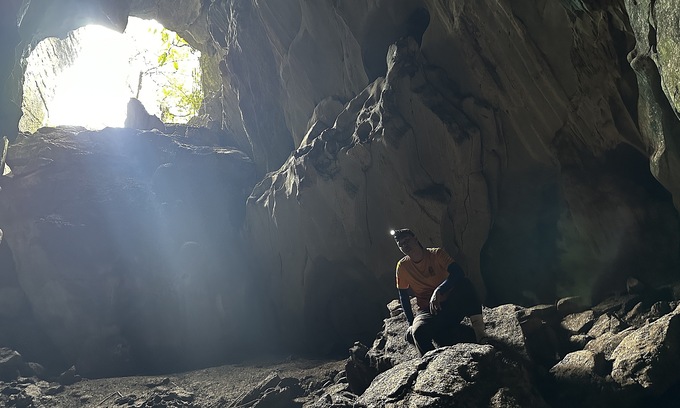

The cave was found on June 23 during a patrol in the Bac Huong Hoa Nature Reserve, the Southern Quang Tri Special Forest Management Board announced.
The cave’s entrance opens into a chamber nearly 70 meters wide. Around 200 meters from the entrance, the cave splits into four large branches that run deep into the mountain.
Inside them are stalactites in fantastic shapes. When illuminated by flashlights, the mineral-rich formations reflect their dazzling colors, creating a striking visual effect throughout the cavern.
The survey team believes a larger network of stalactites and a shallow underground water source may lie deeper inside the cave. But exploration is constrained by the lack of specialized equipment needed to access all four branches.
The cave is close to Van Tien Cave in Huong Son Commune, where another notable stalactite-stalagmite formation was found a decade ago.
The geological characteristics of the area suggest the presence of an extensive underground karst cave network with interconnected passages.
Karst caves form over millions of years as water gradually dissolves limestone, creating underground chambers, mineral formations, sinkholes and river systems. Such places are often valued for their geological significance and biodiversity.
Stalactite formations inside a cave discovered in Quang Tri Province in central Vietnam, June 2026. Photo courtesy of the Southern Quang Tri Special Forest Management Board |
The management board plans to work with cave exploration experts to conduct detailed surveys and map the newly discovered system.
The findings are expected to support conservation efforts while helping assess the cave’s potential as an ecotourism attraction.
Covering more than 23,000 hectares in the western part of Quang Tri Province, the Bac Huong Hoa Nature Reserve is known for its rugged mountains, steep valleys, and dense network of rivers and streams.
The reserve is home to a rich variety of flora and fauna, including many species listed in Vietnam’s Red Book and international conservation records. Its ecosystems range in location from 150 to 1,700 meters above sea level, creating habitats for numerous endemic species.
According to conservation authorities, the reserve contains 109 mammal, 207 bird, 81 reptile and amphibian, and 33 fish species, and 283 kinds of plants, including 59 rare varieties.
The discovery follows another major cave-finding mission last April, when a British-Vietnamese expedition identified 26 previously unknown caves in Phong Nha-Ke Bang National Park with a combined length of more than 13.6 kilometers.
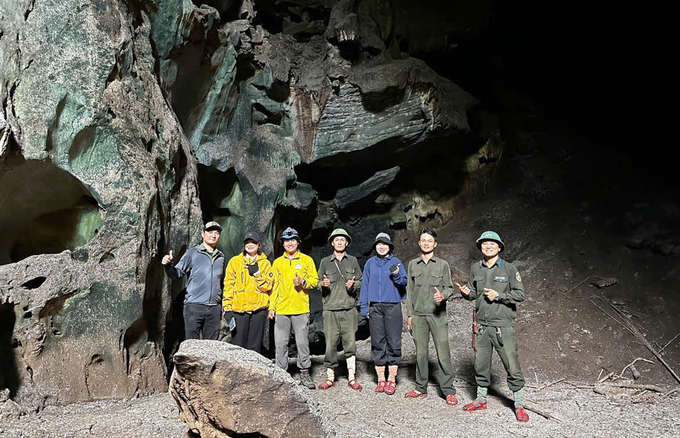 |
Forest rangers inside a cave discovered in Quang Tri Province, central Vietnam, in June 2026. Photo courtesy of Southern Quang Tri Special Forest Management Board |

Comments are closed.