
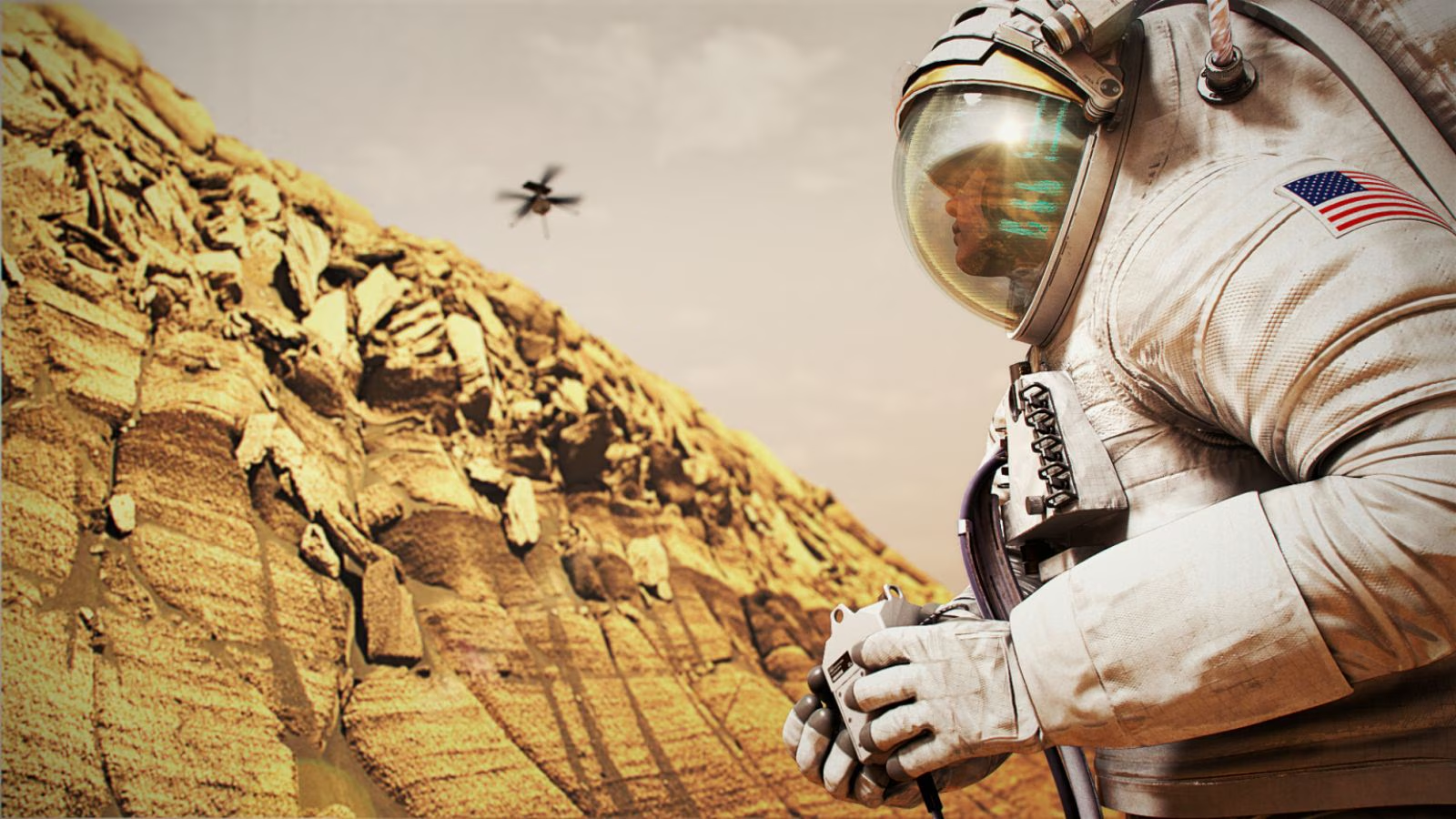
New Mars mission blueprint lays out science goals for humanity’s first steps on Red Planet

A landmark blueprint for the first crewed missions to Mars has been released, charting a science agenda that researchers say could shape humanity’s earliest steps on another planet.
The US-based National Academies of Sciences, Engineering, and Medicine published the 240-page document on December 9, following a NASA commission that brought together specialists across multiple fields, including a significant contingent from Penn State.
Although NASA has been developing its Moon-to-Mars framework for years, the new report represents the most detailed assessment yet of what scientists believe the first three Mars landings should accomplish. It organises dozens of scientific priorities into mission campaigns and outlines the equipment, landing-site criteria and environmental constraints that will determine what is feasible when humans reach the surface.
Researchers from Penn State played roles across the steering committee and related panels, helping set the direction for topics spanning astrobiology, atmospheric science, planetary geology, biological and physical sciences, and crew health. Their influence is reflected throughout the report.
“Penn State expertise helped shape the nation’s highest priority science objectives and recommendations for human exploration of Mars,” said Andrew Read, the university’s senior vice president for research. “This is a thrilling moment for us as scientists. We are setting the guideposts that will transform our knowledge of Mars and, on a deeper level, our place in the cosmos. It underscores Penn State’s research excellence and the calibre of our faculty, whose vision and expertise are influencing the future of space exploration.”
A scientific playbook for life on another world
The document is designed to be more than a wish list. It carefully balances scientific goals with NASA’s mission architecture and expected technological capabilities, offering a science-first rationale for how early explorers should use their limited time and resources on the surface. James Pawelczyk, a Penn State associate professor and member of the steering committee, described it as a guide to the “what” and “why” behind the first crewed forays to Mars.
“This report is considering exploration in a very different way than we have conducted human spaceflight before,” Pawelczyk said. He noted that while geology, climate and potential signs of life remain core interests, long-duration human presence on Mars will generate its own scientific questions. “Mars is this novel environment that people will live in, and maybe the most profound part of it is you’ll look up and somewhere among the star field will be a tiny, little bluish dot, and that will be Earth. This will be the farthest and the most isolated that humans have ever been,” he added.
The report breaks down its scientific ambitions into multi-year campaigns, each with a roadmap describing the samples to be collected, the measurements required before and during crew visits, and the environmental conditions, such as accessible subsurface ice or nearby lava tubes that would make a landing site viable.
The committee identifies top objectives that together capture the scientific potential of the first human missions. These include:
- Determining whether the exploration zone preserves evidence of habitability, prebiotic chemistry or extinct or extant life
- Reconstructing past and present water and CO₂ cycles to understand planetary evolution
- Mapping the geologic history and potential niche habitats tied to volcanism, sedimentary processes, impacts and volatile deposits
- Assessing how the Martian environment affects crew physiology, cognition, emotional resilience and team dynamics over time
- Identifying the triggers and evolution of major dust storms
- Evaluating conditions for in-situ resource utilisation (ISRU), particularly for water and propellants
- Studying whether conditions on Mars alter reproduction or genomic stability in model organisms
- Tracking microbial populations in habitats and biological systems to ensure crew safety
- Understanding how Martian dust impacts human health and the lifespan of hardware
- Measuring radiation in key habitats and sampling locations to refine future risk models
- Examining long-term physiological and developmental changes within integrated biological ecosystems during surface operations
Ethical considerations and planetary protection
The report also raises questions about how strictly planetary protection should be enforced both in avoiding contamination of Mars and in safeguarding Earth from returned samples.
“Getting humans to Mars and back is a doable goal for the next 20 years,” said James Kasting, an emeritus Atherton Professor of Geosciences at Penn State and member of the steering committee. “We have to agree about how careful we should be about planetary protection, though, both forward and backwards. I’m for making reasonable assumptions about how best to do so, assumptions that allow us to push forward,” he added.

Comments are closed.