
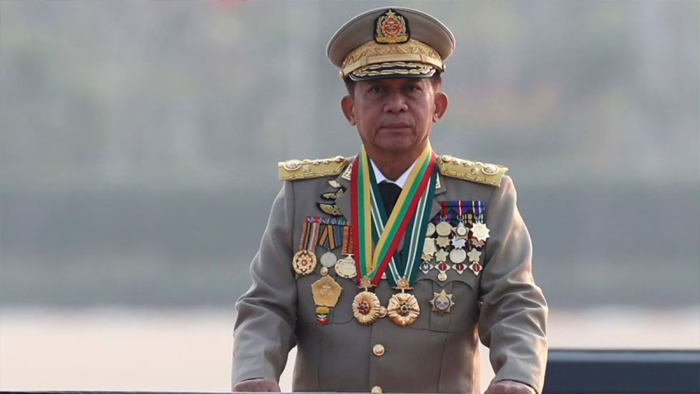
New power game in Myanmar: Army chief Min Aung Hlaing becomes president, military power grows

Desk: Myanmar’s coup leader Min Aung Hlaing has won the parliamentary elections and become the country’s President, formally strengthening his political hold in the war-torn country. This move comes five years after he ousted the elected government. Senior General Min Aung Hlaing emerged victorious today by winning 429 out of 584 votes cast by MPs in the country’s military-backed parliament. This was confirmed by Aung Lin Dwe, Speaker of the combined upper and lower houses of the parliament.
69-year-old General Min Aung Hlaing ousted Aung San Suu Kyi’s government and placed her under house arrest in the 2021 Myanmar coup d’état. This move sparked widespread protests, which later escalated into nationwide armed resistance against the military leadership. This transition from a top general to a civilian president came after lopsided elections in December and January, in which the military-backed party won a landslide victory. Critics and Western governments described the elections as a sham, aimed at maintaining military rule under the guise of democracy.
The military-backed Union Solidarity and Development Party won more than 80 percent of the contested parliamentary seats, while current members of the armed forces held uncontested seats, making up a quarter of the total. Min Aung Hlaing ascended to the presidency, a position analysts say he has long sought.
This follows a major reorganization of the leadership of Myanmar’s armed forces, which he had led since 2011. Min Aung had already stepped down as commander-in-chief, as the constitution does not allow the president to simultaneously hold the highest military post. Ye Win Oo, a close aide and former intelligence chief, is considered extremely loyal to the general. He assumed this powerful position last Monday.
According to experts, this transition of power within the military and the elevation of Min Aung Hlaing as president is being seen as a strategic shift aimed at consolidating his power as head of a nominally civilian government and gaining international legitimacy, while also protecting the interests of the armed forces.

Comments are closed.