
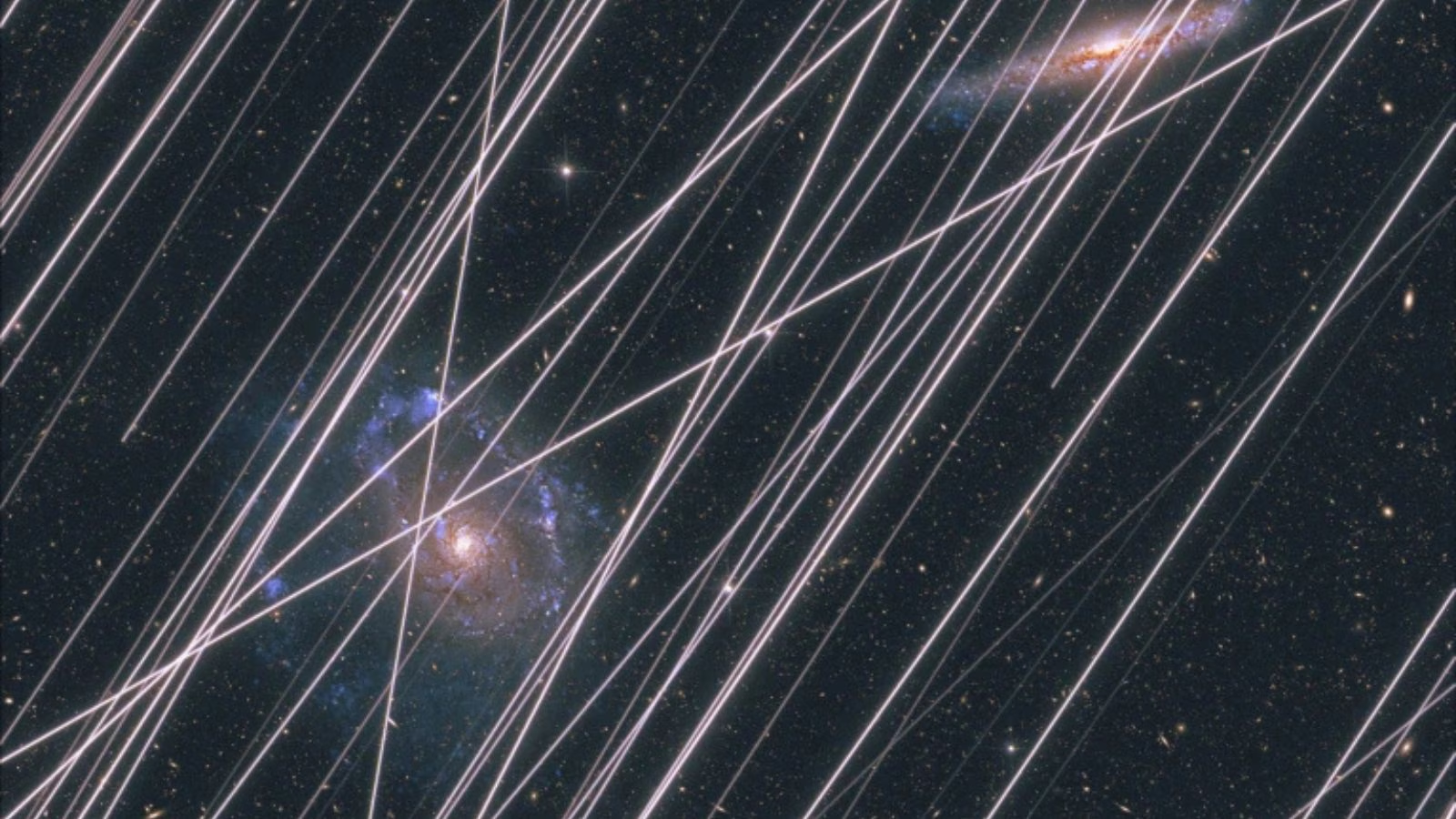

A growing wave of satellite launches is making it increasingly difficult for NASA’s Hubble Space Telescope and other Earth-orbiting observatories to capture clean, unobstructed views of the cosmos. According to a new study published in Naturestreaks from passing satellites could interfere with nearly 40 per cent of Hubble’s images within the next decade and up to 96 per cent of images taken by three other telescopes.
Researchers warn that this growing interference threatens astronomers’ ability to spot potentially hazardous asteroids, identify new exoplanets, or observe faint cosmic phenomena. Without stricter limits on light pollution from expanding satellite networks, they say, our window into deep space will continue to blur.
Lead author Alejandro Borlaff, a NASA research scientist, says the trend marks a troubling shift: “My career has been focused on making telescopes see better, more sensitive, more precise. For the first time, we’ve found something that could make things significantly worse in the future.”
Between 2018 and 2021, satellite streaks appeared in about 4.3 per cent of Hubble images. But the number of spacecraft orbiting Earth has surged since then. The European Space Agency (ESA) reports that the satellite count has jumped from around 5,000 in 2019 to more than 15,800 today, a number that could soar to over half a million if planned launches move forward over the next decade.
Using simulations, the research team predicted how crowded the sky could become for several major space telescopes. If launch plans stay on track, Hubble could see an average of more than two satellites cross each exposure. China’s upcoming Xuntian telescope, set to launch next year, could encounter as many as 92 satellites per image due to its wide field of view. Hubble is less vulnerable because it observes a narrower slice of the sky, while more distant observatories like the James Webb Space Telescope remain largely unaffected.
Story continues below this ad
Beyond photobombing
The issue extends beyond simple photobombing. Satellites reflect sunlight, moonlight, and even Earth’s glow, creating bright trails that can wash out faint details in astronomical images. Subtle dips in starlight, often the key to detecting exoplanets, could be lost entirely if a satellite streak passes through the frame. “You lose that information because a satellite passed in front of you,” Borlaff explains.
Researchers stress that solutions are needed now, before the orbital environment becomes too crowded to manage. Attempts to make satellites darker have had mixed results: less reflective designs absorb more heat, causing them to emit additional infrared light, which introduces its own interference. Scientists are also exploring ways to schedule observations for times and locations with fewer satellites overhead, though this becomes harder as more spacecraft fill the sky.
Long-term fixes will likely require coordination between governments, space agencies, and private companies. Adjusting satellite orbits, keeping mega-constellations below key telescope altitudes, or adopting new deployment rules could all help reduce the impact on astronomy.
“There has to be an optimal way to place constellations and space telescopes so we can coexist sustainably,” Borlaff says, a challenge that becomes more urgent with every new satellite launched.

Comments are closed.