
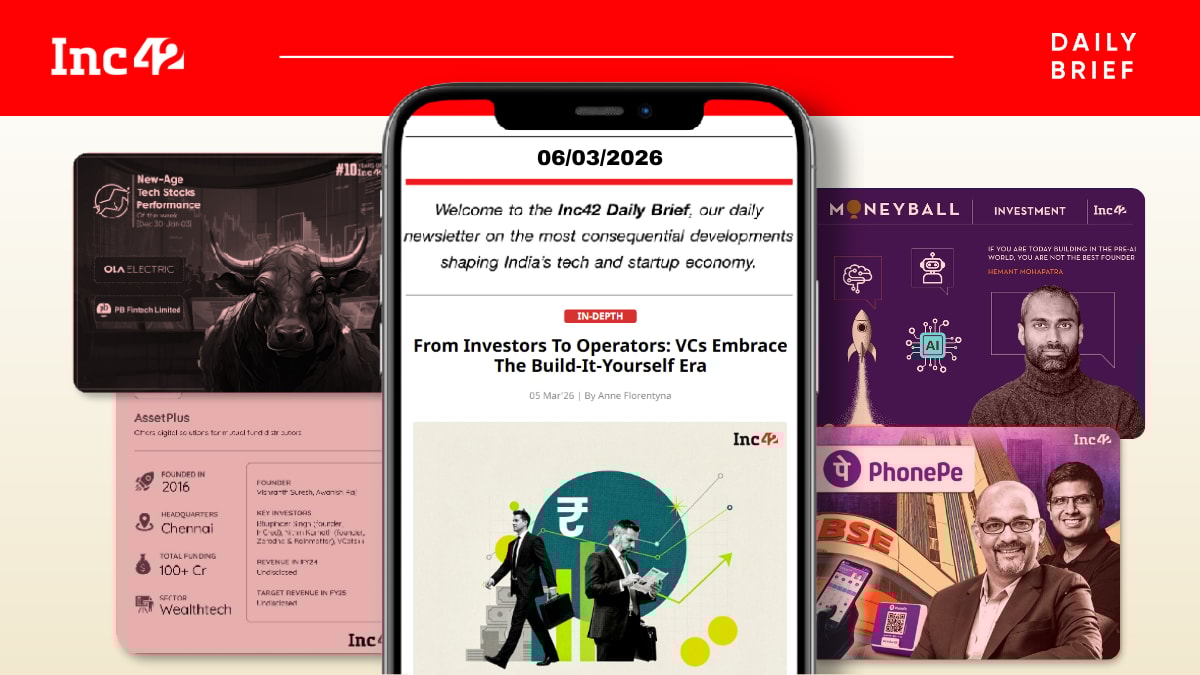

VCs Turn To Building Startups
Indian VCs and angels are no longer content with backing startups. A new breed of venture studios is flipping the usual script by co-creating companies from scratch. So, has the line between investor and founder started to blur?
The Builder VC: While traditional funds continue to raise billions of dollars, 2026 is seeing the rise of the ‘operator-builders’. Existing firms like W Health Ventures (via its 2070 Health studio) are no longer merely scanning for founders, they are actively identifying market white spaces and hiring talent to build solutions.
A Growing Pipeline: The momentum is accelerating with HyKr Studio, which is earmarking a ₹100 Cr commitment to build 20 high-growth ventures. VenturEdu will also launch its first cohort in April to onboard 50 founders from India and Dubai. Simultaneously, Nikhil Kamath’s and Kishore Biyani’s 90-day residential cofounder programme, The Foundery, is also co-creating businesses.
The Force Multiplier: So, why are venture studios becoming the flavour of the season? The answer to this is AI. The technology is collapsing the cost of building early prototypes and enabling VCs to launch early platforms without waiting for an external founding team. This is enabling studios to de-risk the early business model before customers arrive.
The 80/20 Model: Unlike traditional VCs, venture studios often retain a majority of the equity (up to 80%), treating founders as part-owners and part-employees. Investors argue this high-ownership model is justified by the studio’s role in R&D and effort. It effectively transforms the founder from a sole architect into a high-leverage operator within a pre-validated system.
However, thematically, these studios are currently rushing to capture the AI application layer via these controlled, high-conviction bets. Against this backdrop, can these investor-led startup factory models match the raw, organic grit of entrepreneurs? Let’s find out…
From The Editor’s Desk
✨ Lightspeed’s AI Playbook
- While most industry insiders blame the lack of capital for the exodus of tech talent to Silicon Valley, Lightspeed India’s partner Hemant Mohapatra believes the problem is multifaceted, spanning policy, infrastructure and research ecosystems.
- For him, the only thing that VCs can control is the availability of capital. As such, the VC firm’s investment strategy is centred on backing “non-tourist” AI and deeptech founders who are building for the long race, and not the current market trends.
- To hedge against risks like the long gestation periods of AI and deeptech startups, Lightspeed is banking on exits from the upcoming IPOs of its portfolio brands like Zepto, OYO and Razorpay, while its frontier tech bets take their sweet time to mature.
🛏️ RentoMojo Begins IPO Prep
- The furniture rental startup has converted into a public entity, signalling an intention to list on the bourses in the near future. Last year, it also changed the name of its parent entity to align with its business operations.
- The IPO bid comes as Rentomojo has improved its financial performance in the last financial year. Its profit jumped 82%% YoY to ₹40 Cr in FY25, while operating revenue rose 38% YoY to ₹266 Cr.
- Founded in 2014, RentoMojo runs a subscription-based platform for renting furniture, appliances and other home essentials. It has raised more than ₹650 Cr from investors to date.
🖥️ SEDEMAC IPO Day 2
- The deeptech company’s public issue was subscribed 47% on the second day, receiving bids for 26 Lakh shares against 56.33 on offer.
- QIBs led the pack by oversubscribing their quota 1.27X, while NIIs and retail investor portions saw 0.25X and 0.09X subscription, respectively.
- The IIT Bombay-incubated deeptech firm designs electronic control systems for mobility and industrial use. SEDEMAC’s IPO, which consists solely of an OFS component of 80.43 Lakh shares, is seeking a valuation of up to ₹5,970 Cr.
🎮 Delhi HC Bans Dream11 Copycats
- The HC has ordered the blocking of 21 offshore apps that copied the erstwhile RMG giant’s brand identity and user interface. This came after the gaming startup filed petitions against these platforms.
- The court held that the copyright infringement could lead to irreparable damage to the company’s brand value. The HC has slated the matter for next hearing in April.
- Dream 11 has been roiling in choppy waters ever since the Centre banned real money gaming last year. Just like its peers, the startup is exploring other verticals to offset the regulatory crackdown and create alternate streams of revenue.
💸 PhonePe Eyes $10.5 Bn IPO Valuation
- The fintech giant is looking to raise anywhere between $900 Mn and $1.5 Bn through its upcoming OFS-only IPO. The listing is likely slated for next month, provided the current geopolitical hostilities in the Middle East do not escalate further.
- The IPO could value PhonePe between $9 Bn and $10.5 Bn, which is lower than the $12 Bn valuation it commanded during its last $100 Mn fund raise in 2023.
- Despite consistently accounting for nearly half of UPI market share, PhonePe’s monetisation strategy has come into question ahead of the IPO. Analysts have flagged a lack of profitability as a going concern, with losses ballooning to ₹1,444 Cr in H1 FY26.
✈️ MMT To Acquire Flamingo
- The listed online travel aggregator has signed an agreement to acquire a majority stake in the regional tour operator for an undisclosed amount.
- With this, MakeMyTrip is looking to expand its holiday packages business to regional markets and non-urban travellers. The hotels and package segment already makes up for a bulk of MMTs business, bringing $161.4 Mn in top line in Q3 FY26.
- The latest deal comes as MMT looks to build a full-stack OTA platform. In recent years, the company has acquired corporate travel platform QuestToTravel, hotel tech company Simplotel, travel forex platform BookMyForex and others to boost its travel tech play.
Inc42 Markets
Inc42 Startup Spotlight
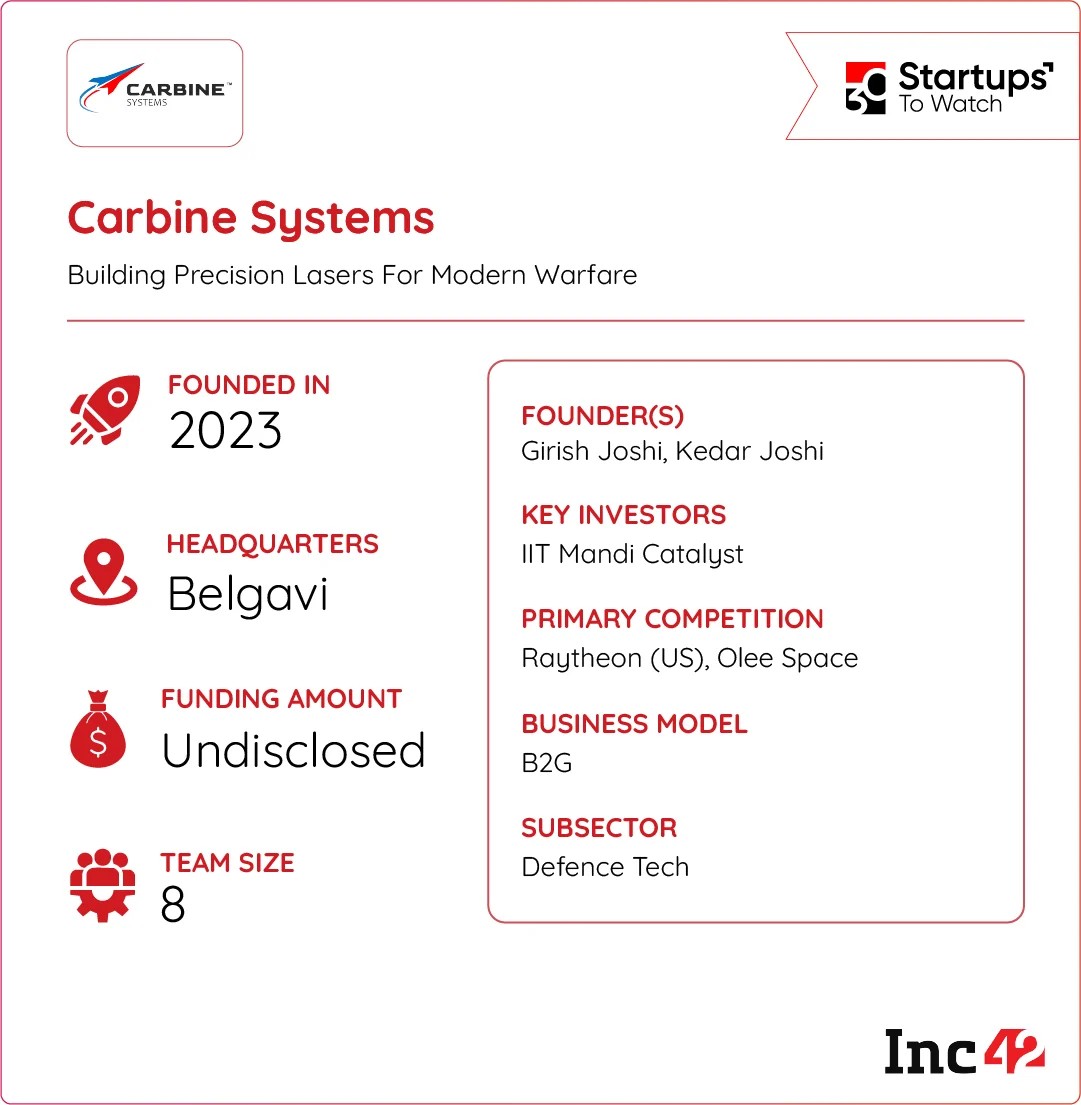
How Carbine Is Building Precision Lasers In India
Modern battlefields are shifting from bullets to beams. However, building reliable, high-energy laser systems in India remains a major challenge due to high cost and a lack of indigenous technologies. Carbine Systems wants to change this with its laser subsystems.
Lasers For Defence: Founded in 2023, Carbine Systems is building high-precision engineering systems for aerospace and defence applications. Its flagship prototype, H.A.R.A. Mk 1 (Hyper Amplification Radiant Array), is a 10 kW-class directed-energy laser designed for engagement ranges of up to 1–2 km.
Designed to offer precise, rapid-response targeting at a lower cost per shot than conventional munitions, it targets threats where speed and accuracy are critical.
Validating Core Architecture: Carbine’s H.A.R.A. Mk 1 has cleared key indoor validation tests across beam stability, thermal management, and system integration, demonstrating robustness at the architectural level. Unlike kinetic systems, its directed-energy platforms promise reduced logistical complexity (no ammunition chains, just power and cooling), making them attractive for layered air defence and point protection.
Incubated at IIT Mandi, Carbine is positioning itself within India’s precision aerospace and defence components market, which is projected to become a $1 Bn opportunity by 2034. Can Carbine Systems put India on the global precision laser map?
Infographic Of The Day
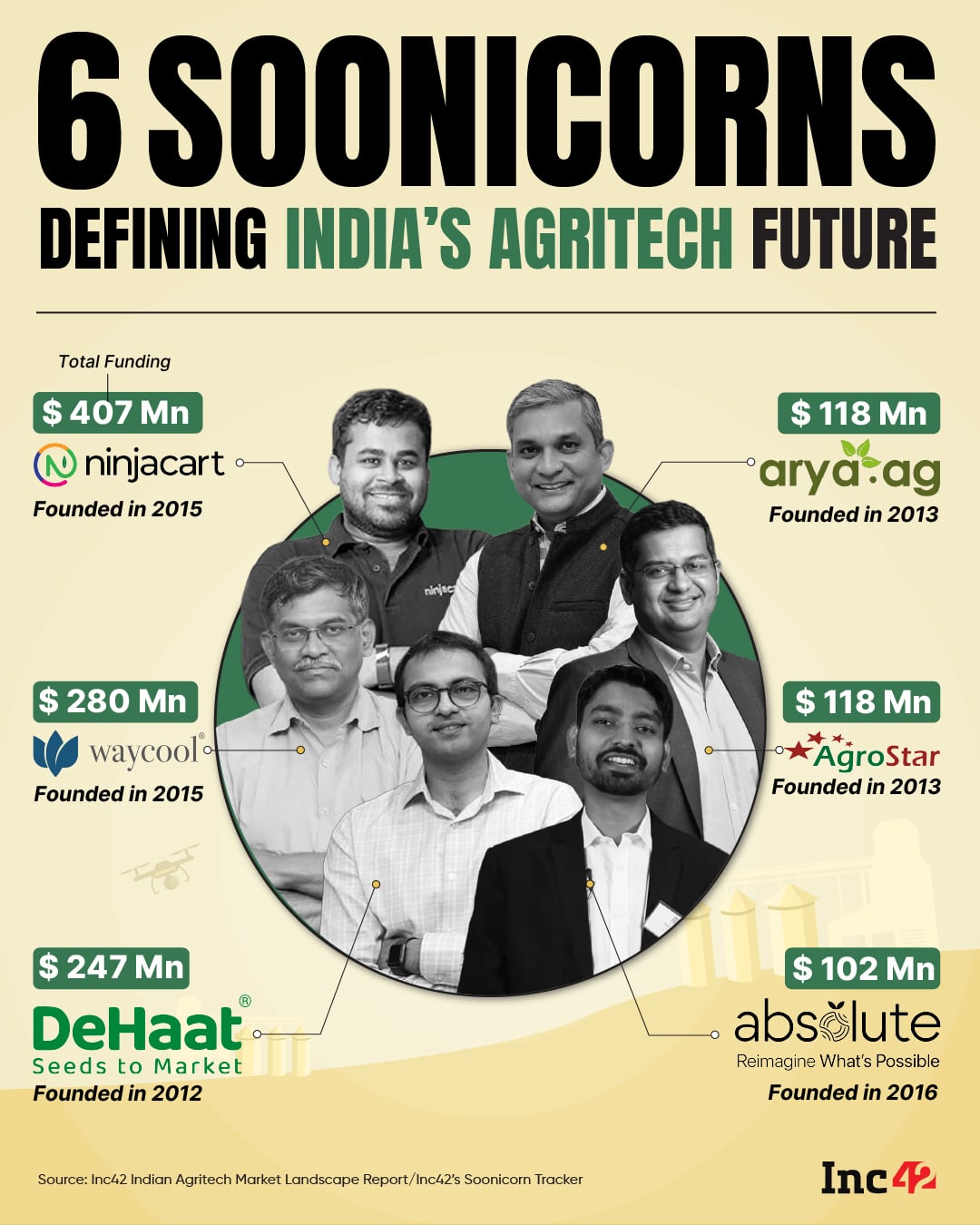
Six Indian soonicorns are shaping the future of Indian agriculture, transforming how food is grown, financed, stored and distributed. Which of these agritech soonicorns will become the next unicorn?

Comments are closed.