
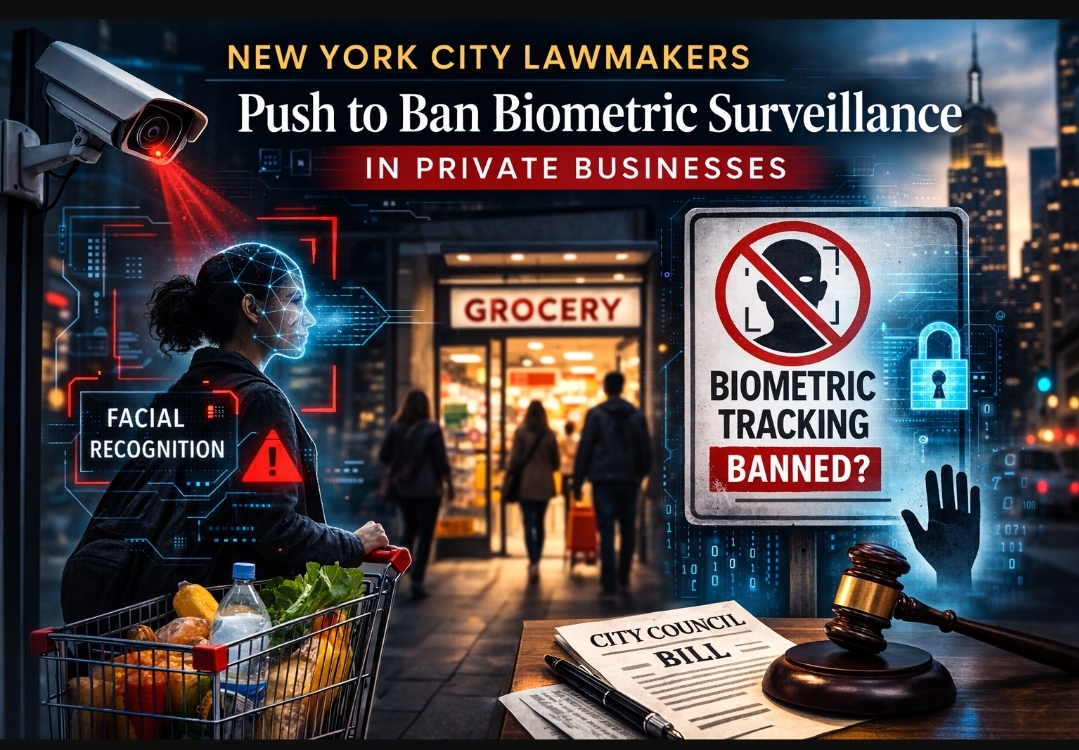

Lawmakers in New York City are moving forward with legislation that could dramatically change how private companies collect and use biometric data. During a recent City Council hearing, officials debated a proposal that would bar businesses open to the public from using technologies such as facial recognition and voice identification to monitor customers.
The push comes amid mounting concerns that biometric surveillance — once largely confined to airports and law enforcement — is quietly becoming part of daily life in grocery stores, apartment buildings, and entertainment venues. Supporters of the bill argue that residents should not have to surrender deeply personal identifiers simply to shop for groceries or attend a concert.
From Store Shelves to Surveillance Systems
Biometric systems rely on distinctive human characteristics to identify individuals. These can include facial geometry, iris patterns, voice signatures, and even palm prints. Unlike passwords or credit cards, these identifiers are permanent and inseparable from a person’s physical identity.
Retailers and security firms increasingly view these systems as tools to deter shoplifting and streamline transactions. In some stores, customers can pay using palm scans instead of cards. In others, surveillance cameras powered by artificial intelligence can flag individuals suspected of prior theft.
The debate in New York intensified earlier this year when reports surfaced that grocery chain Wegmans had begun storing biometric information at certain high-risk stores, including its two locations in Brooklyn and Manhattan. The Rochester-based company has said the technology is limited to stores facing elevated theft concerns and is intended to improve safety for employees and customers.
Still, the revelation unsettled many lawmakers who say most shoppers have little understanding of how their biometric information is captured, stored, or potentially shared.
Proposal Targets Public-Facing Businesses
The legislation, introduced by Councilmember Shahana Hanif, would prohibit the use of biometric tracking in “public accommodations,” a legal term covering businesses open to the public. That category includes grocery stores, retail outlets, restaurants, and performance venues.
Currently, New York City requires businesses that collect biometric data to notify customers by posting clear signage. The new proposal would go much further by banning the practice outright in many consumer settings.
Backers of the measure argue that disclosure alone is insufficient. They contend that customers often have no realistic alternative if they object to biometric monitoring, especially when large retailers adopt such systems. According to supporters, meaningful consent cannot exist if opting out means foregoing access to essential services.
Why Biometric Data Raises Unique Concerns
At the heart of the debate is the permanence of biometric information. Unlike financial data, which can be canceled and replaced, biometric identifiers cannot be changed if compromised. A stolen password can be reset. A face or iris cannot.
Privacy advocates warn that if biometric databases are hacked or misused, individuals could face long-term risks, including identity theft, tracking, or profiling. They also raise questions about how long companies retain such data and whether it might be sold, leased, or shared with third parties.
The proposed legislation seeks to address those risks by prohibiting businesses from profiting off biometric data through sales or trade. It would also require written consent from individuals who voluntarily choose to use biometric-based services, such as palm-scan payment systems.
Supporters frame the bill as a necessary guardrail in an age when artificial intelligence makes large-scale identification cheaper and more accessible than ever before.
Industry Pushback
Not everyone agrees with the sweeping approach. Representatives from the security industry caution that a blanket ban could hamper efforts to combat organized retail theft, which has become a growing concern for stores nationwide.
Industry advocates argue that biometric systems can help identify repeat offenders and protect employees from potentially dangerous confrontations. They also note that some customers prefer the convenience of biometric authentication, particularly for faster checkouts.
Critics of the legislation describe it as government overreach that would restrict businesses from choosing the tools they believe best protect their property and staff. They warn that limiting surveillance options might leave stores more vulnerable to crime.
A National Conversation on Surveillance
The debate unfolding in New York reflects broader discussions taking place across the United States. Cities and states have adopted a patchwork of rules governing biometric data, ranging from simple disclosure requirements to strict prohibitions in certain contexts.
New York City has previously enacted privacy-related measures aimed at increasing transparency in the digital economy. However, some lawmakers now believe that transparency alone does not adequately protect residents in an era of increasingly sophisticated tracking technologies.
The proposal under consideration would make New York one of the most restrictive municipalities in the country regarding biometric surveillance in private commerce. If passed, it could influence how other major cities approach similar concerns.

Comments are closed.