
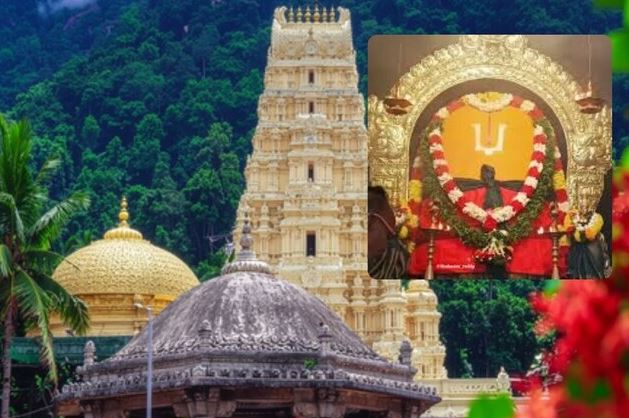
The fierce form of Lord Vishnu is present here in two forms, know why sandalwood paste remains applied throughout the year?

Lord Vishnu has taken different incarnations from time to time to save the earth and destroy the demons. Let us know about the Varaha and Narasimha incarnations of Lord Vishnu. Different temples of Lord Vishnu in both the forms are present in different corners of India, but there is a temple in Visakhapatnam, where the combined form of Lord Vishnu is worshipped. Here the fierce form of Lord Vishnu is worshiped and to keep this fierce form calm, sandalwood paste is applied on the idol. It is believed that just by visiting this temple, all the wishes are fulfilled and all the sins are destroyed. Let us know about this temple of Lord Vishnu…
Joint worship of Varaha and Narasimha incarnations
Sri Varaha Lakshmi Narasimha Temple is situated at an altitude of 800 meters above sea level on the Simhachalam hill in Visakhapatnam, Andhra Pradesh. This temple is dedicated to Lord Vishnu, whose incarnations as Varaha and Narasimha are jointly worshipped. The idol in the temple is covered with sandalwood paste throughout the year and its full form can be seen only on the day of Akshaya Tritiya.
Sandalwood paste is applied on the statue
During the rest of the year, the idol looks like a Shivalinga because it is covered with sandalwood paste. The form of sandalwood without God is called ‘Nijroop Darshan’, whose darshan can be seen only once in a year. The idol is covered with sandalwood paste because the Varaha and Narasimha incarnations of the Lord are full of fierce and fierce energy. To balance his energy, sandalwood paste is applied daily on the idol, so that the Lord gets coolness and he can appear to the devotees in a calm form. The practice of applying sandalwood on the statue has been going on for many years.
Different mythological stories of both the forms
There are different mythological stories for both these forms of Lord Vishnu. To protect his devotee Prahlad, Lord Vishnu took the incarnation of Narasimha and killed the demon Hiranyakshipu, while taking the incarnation of Varaha, Lord Vishnu killed the demon Hiranyaksha and saved Mother Earth.
The temple was built in the 11th century
Many things are said about the construction of the temple. It is believed that the temple was built by King Shri Krishnadevaraya in the 11th century, but the contribution of Narasimha I of the Eastern Ganga dynasty in the 13th century can also be seen in the history of the temple. Both the carvings of the temple and the gopuram show the style of the century. With increasing time, the temple remained under the protection of different states and gradually the construction of the temple increased.
Temple special from tourism point of view
Jayastambh is also installed in the temple, which was built by King Krishnadevaraya of Kalinga during the war. The temple gives evidence of spirituality as well as cultural style and preservation of different eras. This temple is also special from tourism point of view. Devotees come to see the wonderful two forms of the Lord.

Comments are closed.