
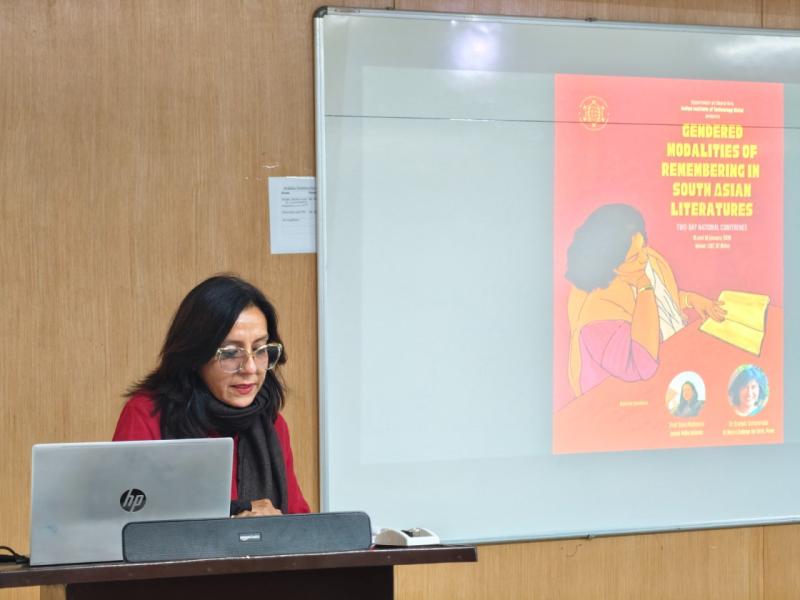
National conference on ‘Gender Modalities of Remembering in South Asian Literature’ organized at IIT Bhilai

Raipur : A two-day national conference on ‘Gender Modalities of Remembering in South Asian Literature’ was organized by the Department of Liberal Arts, Indian Institute of Technology Bhilai on 15–16 January 2026 at Nalanda Lecture Hall. The aim of the conference was to understand memory as a gendered and embodied practice from a South Asian cultural and literary perspective and to provide a platform to share academic research in this area. Faculty members and researchers from various universities of the country participated in the conference.
At the conference, Professor Simi Malhotra of Jamia Millia Islamia discussed the topic ‘Remembering two centuries of women’s movements in India: Rethinking memory and feminist historiography’ in her lecture. She explores feminist historiography from the perspective of memory, outlines the development of women’s movements over the last two hundred years, and highlights the important role of memory in the writing of gender history in South Asia.
On the second day of the conference, Dr. Snobar Satarawala, Vice Principal, St. Mira’s College for Girls, Pune, in her lecture on ‘Remembering the Margin: Gender, Minority Memory and the Politics of Representation in South Asian Literature’, analyzed through cinema, literary texts and oral narratives how the memories of minority communities are preserved or ignored, and underlined the role of literature in resurfacing marginalized histories.
In-depth academic discussions took place in a total of five thematic panels during the conference. The inaugural panel looked at folk and tribal art traditions as living and embodied archives of memory, discussing gender voices and indigenous aesthetics. This was followed by a panel focused on gendered counter-narratives of violence, analyzing how literary and cultural texts express survival, resistance, and affective memory beyond official historiography.
The third panel discussed questions of vulnerability, caste and identity, highlighting the intersection of caste and gender in literary evidence and narrative memory. The fourth panel analyzed gendered notions of maternal heritage, everyday spaces and duty in the context of kinship, domesticity and national memory. The final panel discussed local linguistic and diegetic expressions of memory, exploring alternative mnemonic repositories that challenge prevalent text-centric forms of remembrance.
Overall, the conference made clear that gender memory is an active socio-cultural practice, constructed from embodiment, affect, hierarchy, and narrative forms. The program effectively highlighted the crucial role of literature and cultural texts in empowering marginalized voices in South Asia and creating counter-narratives that challenge prevailing memory practices.

Comments are closed.