

A South Korean traveler had a solution to the frustration of traveling without knowing the language: he printed it on his shirt.
A t-shirt printed with six Vietnamese phrases was all Seri Park needed to eat and navigate his way through Vietnam. Beneath an outer layer, the shirt carried phrases like “No cilantro, please”, “Where is the bathroom?”, “Where can I get a taxi or Grab?”, “How long does it take to go to the airport?” or “Can I have a discount?”. When he needed to communicate, he pulled back his outer shirt and pointed.
The approach required no phone, no app. A video of Park using the shirt went viral on social media, drawing 110,000 likes and thousands of comments.
“No need to worry about your phone dying,” one commenter wrote.
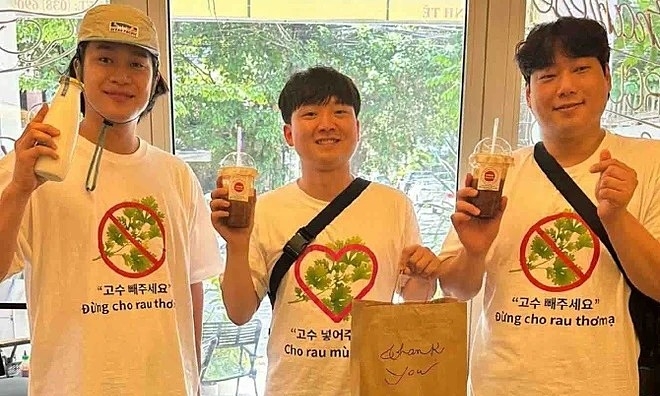
The detail about cilantro reflects a familiar story about South Korean tourists’ tastes in Vietnam. Earlier a group in Da Nang went viral for wearing shirts that read “No cilantro” or “Add cilantro”.
In Vietnamese cooking, cilantro, known as ngo riappears across the menu from banh mi to noodle soups. But not everyone is a fan of the herb.
South Korean travelers wear T-shirts indicating whether they can or cannot eat cilantro while visiting a banh mi shop in Da Nang. Photo by @grandmavuongs |
Research cited by South Korea’s Ministry of Food and Drug Safety suggests that dislike of cilantro may be genetic. A variation in the OR6A2 gene makes some people more sensitive to chemicals also found in soap, causing the herb to taste unpleasant.
This variant is more common in East Asian populations, which explains why cilantro is divisive there but enjoyed in the Middle East and South Asia.
Comments are closed.