
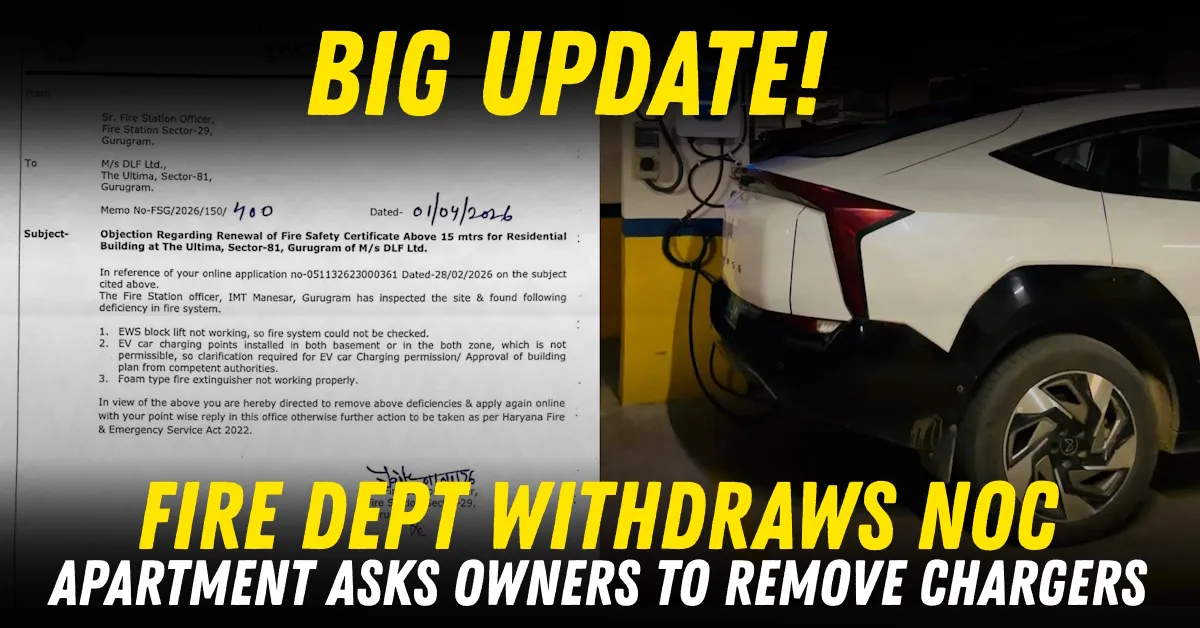

Recently, a post has been shared on Facebook by Shurti Ahujain which an official notice from the fire department and the RWA (Residents Welfare Association) of the DLF The Ultima, which is a premium residential society located in Sector 81, Gurugram, has been attached. In the official notice, the society management has clearly stated that all EV owners must remove their private charging points installed in basement parking areas within the next 7 days.
This time around, it is not just a precautionary request or a suggestion. It has now become a mandatory directive, which the residents who own EVs and have chargers installed in the basements will have to follow. The decision has been taken after the Haryana Fire Department raised serious objections and withheld the Fire NOC (No Objection Certificate) renewal for the building.
As per the notice, the society has engaged with relevant authorities, including DTCP and the Fire Department. All authorities have stated that the installation of EV chargers inside basement areas is strictly prohibited due to significant safety risks posed to residents. As a result, the removal of all EV chargers has become necessary in order to proceed with the Fire NOC renewal process.
The Fire Department has taken a very strong stance on this issue. It has classified EV charging as equivalent to fuel dispensing, similar to petrol, diesel, and CNG. Due to this unique classification, charging EVs inside enclosed basement areas is now being seen as a major safety hazard.
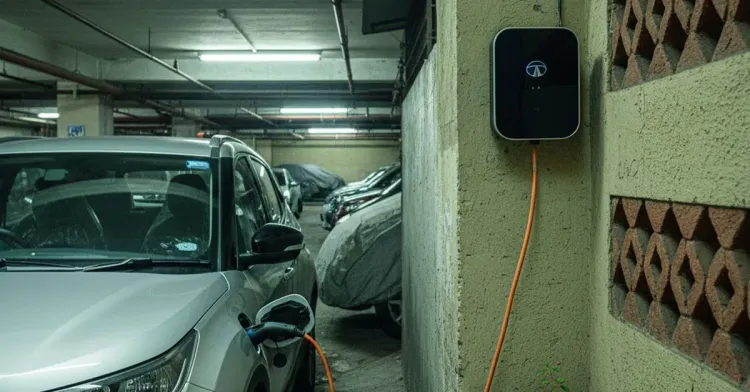
Authorities have also highlighted multiple risks which have been associated with basement EV charging. The first of these major risks is that there is a high risk of short circuits due to increased electrical load in confined spaces. Secondly, in case of a fire, the flames can spread very quickly, as cars are parked close to each other in basements.
Another major concern highlighted by the fire department and other concerned departments is poor ventilation. They have added that smoke accumulation in enclosed basements can make evacuation extremely difficult and dangerous. Additionally, firefighting operations become much more challenging because of restricted access for fire personnel and vehicles.
An official inspection carried out by the Fire Department revealed that EV charging points installed in basements are “not permissible.” The department has now asked for proper approvals from other competent authorities, which currently do not exist in most cases.

Till then, the DLF Ultima society has been instructed to remove all EV charging points and rectify other fire safety issues before reapplying for the Fire NOC. Without complying with these directives, the Fire NOC renewal will remain stalled, as highlighted by the notice from the fire department.
As mentioned above, earlier, many RWAs across cities were either discouraging or not allowing the installation of EV chargers. However, the situation has now changed. Earlier, RWAs were requesting EV owners to not install EV chargers or to remove the ones already installed. However, it has now become enforcement, and the removal of chargers is directly linked to Fire NOC approval.
This decision has created major problems for EV owners living in the society. These owners, who had installed private chargers for the convenience of home charging, will now have to remove them immediately. Home charging is one of the biggest advantages of owning an electric vehicle. However, due to this new mandate, owners will lose the ability to charge their cars overnight in their designated parking spaces.

As a result, EV owners will now have to rely on shared or public charging infrastructure. This will lead to higher charging costs, increased time consumption, and inconvenience. Additionally, many users will have to leave their vehicles unattended for long durations while charging.
Also, renters are the worst affected in this situation. They are already stuck in a three-way deadlock involving landlords, RWAs, and unclear regulations. Landlords often refuse installations due to billing concerns. Meanwhile, RWAs deny permissions due to safety risks.
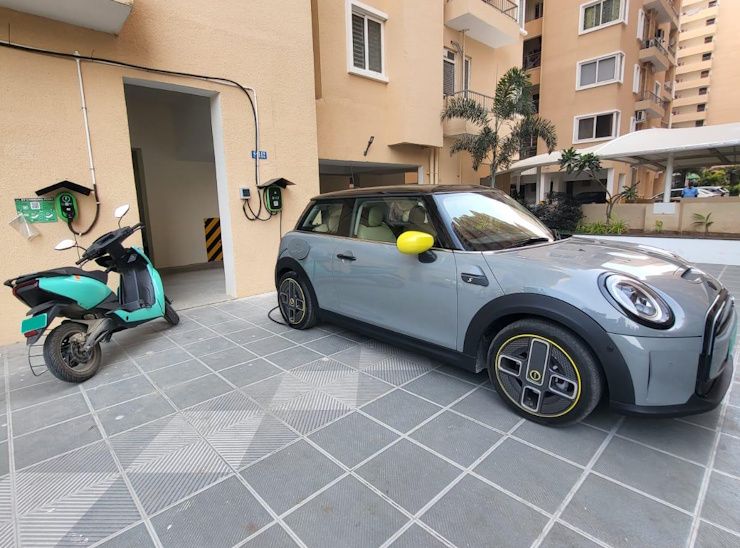
It has been noted that the DLF Ultima society residents who own EVs currently have an alternative solution. This solution is a centralised EV charging station operated by Statiq within the premises. The Statiq DLF Ultima Station is located near the service gate, close to the shopping complex, and is operational 24×7.
This station offers both DC fast charging and AC charging options. The DC fast charger has a capacity of 60 kW and is priced at Rs 16 per unit, using a CCS-2 connector. In addition to this, there are multiple AC chargers rated at 22 kW, priced at Rs 9 per unit, using Type-2 connectors. The station also provides basic amenities such as a cafe, store, and restroom.
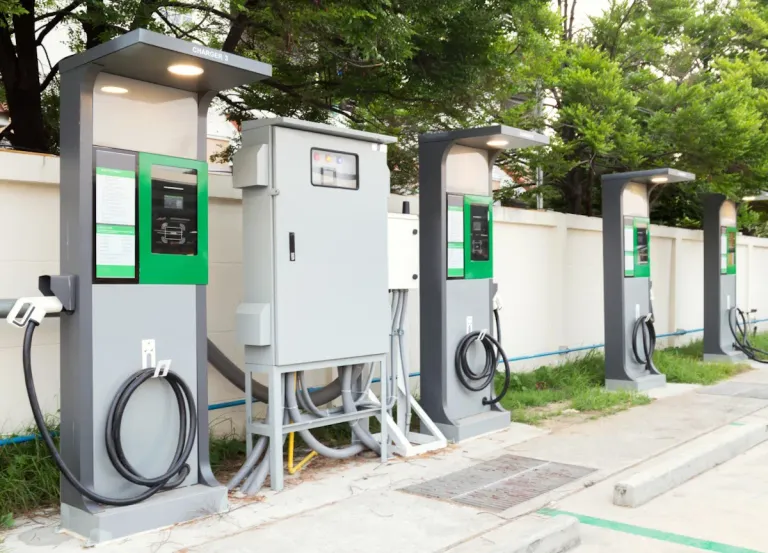
Now, the introduction of a shared charging station provides some relief. However, it has to be mentioned that it does not fully replace the convenience of personal chargers. EV owners will now have to deal with limited charging points and a queue-based system. There is also no guarantee of immediate availability, especially as the number of EVs in the society increases. Compared to home charging, shared charging is less convenient, more expensive in some cases, and significantly more time-consuming.
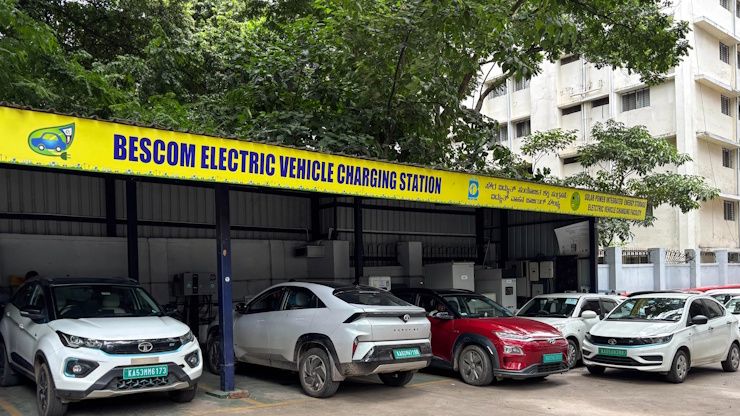
This issue is not limited to a single society. Reports have suggested that over 600 high-rise societies in Gurugram are currently facing delays in Fire NOC approvals due to similar concerns. The problem is not EVs themselves, but the way charging infrastructure has been installed in basements without standardised safety compliance. Authorities across Haryana are now either halting or cancelling Fire NOCs for buildings that do not meet safety norms.
Comments are closed.