
No Hijab, No Veil: Meet Jordan’s Modern Royal Family Where Queens Shine And Daughters Fly Fighter Jets | world news

New Delhi: When people think of monarchs in Muslim countries, the mind often conjures images of strict conservatism, veiled women and closed-off lives. But Jordan’s royal palace tells a different story. Here, the women are free to follow their ambitions, from global fashion to the cockpit of a fighter jet. This is the world of King Abdullah II, where modernity and tradition coexist in harmony.
Prime Minister Narendra Modi recently visited Jordan, where he met King Abdullah II. While discussions focused on strengthening diplomatic ties, the spotlight was also on the King’s family, a lineage tracing back to the 41st generation of the Prophet Muhammad.
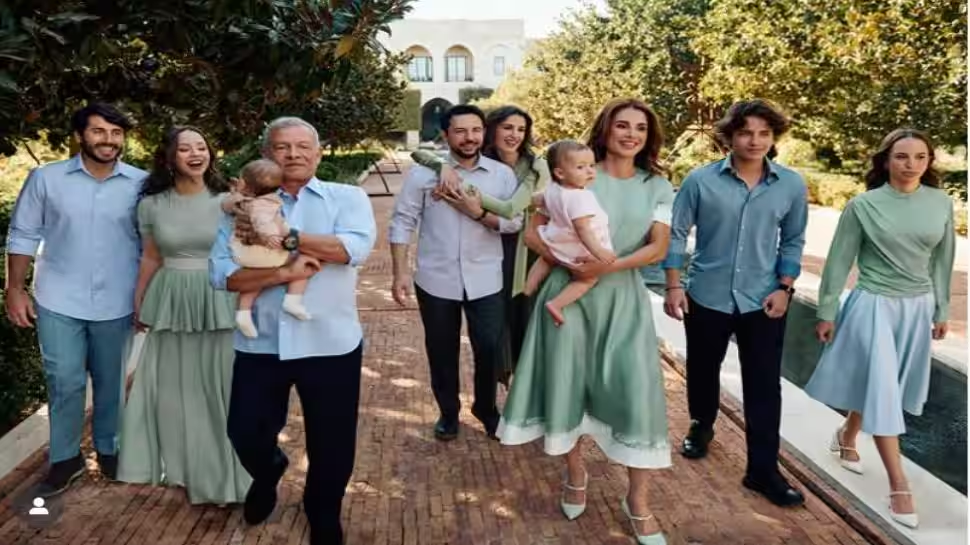
Despite being a royal Muslim family, they live without the strict confines of hijabs (head scarf) or burqas (veils). Queen Rania, who is recognized worldwide for her beauty and style, is a symbol of this modern approach.
King Abdullah himself is a trained pilot, a Star Trek fan and regarded as one of the most approachable Muslim leaders globally.
Crown Prince Hussein
Born in 1994, Crown Prince Hussein studied International History at the Georgetown University in the United States. Following family tradition, he also trained at Britain’s Royal Military Academy Sandhurst.
Today, he serves as a captain in the Jordanian army and often accompanies his father on diplomatic visits. Recently, he married Saudi architect Rajwa Al Saif in a lavish ceremony.
A Reflection Of Her Mother
Born in 1996, Princess Iman is often described as a mirror of Queen Rania. She studied at the Georgetown University and New York’s Parsons School of Design. Active in sports and an avid equestrian, she married Venezuelan financier Jamal Alexander Thermiotis in 2023.
Jordan’s First Female Jet Pilot
Breaking traditional molds, Princess Salma, who was born in 2000, trained at Sandhurst and became Jordan’s first female fighter jet pilot. Her achievement sends a message worldwide that a princess from a Muslim country can pursue careers once considered unconventional.
The Youngest Scholar
The youngest child, Prince Hashem, who was born in 2005, recently graduated from Jordan’s Kings Academy and is now preparing for further studies at the Georgetown University in the United States.
Modernity At Home
Do the women of the royal family wear burqas? The answer is no. Queen Rania is rarely seen in hijab or veil, opting instead for designer Western attire, trousers and skirts. Her hair is often uncovered, and she speaks confidently on global stages.
She has repeatedly emphasized that in Islam, modesty is about the mind and behaviour, not only clothing, and wearing a hijab is a personal choice, not a mandate.
King Abdullah has never imposed conservative dress codes on his family. Both daughters, Iman and Salma, dress in modern attire and participate publicly without head coverings. This signals a societal shift in Jordan, demonstrating that Muslim identity and modernity can coexist.
Wealth, Privacy, Global Assets
Although Jordan is a small country, King Abdullah’s wealth has made headlines. The 2021 Pandora Papers leak revealed that he reportedly purchased luxury properties in the United States and the United Kingdom worth over $100 million (around Rs 800 crore), including seaside villas and high-value homes in some of the world’s most expensive cities.
The leak also revealed that Swiss bank accounts with approximately $245 million (around Rs 2,000 crore).
The royal family, however, dismissed claims of misuse, stating that these are personal family assets used for official duties and security, not public funds.
A King Beyond The Palace
King Abdullah’s life extends far beyond the palace. He is a trained pilot capable of flying a Cobra attack helicopter, enjoys skydiving and scuba diving and even made a cameo in his favorite TV series, ‘Star Trek: Voyager’, before ascending the throne. He has been instrumental in promoting Jordan’s film industry, with Hollywood productions like The Martian and Aladdin filmed in the country.
He often disguises himself to move among citizens as a taxi driver or an elderly man, observing everyday life firsthand.
Bridging Islam, Modernity
King Abdullah II and his family exemplify how deep cultural roots can coexist with modern aspirations. Traditional ceremonies and sword dances are performed along with daughters flying fighter jets and Queen Rania promoting women’s empowerment on global stages.
Their story is not only about wealth and glamour, it delivers a message that a Muslim family can embrace modernity while staying true to faith and identity. This approach contributes to Jordan’s reputation as a stable and peaceful nation in a turbulent region.

Comments are closed.