
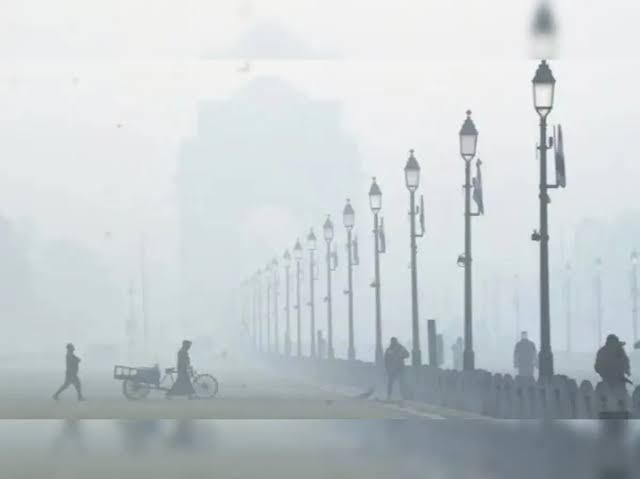
North India Gripped by Severe Cold Wave and Dense Fog; Flights, Trains and Roads Disrupted Across 10 States

Large parts of north India continued to reel under a severe cold wave and dense fog on Sunday, with air pollution worsening in Delhi and transport services facing widespread disruptions across at least 10 states, according to officials.
In the national capital, Delhi’s maximum temperature dropped to 16.9°C, around 5.3 degrees below normal, marking the coldest day of the season so far and meeting the criteria for a “cold day”, as defined by the India Meteorological Department (IMD). Compounding the weather stress, the city’s air quality index (AQI) surged to 410 late Saturday night, placing it firmly in the severe category.
A satellite image captured on Sunday morning showed an extensive and continuous fog cover stretching from Kashmir through Punjab, Haryana, Delhi, Uttarakhand, Uttar Pradesh, Bihar, Jharkhand and West Bengal, and extending into parts of Madhya Pradesh—blanketing one of the most densely populated regions globally.
Flight and Transport Disruptions Continue
At Indira Gandhi International Airport, Delhi, flight operations were disrupted for the fifth consecutive day. Officials confirmed that 66 arriving flights and 63 departures were cancelled, while hundreds more were delayed. Data from Flightradar24 showed that over 220 arrivals and 400 departures experienced delays during the day, with average delays exceeding 30 minutes.
The Airports Authority of India (AAI) issued a weather advisory cautioning passengers that low visibility caused by dense fog may continue to affect flight schedules. Travelers were advised to remain in contact with airlines for real-time updates, while special passenger facilitation teams were deployed at affected airports.
Road and Rail Traffic Impacted
Dense fog also disrupted road and rail traffic. The Union road transport ministry sent precautionary text alerts to vehicle owners and driving licence holders, urging extra caution while driving in low-visibility conditions, following several recent vehicle pile-ups on highways and expressways.
Rail services were similarly affected, with long-distance and premium trains arriving at New Delhi Railway Station delayed by four to six hours, particularly those operating on northern and eastern routes.
In West Bengal’s Nadia district, three people lost their lives and three others were injured after being hit by a train amid dense fog while travelling to attend a political rally, officials said.
Why the Cold Conditions Persist
According to IMD officials, the prolonged cold and fog conditions are being driven by a subtropical westerly jet stream, with wind speeds reaching 105 knots (around 195 kmph) at higher atmospheric levels. This has facilitated cold air incursion and limited daytime solar radiation, resulting in persistent cold day conditions.
“A cold day is declared when temperatures fall below 10°C and the maximum temperature remains 4.5 to 6.4 degrees below normal. A severe cold day occurs when the departure exceeds 6.5 degrees,” the IMD explained.
Weather Alerts Issued
The IMD has issued a red alert for Uttar Pradesh, warning that dense fog and severe cold day conditions are likely to persist until December 24. Orange alerts—the second-highest warning level—have been issued for Delhi, Haryana, Chandigarh and Uttarakhand, cautioning residents and authorities to prepare for continued disruptions.
Meteorologists have warned that while conditions may ease briefly, dense to very dense fog is expected to return between December 25 and 27, indicating that weather-related challenges may continue through the final week of December.
Authorities have urged residents to take precautions during early morning and late-night hours and remain alert to changing weather advisories.

Comments are closed.