
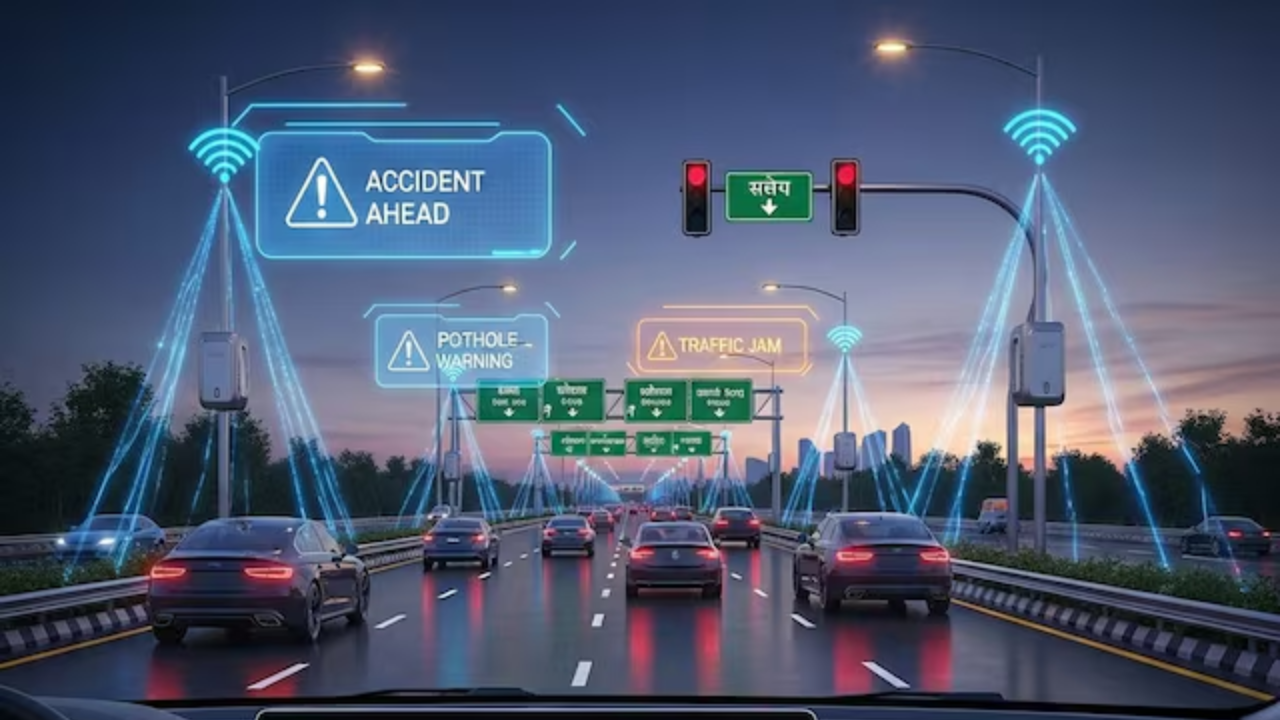
Now the cars running on the road will talk to each other; The season of Smart Driving in India! What is ‘V2X’ technology?

- The beginning of a new era in India too
- V2X consists of four main components
- Why is this technology needed in India?
Smart Driving: Today’s world is changing rapidly and vehicles are no longer just a means of transportation. So their technology is also changing a lot. In all this, a new era is beginning in India as well. V2X—or ‘Vehicle-to-Everything’—technology is an integral part of this transformation. This technology enables vehicles to connect with each other, as well as with their surrounding environment. This means that vehicles can exchange information among themselves; For example, if a vehicle in front brakes suddenly, the vehicle behind it gets a warning. This gives the driver a chance to react in time and take the necessary corrective action. But how exactly will this technology work? Just cry! ‘This’ company’s takeover of the CNG market; Check out the top selling cars list, you will be amazed
V2X consists of four main components
V2X consists of four main components. The first element is ‘Vehicle-to-Vehicle’, in which vehicles communicate directly with each other. Another factor is ‘Vehicle-to-Infrastructure’, whereby vehicles are connected to traffic signals or road infrastructure. The third component is ‘Vehicle-to-Pedestrian’, which works to ensure pedestrian safety. The fourth element is ‘Vehicle-to-Network’ (V2N), through which information is received through mobile networks. Thus, the vehicle is transformed into a ‘smart system’, which is constantly updated.
Why is this technology needed in India?
Road accidents are a serious problem in India. Every year, thousands of people lose their lives in accidents. The main causes of these accidents are human error and failure to react in time. Often, drivers notice a potential hazard too late, resulting in an accident. This is exactly where V2X technology can come in handy. This technology alerts drivers with advance warnings of potential hazards. This increases the time to react and consequently, helps to avoid accidents. In a country like India which is characterized by heavy traffic and constantly congested roads, this technology can be very beneficial. Furthermore, this technology can also help reduce traffic congestion; Because vehicles can control their speed by interacting with traffic signals.
It is used in many countries around the world
Many countries around the world have started working on this technology. In America, under the ‘Connected Vehicle’ project, vehicles and traffic management systems are interconnected. Traffic signals there actively exchange data, enabling more efficient traffic management. Several European nations have also tested this technology; Countries such as Germany, France and the Netherlands are currently implementing smart transport systems. China is making rapid progress in this area, where vehicles are being interconnected through 5G networks. Even in Japan, vehicles and transportation systems are already operating in real-time. These examples clearly show that V2X has emerged as a necessity for the future.
Challenges to implement this system in India
While this technology offers tremendous benefits, its implementation in India will not be without challenges. This requires proper spectrum allocation and effective coordination among various stakeholders and companies. Moreover, since a large amount of information is exchanged in the system, data security is a major concern. In addition, installing the necessary hardware in each vehicle—along with setting up a nationwide network infrastructure—is a major logistical challenge. As 5G network coverage is not yet universally available across the country, full-scale implementation of this technology may take some time.
Royal Enfield’s new blast! A special stylish Heritage Collection has been launched

Comments are closed.