
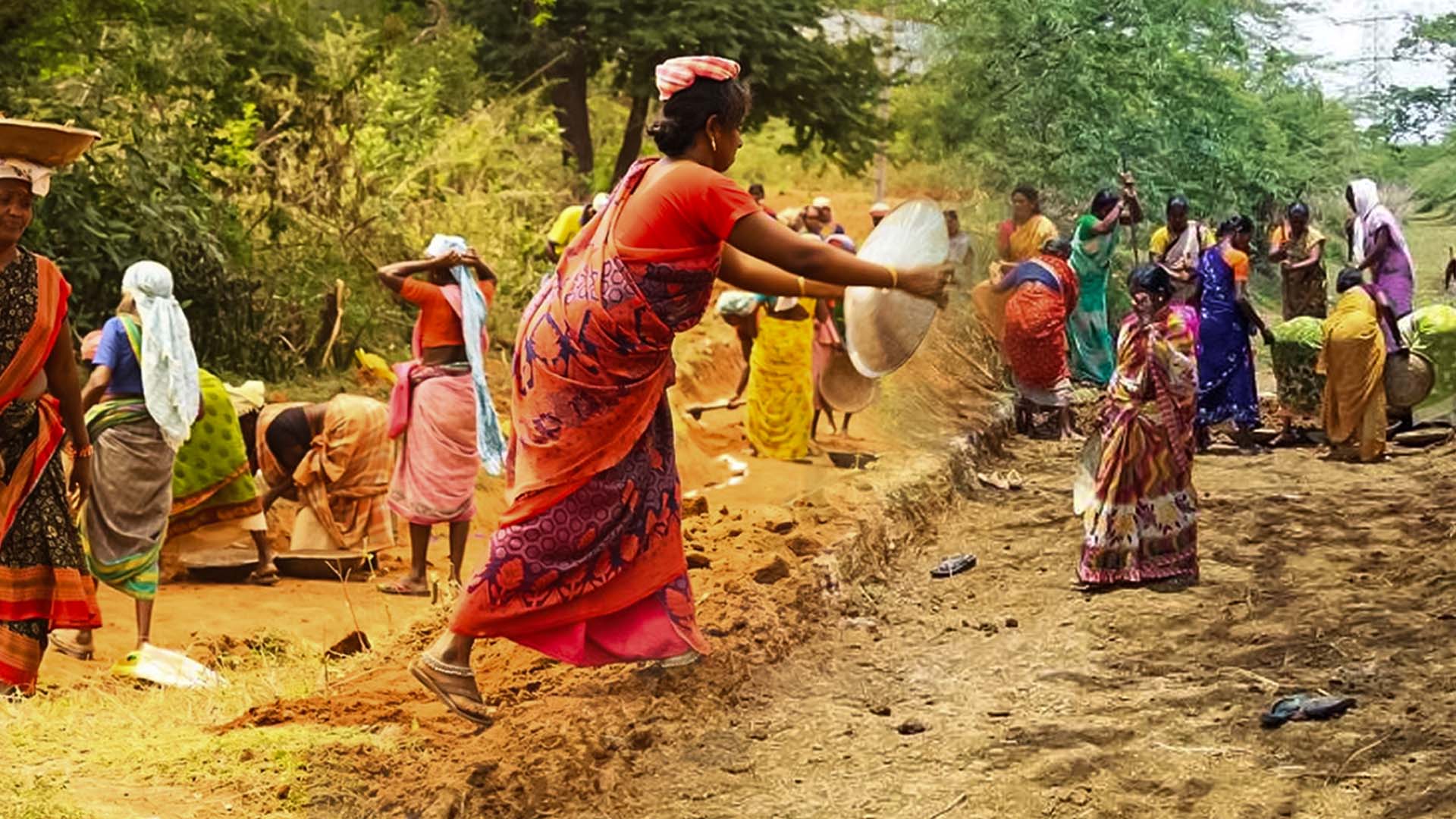

The Federal spoke to political editor Puneet Nicholas Yadav to understand the government’s move to replace the Mahatma Gandhi National Rural Employment Guarantee Act with a new law and why it has triggered sharp political and federal tensions.
What is the most striking change in replacing MGNREGA with the new law?
The most obvious change is the name. You are removing a scheme named after the father of the nation and replacing it with a long, complicated name whose acronym includes the word “Ram”. That clearly plays to the ideological strengths of a particular political party, the BJP. This part is very much in your face.
But the more substantive changes are far more serious. Earlier, under NREGA, there was a constitutional and legal guarantee. Any citizen could demand work for up to 100 days in a year, either continuously or in parts. If work was not provided within a stipulated time, the person was entitled to an unemployment allowance. That was the framework.
How does the funding structure change under the new law?
Earlier, the entire wage bill was paid by the Centre. Now, the Centre will pay only 60 per cent, while states have to arrange the remaining 40 per cent on their own.
Also read: Sonia Gandhi slams VB-G RAM G Bill, says Centre bulldozed MGNREGA
This is happening at a time when states are already under financial stress. Their revenue streams have dried up due to GST, as taxes now go into a central pool and are redistributed.
States have very limited independent sources of income. Adding a 40 per cent burden will strain their coffers even more.
What impact will this have on employment guarantees at the ground level?
Earlier, NREGA was demand-driven. People could ask for work, and either get employment or an allowance. Now, states may simply say they do not have the money.
Earlier, states submitted estimates to the Centre about how many people would seek work and how much money was needed, and funds were allocated accordingly. Now, the Centre will decide how much money a state gets, where it is spent, and what kind of work is undertaken, without fully funding it.
If states exceed the 60 per cent limit, they must bear the cost themselves. So, states may simply cap employment at what they can afford, effectively dismantling the scheme.
Was NREGA even meeting its original promise earlier?
Even earlier, most states could not provide more than around 55 days of work on average, despite the guarantee being 100 days. This was because the Centre often did not release funds on time or in full. With the new structure, the situation will only worsen.
Also read: Congress leader Jairam Ramesh flags ‘bigger conspiracy’ in MGNREGA law change
This scheme made a huge difference to people facing financial distress in rural areas. For those with no other avenues of work, it was a lifesaver. Now, that safety net is being taken away.
Is reforming NREGA entirely unnecessary then?
Reform is a different issue. No law or scheme is perfect, and there is always scope for improvement. But improvement means making it better, not dismantling it.
If you say you will cut funding, remove state autonomy in deciding jobs, control the nature and number of jobs, and still call it reform, then how exactly is the system improving?
The government cites corruption as a reason. How valid is that claim?
Corruption is the easiest allegation to make against any scheme. If corruption existed, the government should have identified specific instances, pointed out the loopholes, and proposed systems to fix them.
The Lok Sabha debated this bill for nearly eight hours. When the minister, Shivraj Singh Chouhan, replied, not a single concrete instance of corruption was cited. In the last 11 years, has the government pursued even one NREGA corruption case to court with evidence and charge sheets? Not one.
On this vague allegation alone, an entire scheme is being dismantled. That shows intent is not reform, but ending the scheme.
Why does the BJP keep renaming schemes instead of launching new ones?
They have launched some new schemes, but the proportion is very small. Roughly 38 to 40 schemes are renamed versions of older ones from previous governments, including the Vajpayee government.
Also read: ‘VB-G RAM G Bill anti-village, 20 yrs of MGNREGA demolished in a single day’: Rahul
Flagship schemes like urban renewal or subsidised LPG cylinders were rebranded with new names. Renaming has become a national pastime, extending beyond schemes to cities, roads, trains, and buildings.
What is the political purpose behind this renaming exercise?
There are three broad purposes. First is appropriation. The BJP did not exist during much of the freedom struggle, and even its ideological predecessors did not play a role in strengthening it. So, icons like Sardar Patel are appropriated despite their ideological opposition to the RSS.
Second is cultural imposition. This is not about India’s composite culture, but an exclusive version rooted in Hindutva. Everything before 2014 is projected as worthless, while post-2014 is portrayed as reclaiming a vague past glory.
Third is humiliation. Icons associated with the Congress or Muslims are targeted, renamed, or erased, often without historical context.
How does language factor into this renaming politics?
A major element is Hindi imposition. Laws are increasingly named in Hindi or Sanskritised Hindi. India has hundreds of languages, but there are no laws named in Tamil, Bengali, Malayalam, Telugu, or Marathi.
Even many Hindi-speaking people do not understand the terms used. This is cultural imposition, not accessibility.
Why has renaming become a centre–state flashpoint?
Renaming itself is a red herring. The real issue is centre–state relations and funding. The Centre is curtailing the rights and autonomy of states, which goes against Tezzbuzz structure enshrined in the Constitution.
States created on linguistic lines, like Tamil Nadu, have strong histories of resisting such imposition. Forcing Hindi names where people cannot even understand them serves no practical purpose.
Do beneficiaries see any real change on the ground?
No. It only creates confusion. People who earlier enrolled under NREGA now do not know their entitlements. They are unsure if they will get work, wages, or the same kinds of jobs. This confusion helps no one.
Does rebranding actually translate into electoral gains?
Yes, it does. Politics since 2014 has moved towards personality-centric branding. Schemes are plastered with the Prime Minister’s image. Even when schemes are rebranded, the message at the grassroots is that benefits come directly from the Prime Minister.
Also read: VB-G RAM G Bill repeals job guarantee, warns economist Jean Dreze
Alongside this, years of jingoism, communal polarisation, and faux nationalism have created an environment where renaming feeds into a broader narrative. Removing Muslim or British names and promoting a Hindu-Hindi identity reinforces this politics.
It sends a message to the majority population that only this government protects their interests. That narrative has paid electoral dividends, and that is why this project continues.
The content above has been transcribed using a fine-tuned AI model. To ensure accuracy, quality, and editorial integrity, we employ a Human-In-The-Loop (HITL) process. While AI assists in creating the initial draft, our experienced editorial team carefully reviews, edits, and refines the content before publication. At The Federal, we combine the efficiency of AI with the expertise of human editors to deliver reliable and insightful journalism.

Comments are closed.