
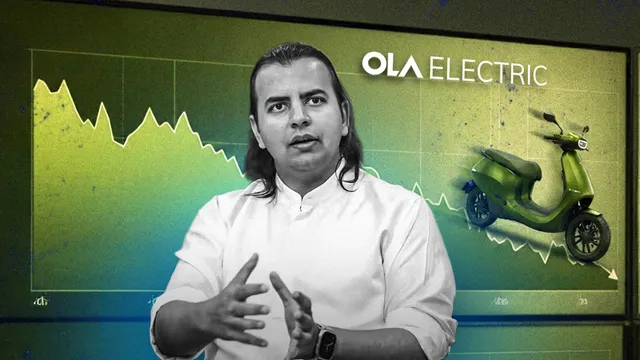

It was another bruising day for Ola Electric shareholders.
On March 2, the stock crashed nearly 16% during intraday trade to hit a fresh all-time low of ₹21.21 on the BSE. Though it clawed back some losses by the closing bell, settling 4.56% lower at ₹24.07, the damage was hard to ignore.
The company’s market capitalisation now stands at about ₹10,616 crore ($1.16 billion). Just seven months ago, in August 2024, it was hovering around ₹69,000 crore ($7.5 billion). That’s not just a correction — that’s a collapse in investor confidence.
And this time, the fall wasn’t triggered by rumours. It was numbers.
Credits: Outlook Business
A Near 50% Sales Shock
The immediate blow came from February’s registration data.
Ola Electric’s two-wheeler EV registrations fell more than 47% month-on-month — from 7,531 units in January to just 3,968 units in February. The company has now slipped to sixth place in India’s electric two-wheeler market, a sharp fall for a brand that once dominated headlines and market share charts.
Zoom out further, and the trend looks even more worrying. In 2025 so far, its EV sales have dropped 51% to 1.99 lakh units compared to 4.07 lakh units in 2024.
For a company that built its identity around scale and aggressive expansion, shrinking volumes tell a very different story.
Service Woes And Legal Overhang
Beyond sales, operational cracks have also become harder to hide.
Ola Electric has faced mounting complaints over delayed servicing, refund disputes, and customer dissatisfaction. The Central Consumer Protection Authority (CCPA) is probing the company after reportedly receiving over 10,000 complaints related to service issues and alleged misleading advertisements.
Then came the legal drama. A bailable arrest warrant was issued against founder and CEO Bhavish Aggarwal after he failed to appear before a consumer commission in South Goa in a case involving a missing e-scooter. The warrant was later stayed by the Bombay High Court at Goa, which noted that the commission had exceeded its jurisdiction.
While the immediate legal threat has eased, reputational damage tends to linger longer than court orders.
Losses Narrow, But Revenue Falls Off A Cliff
Financially, the picture is mixed — and that’s putting it mildly.
In Q3 FY26, Ola Electric managed to narrow its net loss by 14% year-on-year to ₹487 crore. But sequentially, losses widened 17% from ₹418 crore.
The bigger red flag? Revenue.
Revenue plunged 55% year-on-year and 32% quarter-on-quarter to ₹470 crore. For growth-focused companies, falling revenue is often more alarming than rising losses. It signals demand trouble, not just cost inefficiencies.
Investors aren’t just asking when profitability will come — they’re asking whether growth itself is slowing structurally.
A Diversification Pivot: Ola Shakti
With scooter sales under pressure, the company is looking beyond vehicles. Its battery energy storage system (BESS) play, branded ‘Ola Shakti’, is positioned as a new growth engine.
The ambition is clear: evolve from an EV maker into a broader energy solutions company.
But new verticals don’t scale overnight. For now, the core scooter business still drives sentiment — and that engine is sputtering.
Caught In A Wider Market Storm
It didn’t help that the broader market was in free fall.
The BSE Sensex ended 1.29% lower at 80,238.85, while the Nifty 50 closed down 1.24% at 24,865.70. Escalating geopolitical tensions in the Middle East rattled global markets, raising fears of oil supply disruptions through the Strait of Hormuz.
In risk-off environments, high-growth, loss-making stocks are often the first to get hit. Ola Electric found itself right in that firing line.

From Poster Child To Pressure Point
There was a time when Ola Electric symbolised India’s EV revolution — bold projections, massive factories, ambitious founder energy.
Today, the narrative feels different.
The company is battling slowing sales, customer dissatisfaction, regulatory scrutiny, and investor fatigue — all at once. The stock’s journey from ₹69,000 crore in valuation to nearly ₹10,000 crore reflects more than just market volatility. It reflects a shift in belief.
The next few quarters will be crucial. If Ola Electric can stabilise sales, fix service bottlenecks, and show revenue momentum again, this phase may be remembered as a painful reset.
If not, the slide may not be over yet.

Comments are closed.