


Automobile safety and crashworthiness have had great improvements over the years. Cars sold today are much safer than those sold a decade or two ago. A crash test conducted by US-based Insurance Institute for Highway Safety (IIHS)proves just the same. In it, a 2026 Chevrolet Blazer was crash-tested against an old 1996 Blazer. The head-on collision proved that the old SUV was much more unsafe than the new model.
This is indeed an unusual crash test. It compared the safety levels offered by two versions of the same model, separated by three decades of time gap. There is a common belief that older cars are safer because they were built with thicker, heavier steel. This test has busted that myth.
As the video begins, we see Joe Nolan, the Chief Operating Officer at IIHS, giving a brief introduction. He says that the vast majority of new vehicles in the United States do well in crash tests conducted by IIHS. He adds that the insurance industry has funded IIHS to test vehicles consistently. The automakers, he says, have responded to the tests by improving their designs. IIHS started crash-testing vehicles in 1995. IIHS developed its tests by taking inputs from actual field data.
We then get to see the actual crash. A 2026 Chevy Blazer finished in Red collides head-on against a 1996 Blazer finished in Teal Blue. The new Blazer performed exceptionally well. Its front end absorbed all the crash energy. The occupants in this case, would have walked out without major injuries.
Modern cars and SUVs are designed with advanced materials like high-strength steel and have carefully engineered crumple zones. These are meant to absorb impact energy in a controlled way. After a crash, the front end of a car may look completely destroyed, but the passenger shell will stay largely intact. Joe says that most modern cars behave like the 2026 Blazer in such crashes.
Older vehicles, on the other hand, lack such intelligent design. They may appear strong on the outside, but may excel in crash safety. In this case, the 1996 Blazer’s occupant compartment had a massive collapse. The instrument panel and steering wheel came off and hit the dummy’s head, breaking it off the body. Such a cabin collapse can also mean passengers getting trapped inside. Rescue in such cases can become extremely difficult.
The airbag in the ‘96 Blazer deployed on time, but the actual impact in saving the occupants was minimal. It failed to deliver enough protection due to the structural collapse. The injuries in this case, IIHS says, would most likely be fatal.
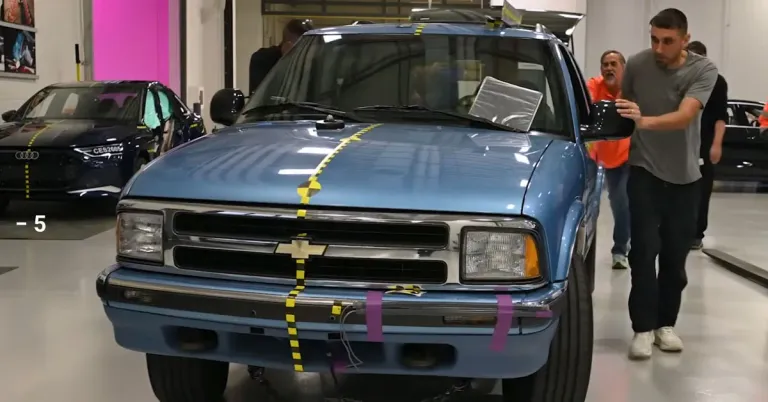
The key issue with older cars is not just the absence of airbags or electronics. The bigger problem is poor structural integrity during crashes.
In modern cars, energy from a collision is redirected away from passengers. In older vehicles, this doesn’t happen and the energy is transferred directly into the cabin. This may lead to a complete or partial structural collapse. In such cases, even airbags or other electronics may fail to save lives.
The Insurance Institute for Highway Safety has been at the forefront of improving vehicle safety in the U.S. It was founded in 1959. It is an independent, non-profit scientific body. Its focus has always been on reducing deaths, injuries and financial losses caused by road accidents.
According to IIHS, its extensive research and crash testing have helped in saving around 50,000 lives over the last 30 years. These have also helped reduce the economic impact of road accidents by approximately $538 billion. The total funding for IIHS during the period was just around $600 million.
IIHS crash tests have pushed carmakers to improve safety offered on their products. These haven’t been limited to the US alone. Results of these tests have influenced design, structure and the array of safety equipment on offer.
IIHS is now expanding its focus to include heavy-duty trucks as well. Work on this front would reduce road fatalities and improve overall safety on the road.
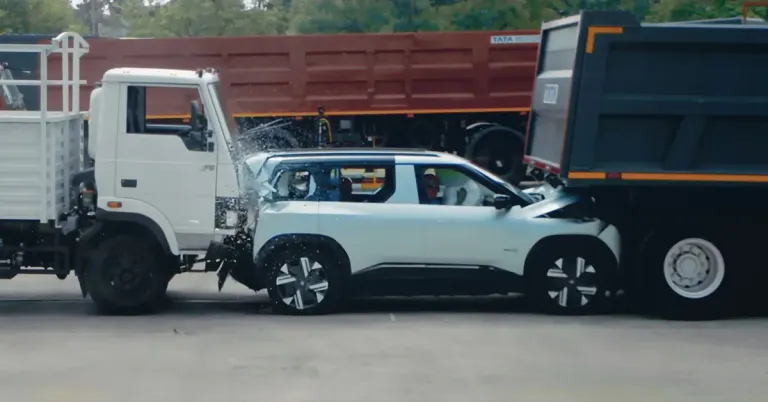
As obvious, crashworthiness has improved significantly over the years. Additionally, the safety equipment array has also grown. In the Indian context, airbags, ABS and EBD were once the benchmark technologies. In 2026, car safety and crashworthiness are much beyond those. Now, ADAS features can mitigate crashes and provide an additional layer of safety. Globally, ADAS performance is now being integrated into the evaluation criteria of various bodies that perform crash tests on vehicles. Smarter designs and a growing list of electronics are making vehicles increasingly safe.
Comments are closed.