
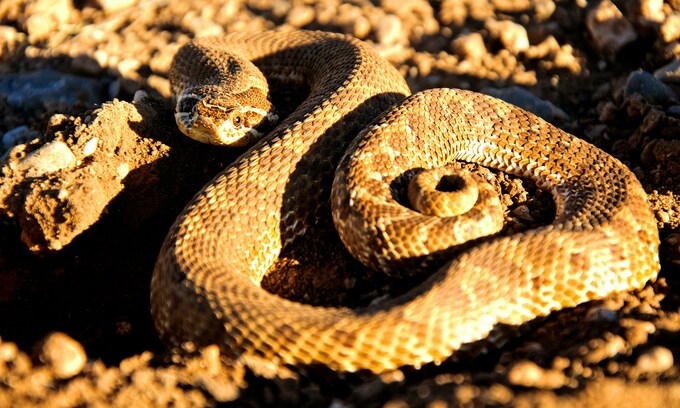

Chris Howarth was visiting his parents in Oroville, in Butte County, with his wife Jenny and their three children in May.
He stepped outside to check the waterline after a stretch of wet weather, felt something sharp underfoot, and looked down to see the snake. It struck twice on his lower right leg, once shallowly and once into a vein, as reported by SFGATE.
Within minutes his tongue had gone numb, his lymph nodes had swollen and he was struggling to breathe.
His wife Jenny drove him to Oroville Hospital, where he received his first dose of antivenom about an hour after the bite. 18 vials went in over the first 24 hours.
Three days later his legs swelled and his condition deteriorated, requiring plasma and platelet infusions alongside more antivenom.
By the fifth day the hospital had nothing left, Howarth told Chico-based Action News Nowwhich reported the case this month.
He was airlifted roughly 200 miles to Stanford Hospital in Palo Alto, where doctors administered 18 more vials.
Jenny told Jam Press that her husband developed disseminated intravascular coagulation, a clotting disorder that triggers bleeding throughout the body. She said Stanford switched him to a different antivenom formulation, which began reversing his symptoms.
He spent 12 days hospitalized, six in intensive care at each facility.
Jenny has said the hospital told the family antivenom ran about $13,000 a vial, and that each night at Stanford was billed at $61,000.
CroFab, the antivenom that has dominated the U.S. pit viper market since 2000, carries a wholesale list price of about $3,198 a vial, according to NPR. Its competitor Anavip lists at $1,220.
Medicare pays roughly $2,000 for a vial of Anavip, close to what hospitals themselves typically pay, NBC reported in an examination of a California child’s snakebite billing.
Less than 1% of what patients are charged reflects the cost of producing the antivenom, according to Washington Post. The rest is hospital markup, and it varies by institution rather than by dose.
The Howarths do not yet know their share after insurance.
The case falls inside an unusually early California snake season. The California Poison Control System logged 77 rattlesnake-related calls by mid-May, against a typical 200 for an entire year, and recorded three fatal encounters, which medical director Rais Vohra called “highly unusual and deeply concerning.”
California normally sees about one rattlesnake death annually. KTLA reported nearly 250 bites statewide as of early July.
Vohra said officials do not know what is behind the shift, and that herpetologists are examining whether habitat change, environmental factors or an anomalous year explain it.
Ventura County fire officials have separately pointed to unseasonably warm March temperatures pulling snakes out of dormancy weeks ahead of schedule.
The Howarths believe the rain worked against them. A wet rattle, they noted, is dulled and harder to hear.
Comments are closed.