

That engagement figure sits well below the global average of 20% and the Southeast Asia average of 25%, according to the inaugural Singapore Workplace Report 2026 from the Singapore Institute of Directors and U.S. analytics firm Gallup.
The Singapore data builds on Gallup’s broader State of the Global Workplace 2026 report, released in April, which found global engagement at its lowest since 2020. Singapore’s number is a three-year rolling average, while the global and regional figures cover a single year.
Speaking at the launch on June 22, Minister of State for Manpower Dinesh Vasu Dash said many organizations still treat their people as a human resources function rather than a strategic one.
“When human capital is treated with the same rigour and discipline as financial capital, organizations make better decisions about their people, and these better decisions then translate directly into better long-term performance,” he said, as reported by Channel News Asia.
Engagement has barely moved in Singapore since dipping in 2019. Across the region in 2025, the report put engagement at 9% in Vietnam, 25% in Malaysia, 27% in Indonesia and 34% in Thailand.
The study defines engagement as how involved and enthusiastic workers are, measured by whether their basic needs are met and whether they have room to contribute, belong and grow.
The sharpest split is generational. Employees under 35 reported lower engagement and more negative emotion than colleagues over 35, with a six-percentage-point engagement gap, wider than the global pattern, and a 16-point lead in daily stress.
The report pushed back on the easy read of those numbers. “Younger employees are frequently described as entitled, fragile or insufficiently committed,” it said, but the “strawberry generation” label misses a more complicated reality.
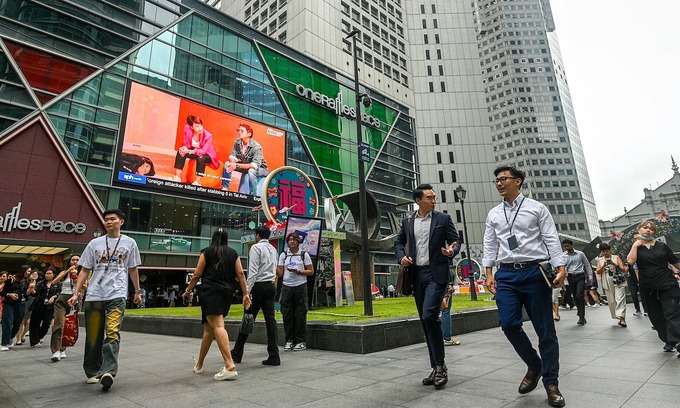
People walk on the street during lunch break at Raffles Place in Singapore on Jan. 22, 2025. Photo by AFP |
The senior leaders the report interviewed, up to 17 of them, largely agreed. Most framed the generational gap as a response to structural pressures rather than soft character, pointing to Singapore’s high cost of living, national service obligations and growing career uncertainty.
A large minority, concentrated in logistics and professional services, worried instead about thinning ambition among the young, in fields where long hours and weekend availability were once non-negotiable.
Artificial intelligence surfaced as its own fault line. Most leaders were confident their firms could capture AI’s value while managing its risks, but were markedly less sure the wider workforce was ready.
The report flagged the bind facing employees told to adopt generative AI tools that could ultimately erode their own roles: “In this context, the rational response is to resist AI rather than embrace it.”
Asked why engagement stays low, leaders pointed outward to market forces and economic conditions, and to the shape of the local economy itself.
Family-owned small and medium enterprises employ about 70% of Singapore’s workforce. “If you look at the employment landscape, it’s largely SMEs and family-owned companies. Sixty-two per cent or so of our listed companies in Singapore are family-owned,” one unnamed executive said in the report.
Another cited a “cutthroat,” high-cost environment that loads productivity expectations onto staff.
What leaders ranked above culture, HR reform and talent density was the manager. “Nothing beats the day-to-day, and how people walk into their job, and feel supported by people that they interact with,” one said in the report.
Yet the same firms that pour development into senior executives and technical training into individual staff have left frontline managers comparatively unsupported, often without the authority to fix what drains their teams.
Even a well-backed manager burns out if the organization never revisits workloads or team size.
The report offered one proof of concept: a Singapore financial-services firm that lifted engagement to nearly four times the national average.
It did so by pairing years of investment in manager capability with deliberate cuts to team sizes, so managers could do the job.
Gallup estimates that disengagement cost the world economy $10 trillion in lost productivity in 2025, about 9% of global GDP. For a services-heavy economy like Singapore’s, the report argued, that drag bites harder than most.
Singapore ranks as the world’s second-richest country by GDP per capita on a purchasing-power basis, behind only Liechtenstein, according to the IMF’s 2026 projections.
Comments are closed.