
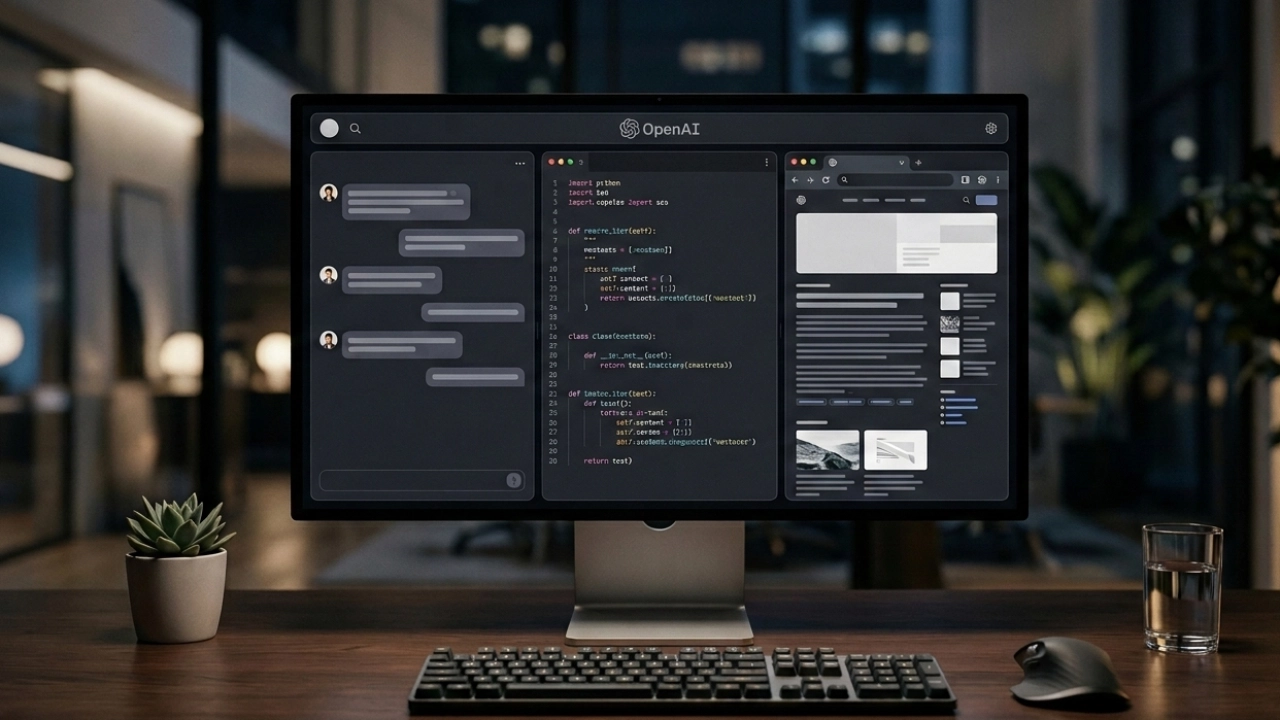

Imagine you open an app to chat with an AI, another to write code, and a third to browse the web with AI assistance. This kind of fragmentation is exactly what the OpenAI Superapp aims to solve by bringing everything into one unified experience.
In mid-March 2026, OpenAI’s Chief of Applications, Fidji Simo, addressed the employees. He said, “We realized we were spreading our efforts across too many apps and stacks. That fragmentation has been slowing us down and making it harder to hit the quality bar we want. ” And hence, you have one superapp to replace all three.
The Fragmentation Problem Nobody Talked About
- OpenAI created ChatGPT, a kind of computer program that talks to people. You can use ChatGPT on the web and on your phone.
- OpenAI developed OpenAI Codex, a tool that helps people write code on computers, usable on macOS and Windows.
- OpenAI developed OpenAI Atlas, a web browser that uses OpenAI to improve its performance.
Hence, you have the following problems.
- Different user bases loyal to different tools
- No unified experience across products
- Wasted internal resources, maintaining parallel stacks
One online comment summed it up: “It feels like I’m assembling furniture every time I need to do something simple. It is irritating.”
What the OpenAI Superapp Actually Offers
| Feature | Current State | Superapp Vision |
| ChatGPT (LLM) | Standalone web/app | Unified desktop hub |
| Codex (coding) | Separate macOS/Windows app | Integrated agent layer |
| Atlas (browser) | Standalone browser | Built-in web layer |
| Agentic tools | Partial CLI/IDE support | Full cross-platform execution |
| Desktop tasks | Limited | Native desktop automation |
Who Benefits Most
Student
- One platform for research, drafting, and coding projects
- Removes the need to toggle constantly
- Learning curve exists as agentic tools aren’t beginner-simple
So, it has high payoffs if you can go through the moderate adjustment period.
Small Business Owners
- Automations can replace separate project management and documentation tools
- Multi-agent workflows handle repetitive tasks on schedule
- Could consolidate several software costs under one subscription
It has strong value, especially for tech-adjacent businesses.
Developers
- Multi-agent parallel workflows already exist in Codex.
- Skills systems extend AI beyond code, with writing, research, and deployment.
- Desktop-native sandboxing keeps security configurable.
So, the developers are the highest immediate gainers among any user group.
Budget-Conscious Users
| Plan | Monthly Cost (USD) | Superapp Included |
| Free | $0 | Limited (Codex trial) |
| Plus | $20 | Yes |
| Pro | $200 | Yes |
| Business/Enterprise | Custom | Yes |
There is no new pricing tier for the superapp; it just rolls into the existing subscriptions.
Families
- Simpler than explaining three different apps.
- One login handles both login and mixed-use cases in one place.
- May feel overwhelming for non-technical users
So, it does have an easier entry point, but simplicity depends on how well you can handle the technical execution.
What Often Goes Unsaid
- Execution risk – Consolidation projects regularly introduce bugs and degraded experiences during transition
- Agentic autonomy – An AI making decisions across your browsers, code editor, and desktop raises real concerns about unintended actions.
- Casual user gap – Sandbox defaults and permission configurations won’t be obvious to everyday users.
OpenAI has addressed security partially, as agents default to restricted permissions and must request elevated access. But that nuance gets lost for most users.
Key Challenges and Trade-Offs
| User Type | Key Benefit | Key Risk |
| Students | Lower friction, one-stop workflow | Learning curve on agentic tools |
| Developers | Multi-agent orchestration | Complex configs for new users |
| Small businesses | Cost consolidation | Transition period instability |
| Families | Simpler access | May feel less focused than single tools |
| Budget users | No extra cost | Value depends on execution quality |
Final Thoughts
The superapp is a strategic idea. Whether it delivers depends entirely on how cleanly OpenAI executes a consolidation of three products without losing what made each one useful on its own. The answer won’t come from a simple press release but from how people actually use it.
Are you already in the OpenAI ecosystem? Then the superapp is worth watching closely. Are you new to AI tools? Then, this is the simplest entry point yet – if the final product lives up to the plan.

Comments are closed.