
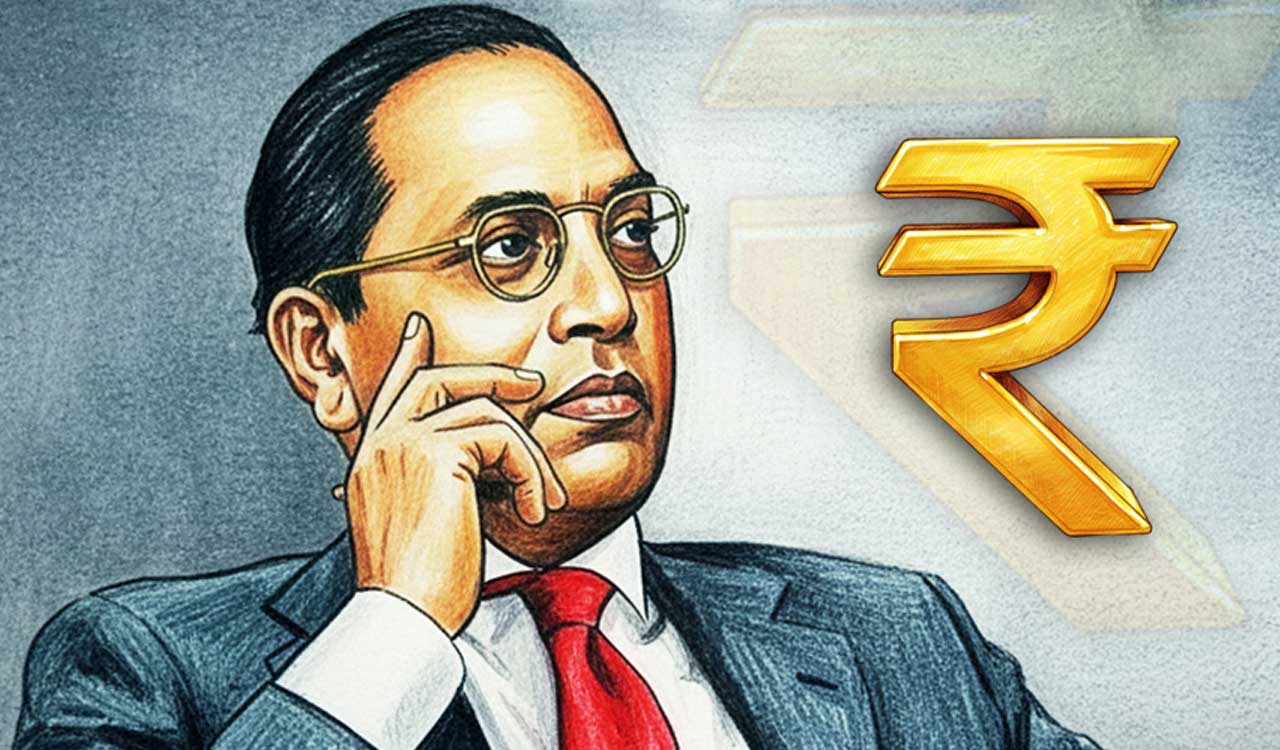

Ambedkar’s century-old work reminds us that a stable rupee is earned over time through credible institutions, clear policy, and structural reforms
Published Date – 26 December 2025, 06:00 PM
By Dr Jadadhahar Chakdhar, Dr Nitin Tagade
Since 2012, the rupee has weakened by approximately 70% against the US dollardeclining from an average of around Rs 53.4 per dollar in 2012 to about Rs 90.7 as of 15 December 2025. When the rupee slides, it rarely remains a “market story”. It quickly becomes a household story, marked by costlier fuel, pricier cooking oil, expensive education abroad, higher input costs for farmers and small businesses, and a general sense that the economy is becoming increasingly difficult to manage. Every fresh bout of depreciation revives an old anxiety: are we becoming more vulnerable to forces outside our control?
In seeking answers, we often jump straight to the usual suspects: US interest rates, geopolitical tensions, oil prices, and risk-off global investors, all of which are essential factors. But there is value in looking beyond the day’s headlines to an older, sharper mind that treated currency not as a technical detail, but as a moral and institutional question. Dr BR Ambedkar’s ‘The Problem of the Rupee: Its Origin and Its Solution’ (1923) was written during a colonial era, yet it reads like a warning addressed to any country trying to maintain its economic stability in an uncertain world.
Money as Confidence
Ambedkar’s starting point is disarmingly simple: money is not just a medium of exchange; it is the foundation of economic confidence. If the value of money becomes unstable, vacillates unpredictably or is held up by artificial arrangements, investment decisions become cautious, trade becomes distorted, and the burden ultimately falls on ordinary people.
In his view, currency instability is not a minor fluctuation; it is a disruption that leaks into prices, wages, savings, and planning. That comprehension remains painfully relevant. A weaker rupee raises the import bill, especially for energy and essential inputs. It can fuel inflation and complicate the job of balancing growth with price stability. Even when depreciation is “explained” by global factors, its consequences are felt locally and immediately.
External Anchors
The second lesson Ambedkar offers is his profound scepticism of rigid monetary regimes that overlook domestic realities. In his time, the gold standard was often regarded as a symbol of credibility. Ambedkar was unimpressed by badges. He was interested in outcomes. His historical analysis showed that tying India too closely to external anchors left the economy exposed to shocks and decisions taken elsewhere. When global conditions tightened, India could be forced into monetary contraction precisely when it needed breathing room.
The question is whether domestic foundations are strong enough to absorb the shocks and swings without turning every episode of depreciation into a national alarm
The details have changed, but the underlying problem remains familiar. The world still operates within a dollar-centric financial system, and US monetary policy continues to send ripples through emerging markets. When the US Federal Reserve tightens, capital can rush out, currencies can weakenand domestic conditions can tighten even if the local economy is doing many things right.
Ambedkar’s point was not that a country can seal itself off from the world. It was that monetary arrangements must protect domestic stability, not surrender it. This logic explains why modern India has sought to build buffers through more flexible exchange rate management, stronger macroeconomic frameworks, deeper financial markets, and the ability to absorb external shocks without panic. In spirit, these are contemporary answers to Ambedkar’s old warning: never outsource your economic stability to an external anchor.
Scientific, Credible Policy
A third thread running through Ambedkar’s work is his insistence that monetary policy must be “scientific”, guided by evidence, clear rules, and institutional discipline rather than convenience or political impulse. He criticised the ad hoc currency tinkering that served administrative or fiscal interests without regard for economic logic. Read in today’s language, he was arguing for credibility: policy that is predictable, transparent, and insulated from short-term pressures.
This is why central banks emphasise communication, data-driven approaches, and rules-based frameworks. When currency markets are jittery, credibility serves as a stabiliser. Mixed signals, sudden interventions without explanation, or perceptions of interference can worsen pressure. Ambedkar’s argument, therefore, was not academic; it was practical. In turbulent times, institutions matter as much as instruments.
Perhaps Ambedkar’s most underappreciated understanding is that currency troubles often reflect deeper structural weaknesses. He did not treat exchange rates as a standalone drama. Instead, he linked currency stability to real economy — trade patterns, production capacity, fiscal behaviour, and productivity. When the real economy is structurally fragile, the currency comes under repeated strain. That diagnosis fits uncomfortably well with many contemporary debates.
A rupee under pressure is not always just a “market reaction”; it can also be a mirror held up to an economy’s dependence on imported energy, its limited export diversification, sensitivity to global commodity cycles, and the uneven productivity gains. Interventions in the foreign exchange market can help smooth volatility, but they cannot permanently substitute for strengthening the fundamentals.
Strategic Risk
Ambedkar also recognised that external dependence is not just a financial risk, but a strategic one. During the colonial period, India’s currency arrangements were influenced by imperial interests, leaving the economy vulnerable to fluctuations in global metal markets and foreign decisions. India is sovereign today, but exposure has not disappeared; it has only changed form. Global portfolio flows can be quick to enter and quicker to exit. Sentiment swings can move exchange rates despite stable domestic indicators.
Ambedkar’s preference would be clear: reduce vulnerability wherever possible. That does not mean rejecting foreign capital but favouring stability over volatility, long-term investment and real productive capacity over short-term gains. It also means strengthening domestic savings and deepening local financial markets so that national development is not hostage to global mood swings.
Institutions and Trust
Finally, Ambedkar repeatedly returns to institutions. He believed currency stability requires a trusted monetary authority — professional, credible, and capable of resisting pressures that compromise long-term stability. This, too, feels contemporary. A currency is partly economics and partly belief. Investors, businesses, and households form expectations about inflation, policy discipline, and the willingness of institutions to take necessary actions. When trust is strong, economies ride out storms with less damage. When trust weakens, storms become crises.
So what does Ambedkar ultimately teach us about the rupee’s present challenges? He would likely reject quick fixes dressed up as grand solutions. He would not be impressed by symbolic gestures or reactive blame games. His message would be steadier and tougher: the value of a currency is an outcome of disciplined governance, credible institutions, and a strong real economy. Global shocks will come and go. Commodity prices will rise and fall. External interest rates will fluctuate. The question is whether domestic foundations are strong enough to absorb these swings without turning every episode of depreciation into a national alarm.
That is why Ambedkar’s century-old work remains relevant. It reminds us that a stable rupee is not manufactured in a single policy meeting. It is earned over time through institutional credibility, policy clarity, and structural reforms that expand productive capacity and export strength. In the end, the rupee’s stability is not just a chart; it reflects national economic resilience and the seriousness with which we build and protect the institutions that underpin it.
(Dr Jadhav Chakradhar is Assistant Professor at the Centre for Economic and Social Studies (CESS), Hyderabad. Dr Nitin Tagade is Associate Professor at the School of Economics, University of Hyderabad)

Comments are closed.