

The Philippine President’s visit marks a shift from symbolic engagement to substantive strategic cooperation amid changing Indo-Pacific geopolitics
Published Date – 30 December 2025, 09:50 PM
By Martand Jha
The visit of Philippine President Ferdinand Marcos Jr to India in August marked the establishment of a strategic partnership between the two nations. The visit assumed a greater importance as the last time a Philippine president made a state visit was in 2007. The two countries signed 13 memoranda of understanding and agreements, covering areas such as culture, defence, digital technologies, science, space cooperation, and tourism.
It has been almost 76 years since both countries established diplomatic ties in 1949. However, meaningful bilateral engagement was recalibrated after India adopted the Act East Policy in 2014. After its independence in 1947, India did not pay much attention to its eastern neighbourhood and instead focused overwhelmingly on its western front. This led to an attention deficit in India’s foreign policy circles towards the Indo-Pacific region.
Interestingly, in 2011, Hillary Clinton, then the US Secretary of State, during her visit to India, urged the country to “act east” instead of merely “looking east.” She underscored the need for India to play a proactive role in the Asia-Pacific region. Policymakers in the Ministry of External Affairs took note of this appeal, and in 2014, External Affairs Minister Sushma Swaraj declared that India was now ready to “Act East”.
Indo-Philippine Ties
The increasing intensity of bilateral cooperation between the two nations signifies India’s larger ambitions in the Indo-Pacific. India seeks to shed its status as an emerging power in the international system and aims to become a rising power. For this to happen, New Delhi has decided not to look at the Indo-Pacific and Oceania as ‘peripheral’ concerns but as areas of immediate concerns. For a long time, India regarded this region as peripheral due to the Cold War geopolitics and the vast geographical distances between its main landmass.
Today, India cannot afford to look away from this region and has, therefore, come up with initiatives such as SAGAR (Security and Growth for All in the Region), which has now evolved into MAHASAGAR (Mutual and Holistic Advancement for Security and Growth Across Regions). The Hindi word sagar means sea, while Mahasagar means ocean. These acronyms reflect India’s increasing maritime interests in the region.
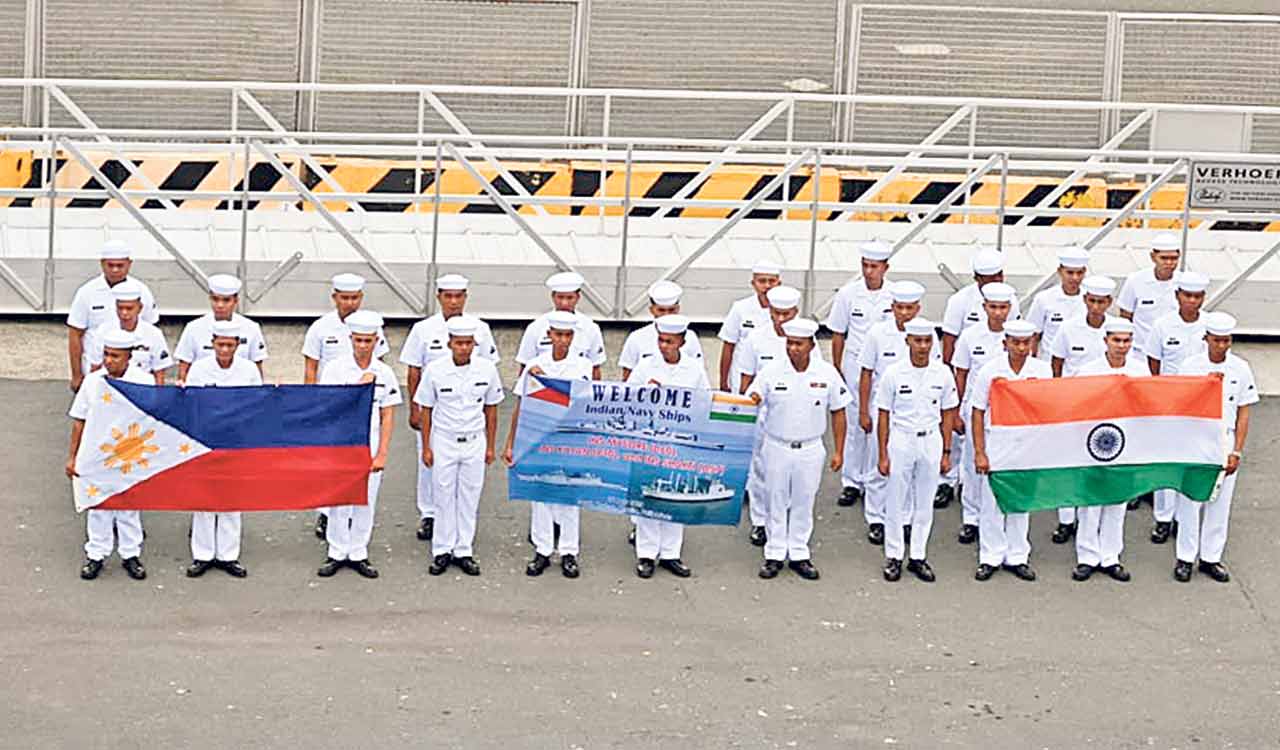
These interests came into sharp focus during President Marcos’ visit when the Philippines and the Indian navies conducted their first-ever joint exercises in the South China Sea, within the Philippine Exclusive Economic Zone. India deployed its three warships — INS Delhi, INS Kiltan and INS Shakti — while the Philippines fielded its two warships — BRP Jose Rizal and BRP Miguel Malvar. The exercises demonstrated a mutual effort to counter China’s assertive behaviour in the South China Sea region.
People Power
Indo-Philippine bilateral ties are no longer merely ceremonial. India’s efforts towards joint naval patrols, the supply of BrahMos missiles, and the strengthening of joint working groups on counter-terrorism indicate a sustainable and long-term strategic vision rather than a symbolic diplomatic alignment.
New Delhi’s growing engagement with the Philippines, and possibly in future towards other Southeast Asian nations, is guided by its vision to counterbalance China’s influence in the region. Any Indian initiative in the Indo-Pacific today inevitably takes China’s presence into account. India needs to intensify its presence in the region, especially as a new international order takes shape under the presidency of Donald Trump in the United States. Strong allies and all-time friends in the Indo-Pacific are crucial for India to balance China while enhancing its own strategic power.
From defence cooperation to maritime security, New Delhi and Manila are aligning more closely as the Indo-Pacific undergoes a strategic churn
India recognises that deeper partnerships are sustained through strong people-to-people ties. Millions of Indians travel to destinations such as Manila, Bali, Singapore, and Kuala Lumpur, underscoring the importance of tourism in strengthening regional engagement. This explains New Delhi’s growing focus on tourism cooperation with the Philippines.
However, India’s partnership with Manila should not be viewed just as a measure to counter China. Instead, it must evolve into a robust and enduring relationship. For the Philippines, acquiring the BrahMos missile system from India significantly enhances its maritime defence capabilities, particularly under its Comprehensive Archipelagic Defence Concept. These missiles strengthen the Philippines’ land-based anti-access, area denial capability, which is critical for defending its archipelago. President Marcos’ visit was substantive, elevating India to the rank of one of the Philippines’ five major strategic partners, alongside Japan, South Korea, Vietnam and Australia.
Shared History
India views the Philippines not only as a strategic partner but also as an important member of ASEAN. The Indo-Philippines diplomatic relations, which started on 26 November 1949 — the day India formally adopted its Constitution — have reached a turning point. In hindsight, this coincidence appears symbolic of the depth of ties the two countries can cultivate. While relations have been elevated to a strategic partnership, they hold potential for deeper cooperation.
The rise of China and the reluctance of the United States to play its traditional leadership role are reshaping the global order. Old alliances shift, new partnerships are emerging. India should seize this moment to enhance its regional stature.
India and the Philippines have shared a history of strong defence tieups, and it has been a pillar of strong bilateral cooperation between the two countries. This was highlighted by the delivery of the first batch of the BrahMos missile system to the Philippines on 19 April 2024. However, India’s large consumer base also presents opportunities for expanding economic ties. Stronger trade relations would reinforce cooperation across multiple sectors. While defence and strategic dialogue remain priorities, it is ultimately people-to-people engagement, supported by rising trade, that will sustain long-term ties.
President Marcos’ visit has opened new strategic conversations in both countries. This may pave the way for India and the Philippines to evolve from strategic partners into close allies, and possibly enduring friends.

(The author is a PhD from School of International Studies, Jawaharlal Nehru University, New Delhi)

Comments are closed.