
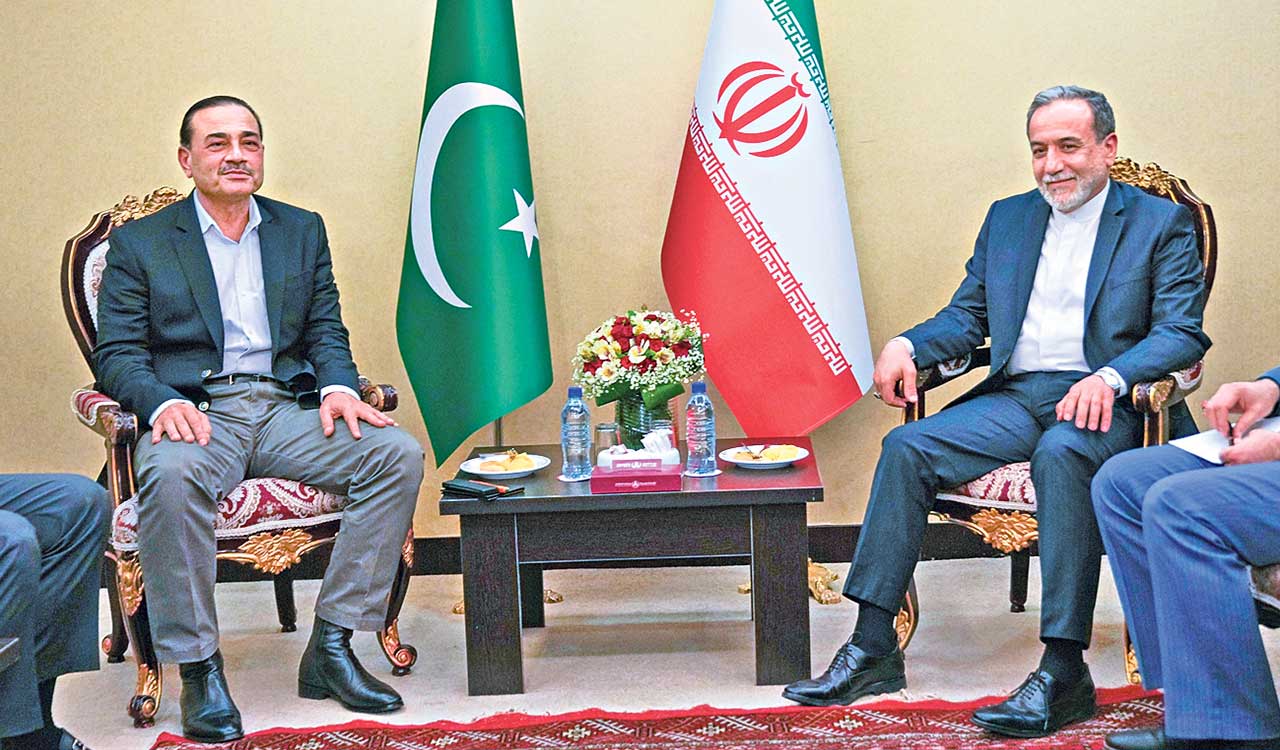

Pakistan’s emergence as mediator between Iran & US-Israel reflects interplay of trust deficits, geographic realities, and economic compulsions
Published Date – 20 April 2026, 12:22 AM
By Brig Advitya Madan
The emergence of Pakistan as a mediator in the ongoing tensions involving Iran, the United States, and Israel has raised important questions about shifting geopolitical alignments. At first glance, this role may appear to signal Pakistan’s growing influence in global diplomacy. However, a closer examination suggests that this development is driven less by strategic dominance and more by pragmatic necessity shaped by regional realities.
To understand why Pakistan has been able to position itself as a mediator, one must begin with Iran’s perspective. Mediation fundamentally rests on trust, and recent events have significantly eroded Iran’s confidence in the Gulf Cooperation Council (GCC) countries — Kuwait, Bahrain, Qatar, United Arab Emirates, Oman, and Saudi Arabia. The recent conflict has underscored this mistrust, with direct hostilities making these nations unsuitable as neutral intermediaries in Tehran’s eyes.
In contrast, Pakistan offers certain advantages. Geography plays a crucial role: Iran shares a long border of approximately 900 kilometres with Pakistan, fostering sustained diplomatic and security engagement. Moreover, Pakistan’s lack of formal diplomatic relations with Israel — rooted in its consistent support for the Palestinian cause — aligns with Iran’s ideological stance. This absence of ties reduces suspicion and makes Islamabad a more acceptable interlocutor.
There is also a sociocultural dimension that cannot be ignored. Pakistan is home to one of the largest Shia populations outside Iran, estimated at around 40 million. While sectarian dynamics within Pakistan are complex, this shared religious linkage provides an additional layer of familiarity that may facilitate communication. By contrast, countries such as Turkey, despite their regional importance, are viewed with caution by Iran due to their membership in NATO, which ties them to Western strategic frameworks.
Pakistan’s defence cooperation with Saudi Arabia further enhances its utility as a mediator. This dual engagement — maintaining ties with both Iran and key Arab states — allows Pakistan to occupy a rare middle ground in an otherwise polarised region.
From the perspective of the United States, Pakistan’s role is also explicable. Under Donald Trump, there has been a renewed, albeit transactional, engagement with Pakistan. Diplomatic gestures and public statements, including favourable references to Pakistan’s military leadership, such as Asim Munir, indicate a degree of political comfort. Additionally, Pakistan’s established relationships with Gulf monarchies make it a convenient channel for backdoor diplomacy.
Yet, interpreting this moment as a sign of Pakistan’s rising geopolitical clout would be misleading. Pakistan’s actions are better understood through the lens of economic vulnerability and strategic compulsion. The country is heavily dependent on Middle Eastern oil imports, and its economy is deeply intertwined with the region through remittances from millions of expatriate workers. Any prolonged conflict that drives up global oil prices would have immediate and severe repercussions for Pakistan’s already fragile economy.
This distinguishes Pakistan sharply from India. While India is also affected by fluctuations in global energy prices, it possesses the financial resilience to absorb such shocks more effectively. Pakistan, by contrast, faces acute fiscal constraints. Rising energy costs could exacerbate inflationary pressures and strain the government led by Shehbaz Sharif, which is already grappling with economic instability.
Internal security challenges further limit Pakistan’s capacity to act as a decisive mediator. Persistent unrest in regions such as Balochistan and Khyber Pakhtunkhwa, along with threats from militant groups operating along the Afghan border, constrain the state’s strategic bandwidth. These domestic pressures underscore the limits of Pakistan’s external ambitions.
It is true that Pakistan’s diplomatic profile has received a boost, partly due to support from China. However, this backing does not translate into the ability to enforce outcomes. At present, Pakistan functions more as a facilitator than as a power capable of guaranteeing a ceasefire. Its influence remains contingent and fragile.
Indeed, the risks are considerable. Should mediation efforts fail, Pakistan could find itself blamed by multiple parties. Moreover, any perceived tilt towards either the United States or Iran carries significant costs — either in terms of domestic backlash or diplomatic alienation from key regional partners.
For India, however, Pakistan’s involvement does not signify any diminution of its own standing. On the contrary, it presents a nuanced opportunity. If Pakistan succeeds in facilitating de-escalation, it would contribute to regional stability — an outcome India should welcome. Conversely, if these efforts falter, India could step into the diplomatic vacuum and assert a more proactive role.
By advocating restraint and calling for cessation of hostilities without overtly aligning with any party — whether the United States, Israel, or Iran — India can reinforce its image as a responsible global actor. Such an approach would also strengthen its claim to leadership within the Global South, emphasising principles of dialogue, balance, and strategic autonomy.
In sum, Pakistan’s emergence as a mediator reflects the interplay of trust deficits, geographic realities, and economic compulsions. It is less an assertion of power than an exercise in necessity. Recognising this distinction is essential to understanding the evolving dynamics of West Asian geopolitics and the opportunities they present for other regional actors, including India.
(The author commanded 15 Punjab in Lebanon in 2007 and Brigade/Sector in Manipur as DIG in 2013. He was Brigadier Operational Logistics Western Command in 2014)

Comments are closed.