

Rohit Kumar
NEW DELHI, Dec 16: The opposition continued to attack the Narendra Modi government over changing the nomenclature of the UPA government’s flagship rural employment guarantee scheme with the Congress claiming it was a direct insult to the ideals of the father of the nation Mahatma Gandhi while the BJP hitting back saying the Congress was uncomfortable with the bill as it carried the name of Lord Ram.
The bill “Viksit Bharat Guarantee for Rozgar and Ajeevika Mission (Gramin) Bill, 2025,” also known VB- G Ram G Bill to replace the “Mahatma Gandhi National Rural Employment Guarantee Act, 2005” (MGNREGA) was introduced in the Lok Sabha on Tuesday by the agriculture minister Shivraj Singh Chouhan amid strong objections by the opposition to the dropping of Mahatma Gandhi’s name.
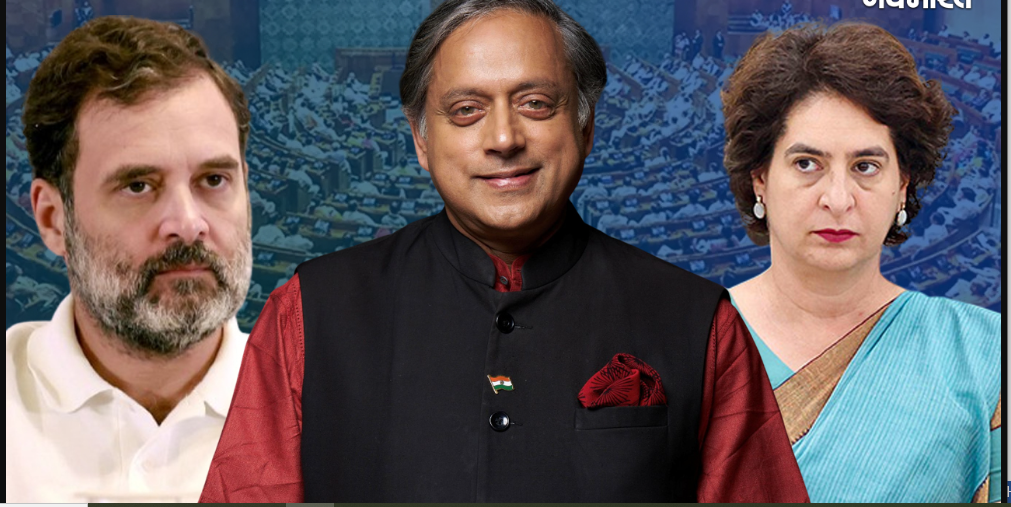
The Leader of Opposition (LoP) in Lok Sabha, Rahul Gandhi hit out at Prime Minister Narendra Modi for the direct insult to the ideals of Mahatma Gandhi, while senior Congress leader Priyanka Gandhi Vadra said the new Bill weakened the law and should be withdrawn. The Wayanad MP also said no law should be passed based on someone’s “whim, ambition and prejudice.” The Congress also staged a protest on the Parliament premises, holding up photographs of Mahatma Gandhi, after whom the MGNREGA is named.
Mr Rahul Gandhi alleged that the MGNREGA had “always unresolved” PM Modi.
In his first reaction to the controversy, he accused the BJP-led government of attempting to weaken the scheme over the past decade. “The Prime Minister Modi has always been irritated by this scheme, and for the past 10 years, he has been trying to weaken it. Today, he is determined to wipe out MGNREGA completely.” in a long post on
While accusing the government of “targeting” the livelihoods of poor rural families, Rahul Gandhi listed the three fundamental principles on which MGNREGA was built: the right to employment, autonomy for villages to decide their own development works, and full wage support by the central government.
The Congress leader alleged that PM Modi wanted to “transform MGNREGA into a tool of centralized control.” He claimed that this would be done by “budgets, schemes, and rules will be dictated by the Centre; states will be forced to bear 40% of the costs; and once funds run out, or during harvest season, workers will be denied employment for months.”
He said the Congress would oppose the “anti-people” bill. “This new bill is a direct insult to the ideals of Mahatma Gandhi. After destroying the future of India’s youth through massive unemployment, the Modi Government is now targeting the secure livelihood of poor rural families,” he wrote on X.
The BJP leader and former Minority Affairs Minister Mukhtar Abbas Naqvi said the Congress’s problem was that the Bill is named after Lord Ram. “They cannot tolerate the inclusion of Lord Ram’s name, which is why they are creating such a fuss.”
Notably, the draft bill aims to provide a statutory guarantee of 125 days of wage employment per financial year for every rural household whose adult members enroll for unskilled manual work.
Under the new proposal, the centre-state fund-sharing ratio will be 60:40 for all states and Union territories with legislatures. However, north eastern states, Himalayan states, and UTs such as Uttarakhand, Himachal Pradesh, and Jammu and Kashmir will have a 90:10 ratio.
Replacing the MGNREGA scheme with VB-G Ram G aligns with the Viksit Bharat (developed India) goal, a government official claimed. “MGNREGA works were scattered across many categories without a robust national strategy. The new act focuses on 4 major types of works ensuring durable assets that directly support water security, core rural infrastructure, livelihood-related infrastructure creation and climate adaptation. The new Act mandates Viksit gram panchayat plans, prepared by panchayats themselves and integrated with national spatial systems like PM Gati-Shakti,” the official said.
In essence, the former is sponsored by the central government. That means 100 per cent of the wages paid to unskilled workers are from its pocket. States bear a fraction of total expenses. The G RAM G bill changes that funding structure, requiring states to bear 40 per cent of the overall costs, and opposition leaders, including those from a key BJP ally – Andhra Pradesh’s ruling Telugu Desam Party – have objected to this, citing increased burden on state finances.
Priyanka Gandhi opposed the Bill under Rule 72(1) of the Rules of Procedure and Conduct of Business in Lok Sabha. “I register my strong objection, MGNREGA has been successful in providing livelihood to rural India and strengthening the rural economy for 20 years. This is such a revolutionary law that when it was brought, all political parties in parliament supported it. This provides 100 days of employment in a year to the poorest of the poor in this country,” she said.
MGNREGA was brought in 2005 by the then UPA government and guarantees 100 days of paid work in a year to every individual in rural areas. The scheme has been hailed as a game-changer for the rural economy over the past two decades.
Priyanka Gandhi said MGNREGA provided work based on demand, and the Centre’s funding for the scheme is also demand-based. The new Bill, however, allows the Center to decide the fund allocation beforehand. She also said while MGNREGA empowered Gram Sabhas to assess the demand for work as per the situation on the ground, the new Bill weakens the role of Gram Sabhas. “The right to employment is being weakened, and this is against our Constitution.”
Priyanka Gandhi pointed out that the Centre’s contribution to the scheme’s funding has been reduced to 60 per cent for most states. “This will impact states’ economy when they are already waiting for GST dues from the Centre,” she said. The Congress leader also questioned the “craze” to change the name of every scheme and pointed out that the Center incurs a cost every time such steps are taken. “Bill should not be passed in haste without discussion and without taking the advice of this House. This Bill must be withdrawn, and the government should bring a new Bill,” she said. When someone from the treasury benches made a “family” remark, she replied, “Mahatma Gandhi is not from my family, but he is like my family member and the entire country feels the same way,” she said.
Besides Priyanka Gandhi, several opposition leaders flagged provisions of the new Bill, particularly the shift from demand-based to normative funding and the reduction of the Centre’s contribution. Her party colleague Shashi Tharoor, too, opposed the Bill, saying it was “immoral to remove Mahatma Gandhi’s name.”

Comments are closed.