
The mother cursed, so ‘Ora-maa’ Took recourse to! What is the story of Japan’s Punch-kun and the mystery of the monkey world?

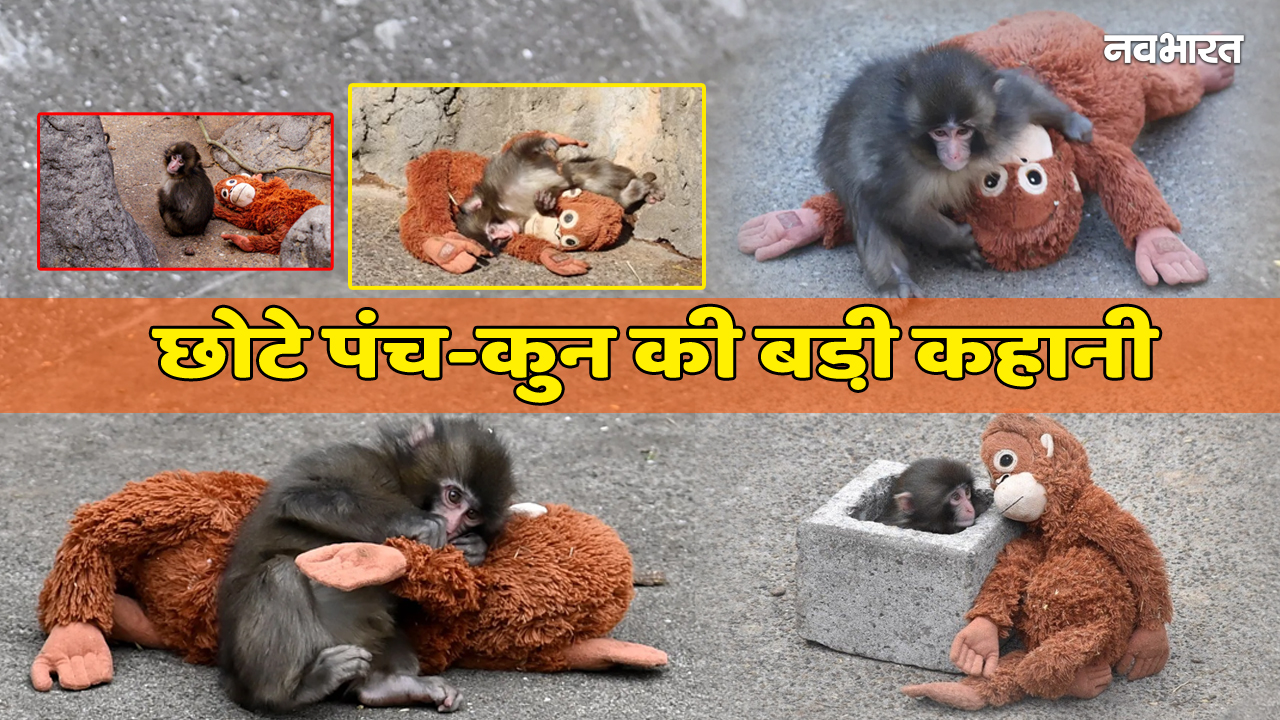
Baby Monkey Punch: A video is going viral on social media in which a baby monkey of macaque species is eating something. Suddenly a big monkey comes and starts dragging him on the ground and spinning him in circles. As soon as this little monkey frees himself from the strong grip of the big monkey, he immediately runs and hugs tightly to an orange orangutan toy kept at a distance. The name of this famous baby macaque of Japan is ‘Punch-kun’ Is.
A huge crowd of people is gathering at Japan’s Ichikawa City Zoo to see the unique antics of little Punch-kun. It is possible that you too must have seen the viral video of this innocent monkey on the internet. But amidst all this, a big question arises that why is a monkey considering an inanimate toy as his real mother? Is this behavior normal in monkeys? After all, what is its real story?
After all, what is the whole story of Punch-kun?
On July 26, 2025, a six-month-old pregnant female macaque gave birth to her first baby at the Ichikawa City Zoo in Japan. The name of this child is ‘Punch-kun’ Kept. Panch-kun weighed only 500 grams at the time of birth. Due to the severe heat at that time and the fatigue of the delivery process, his mother had become very weak physically. Because of this weakness, he did not pay any attention to his newborn child.
Why did Punch-kun’s mother leave him?
Japanese macaques live in groups, but other females in the herd did not adopt Pancha-kun. The zoo staff were forced to bottle feed him from the next day. ‘Science Direct’ According to a report by experts Dario Maestripieri and Kelly A. Carroll, it is not a rare occurrence for macaque females to abandon their babies immediately or within a few days after birth. Macaque females do this frequently for several reasons.
Why do female macaques become aggressive?
Young and inexperienced females often abandon their young early due to the fatigue of childbirth. ‘cortisol’in lactating macaque females. The level of stress hormone increases significantly. Due to this change they become aggressive and abandon the child. Apart from this, females who have spent their childhood in loneliness or under severe stress also become aggressive mothers in future and are unable to take care of their children.
Punch-kun ‘Orangutan’ Why choose?
Zoo staff placed blankets and toys near Punch-kun to comfort him. Of these, Punch-kun bought a stuffed ‘orangutan’ Chose the toy. On social media, people are lovingly calling this toy ‘Ora-Maa’. Actually, innocent Punch-kun has considered this orangutan teddy as his real mother. This is the reason why he does not separate this toy from himself and always keeps it close to his chest.
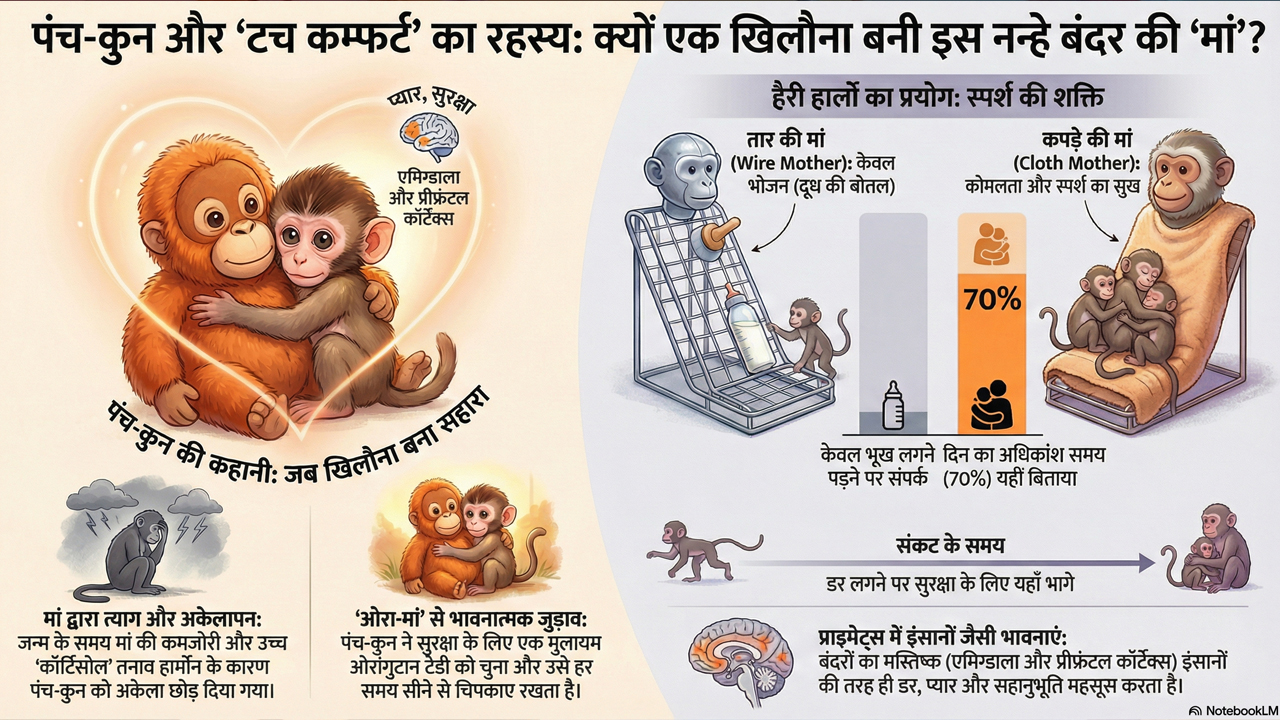
The Story of Punch-kun (Infographic – AI)
Scientists believe that monkeys’ attachment to their mother is not just because of getting food. The real emotional connection between them is ‘touch comfort’ That is, it is formed by touching and hugging. In 1958, American scientist Harry Harlow conducted his famous ‘Monkey Experiment’ This fact was proved through. According to Harlow’s research, touch is the first means of communication between mother and baby, which starts in the womb.
What did Harry Harlow prove in his experiment?
Harry Harlow, during an experiment, removed some newborn monkeys from their original mothers. They were given two artificial mothers – one a wire mother with a milk bottle, and the other a soft cloth mother without milk. Young monkeys in the experiment spent 70% of their time with the cloth mother, while only one hour was given to the wire mother. They would go to drink milk only when hungry and immediately return to their mother with clothes.
More than food ‘touch comfort’ Necessary
Seeing the scary toys, the monkeys stuck to the soft cloth mother for protection instead of the wire mother who was giving milk. Harlow saw that not getting maternal love has very bad effects. Monkeys left alone for three months had less of an effect, but those left alone for a year never returned to normal. This proved that ‘touch comfort’ is more important than food in mental development and mother-child relationship. Or touch is necessary.
Do monkeys have emotions like humans?
Millions of years ago, humans and monkeys had common ancestors. Famous expert Frans de Waal says that emotions are not limited to humans only. Although our senses are more developed, in essence they are not much different from those of monkeys. It has also become clear from neuroimaging studies of the brain that exactly the same parts are present in the brains of monkeys, which give rise to various emotions in humans.
Also read: Rahul Gandhi and PM Modi in Epstein files? The pictures created a huge uproar, the biggest reality came to light!
The ‘prefrontal cortex’ of the human brain. emotions, the ‘anterior cingulate cortex’ to empathy, and the ‘amygdala’ Controls fear. Emotions are controlled by these parts in monkeys also. During stress, cortisol increases in monkeys, just like in humans, which leads to changes like weight loss. Primates like monkeys and chimpanzees, just like us, show clear feelings of happiness, sadness, love, fear, contentment, empathy and humor.
What did Darwin’s experiment prove?
In 1871, scientist Darwin had reported that female monkeys mourn the death of a child and sometimes keep the dead child with them for a long time. Research in 1991 showed that monkeys scratched themselves less when given an anxiety-reducing drug and more when given an anti-anxiety drug. In an experiment with macaque monkeys, they had to pull a chain to get food, due to which their companions were electrocuted. To save their companions from electrocution, the monkeys left their food and stopped pulling the chain.
In another research, the capuchin monkey, who was happy after eating cucumber, refused to eat cucumber after seeing his neighbor getting grapes. According to Frans de Waal, monkeys show complete impartiality. If a monkey gets more or better food than its other companions, it clearly objects to this discrimination against others.
Why did the monkey drag Punch-kun?
On January 19 this year, the zoo administration released Panch-Kun into a huge enclosure with 60 other macaque monkeys. There other members of the herd were seen harassing this little monkey. On February 20, staff reported that an adult female had dragged Panch-kun a long distance. Because Punch-kun was unknowingly going near the female’s baby, she pulled him back to protect her baby.
Will Punch-kun ever be normal?
Ichikawa Zoo administration has set the duties of the employees in such a way that they keep meeting Panch-kun regularly. When workers bring food into the enclosure, the other monkeys keep their distance, but Punch-kun runs and clings to their legs. According to officials, this little monkey is now slowly trying to mix with his herd. Efforts are on to integrate him into the group and soon he will learn a normal life.

Comments are closed.