
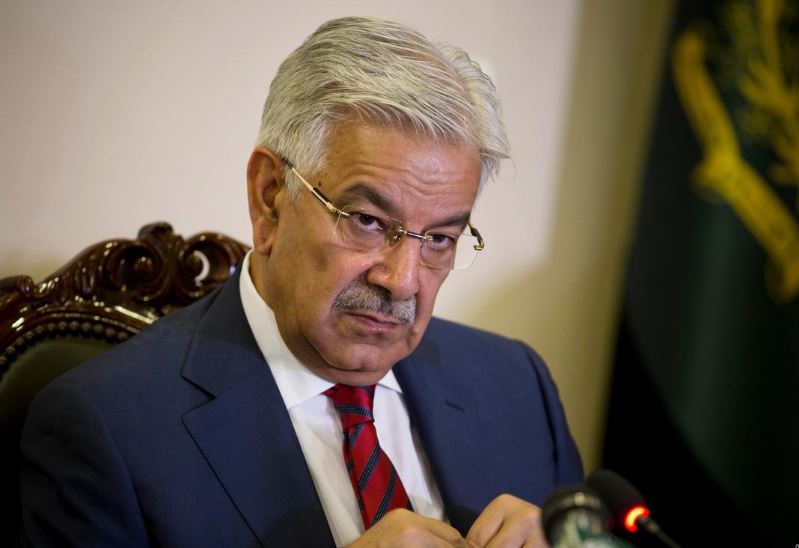

Islamabad: Pakistan Defence Minister Khawaja Asif has termed the protesters in Pakistan-occupied Kashmir as “enemies” like India and ruled out dialogue with them, even as the Joint Awami Action Committee (JAAC) Wednesday claimed that security forces have killed 37 people in the last two days.
“There will be no dialogue with the protesters. I bracket them with India. I put them in the same category as India and consider them as enemies of Pakistan,” Asif told reporters Tuesday.
However, the Prime Minister’s Adviser Rana Sanaullah told reporters that the JAAC held a meeting with him and presented its 38 demands.
Alleging that the protesters want to seize Muzaffarabad and Mirpur through force, Sanaullah on Tuesday claimed that they were currently engaged in an “India-like attack”.
Sanaullah claimed that no one was killed in clashes between the law enforcement personnel and protesters.
However, the JAAC, a collective of activist groups, Wednesday said that 37 unarmed peaceful protesters and people, including women and children, who were not even protesting, have been killed by Pakistani forces in the last two days. The party’s claim could not be independently verified.
It said the violence erupted Monday when the JAAC launched a long march, coinciding with the first phase of polls for the so-called legislative assembly in PoK.
In a statement, the JAAC said that a large number of people are critically injured with bullet wounds. “Hospitals are under forces’ control, doctors have been removed, medical stores have no medicines left. Volunteers who try to pick up the dead or injured are also being fired upon,” it said.
It urged ‘Doctors Without Borders’ to immediately send independent international medical teams to Rawalakot.
Meanwhile, shops and markets in Mirpur remained closed Wednesday, BBC Urdu reported.
The authorities have suspended internet services in the region. Besides, there has been a complete media ban in Pakistan on the coverage of the JAAC protest.
Speaking to Geo News on Tuesday, Sanaullah said that militants once trained by Pakistan eventually turned their guns against the country.
The protesters in PoK are similar to the ‘mujahideen’ whom Pakistan had trained in the past, but later they turned against us, Sanaullah said while responding to questions about the unrest in PoK.
This candid reference appeared to acknowledge the long-term consequences of Pakistan’s policy of supporting and training militants.
He said the protesters included members of organisations with access to weapons with “no genuine political demands”.
“They want to use people as human shields and play a game,” he said, adding that the law-enforcement agencies had no option but to act against the protesters.
Pakistan’s involvement with militant groups during the Afghan war and their subsequent activities has long been the subject of international scrutiny.
Several studies have documented the state’s support for militant groups operating in Afghanistan and Kashmir, while also tracing how parts of the militant infrastructure later contributed to violence inside Pakistan.
In the first phase of elections held Monday in 13 seats, the Pakistan Muslim League-Nawaz secured nine seats, while the Pakistan Peoples Party got four. The second and third phases of the remaining 32 seats will be held August 2 and 10, respectively.
It is a direct contest between the two parties in PoK because former prime minister Imran Khan’s party Pakistan Tehreek-e-Insaf, has boycotted the polls. The first phase of the election was marred by violence and massive rigging allegations.
The JAAC has been holding a series of protests in PoK since last month over 12 contentious seats of the so-called regional legislative assembly. It alleges that the establishment manoeuvres these seats to install a prime minister of its choosing.
India Tuesday described the elections as an attempt by Pakistan to camouflage its illegal occupation and hide its “grave” human rights violations in the region.
“India’s position on this matter has been clear, consistent, and well known. The entire Union Territories of Jammu and Kashmir, and Ladakh, including the areas currently under Pakistan’s illegal and forcible occupation, are integral and inalienable parts of India,” External Affairs Ministry spokesperson Randhir Jaiswal said in Delhi.
“As we have stated earlier, the ongoing mass protests in Pakistan-occupied Jammu and Kashmir are the direct consequences of Pakistan’s economic exploitation, its denial of the people’s fundamental rights, and its administrative oppression,” he said.
The JAAC began protests and a long march across PoK June 9. Before Monday’s violence, 40 people had reportedly been killed during the unrest, including 34 protesters and six police and paramilitary personnel.
The government had opened negotiations with the JAAC to end the protests before the legislative assembly elections, but the talks have so far failed to yield a settlement.
There are 53 seats in the so-called PoK legislative assembly – 45 are directly elected, while eight are reserved for women, technocrats and clerics.

Comments are closed.