
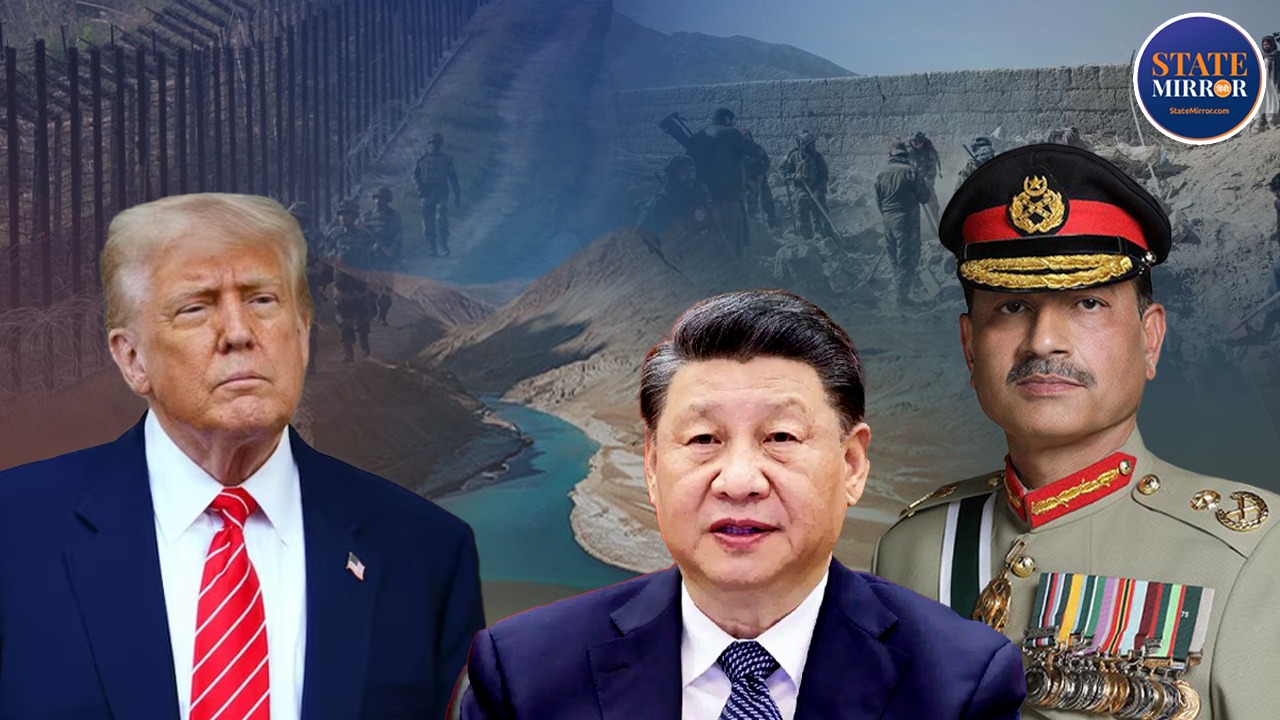
Iran is a peacemaker in the war, an aggressor in Afghanistan and a threat to India, what does Pakistan want and where is it getting its ‘fuel’ from?

On one hand, Pakistan presents itself as a mediator and “peacemaker” in the Iran crisis, on the other hand, the same Pakistan takes military action in Afghanistan. Whereas he continuously gives aggressive statements against India on Indus water, border security and strategic issues. In recent times, it has increased diplomatic activity regarding India and Bangladesh also. At first glance, this policy of Pakistan appears contradictory, but if its security policy, role of army, domestic politics and regional geo-politics are seen together, then it appears to be a multi-layer strategy.
Three different fronts, but one strategy
Pakistan Today it appears active on three different fronts, but there is a common objective behind all three. The first front is Iran, where Pakistan wants to present itself as a responsible regional player and peace-building country. The second front is Afghanistan, where by taking military action across the border, it wants to give the message that it can go to any extent for its security interests. The third front is India, where it wants to keep its traditional security policy and domestic political discourse strong by continuously making strong statements.
If we look at these three fronts together, Pakistan is trying to remain important to many powers simultaneously. It wants to show itself as a country without which the security picture of South Asia and West Asia is incomplete.
peacemaker in iran
Iran crisis is a big diplomatic opportunity for Pakistan. There is a border of more than 900 kilometers between Pakistan and Iran and security challenges between the two countries have existed for a long time. Balochistan region has been a sensitive area for both the countries. Apart from this, Pakistan has relations with different power centers like China, Saudi Arabia, Gulf countries and America.
Pakistan wants to present itself as an influential country in the Muslim world. It has nuclear weapons and wants to increase its role in international crises. By trying to mediate in cases like Iran, it wants to send the message that it is not only a country with security problems but also a part of the regional solution.
There are economic reasons behind this also. Pakistan has long been dependent on foreign investment, international aid and cooperation from Gulf countries. Therefore, it wants to maintain its strategic usefulness so that big countries cannot ignore it.
Why is Pakistan bombing Afghanistan?
This is where the biggest contradiction of Pakistan’s policy is visible. While in Iran he speaks the language of conversation, he takes military action in Afghanistan. Pakistan says that its biggest concern is Tehreek-e-Taliban Pakistan i.e. TTP.
Pakistan alleges that TTP fighters use the land of Afghanistan to carry out attacks in Pakistan. The past years have seen an increase in terrorist incidents in Pakistan, especially in the Khyber Pakhtunkhwa and Balochistan regions. On this basis, Pakistan calls the cross-border action self-defense.
On the other hand, the Afghan Taliban government denies these allegations and calls Pakistan’s action against its sovereignty. This is the reason why tension has increased in the relations between the two countries. Pakistan argues that it is taking action against terrorism, while Afghanistan considers it an attack.
Why the continuous threats to India?
India has been the oldest center of Pakistan’s security policy. There were wars between the two countries in 1947-48, 1965 and 1971, while the Kargil conflict occurred in 1999. Today both countries are nuclear weapon possessing countries.
Due to India’s growing economic, diplomatic and military power, India still remains the biggest issue in Pakistan’s security discourse. Pakistan’s army has been considering India as a major security challenge for a long time, due to which its role remains strong.
The Indus Water Treaty has also become a major issue of tension between the two countries. This treaty, brokered by the World Bank in 1960, had decided the distribution of river water between the two countries, but from time to time the water issue has become a political and strategic weapon.
Earlier, Pakistan’s Defense Minister had threatened India with war, now the Climate Change Minister Musadiq Malik has given a strong statement on this issue and said that if anyone tries to touch Pakistan’s waters, we will respond by cutting off his hands. His statement has come at a time when there is tension between the two countries on the issue of water resources and terrorism.
Where is he getting this ‘fuel’ from?
The fuel of Pakistan’s aggressive policy is not just weapons but many political and strategic reasons. The biggest reason is its internal security challenge. TTP, Baloch insurgency and border instability have increased the pressure on Pakistan’s army.
When the security crisis increases in a country, the role of the army increases. The military in Pakistan has historically been influential in foreign policy and security policy. Army thinking is considered to have a major impact on India policy, Afghan policy and regional strategy.
To understand Pakistan’s aggressive and multi-layered strategy, it is important to see from where it gets support and strategic space. China’s role in this is considered most important. China provides military cooperation, economic investment and diplomatic support to Pakistan. China has a big strategic presence in Pakistan through CPEC.
The role of Saudi Arabia is important in terms of economic and energy security. In times of crisis, financial assistance from Gulf countries provides relief to Pakistan.
America’s role has been changing. America maintained security relations with Pakistan from the Cold War to the anti-terrorism era, but now its relationship is not the same as before, but in Trump’s second term, Pakistan has once again sat in its lap. This is the reason why Trump is openly supporting Pakistan. Whereas with India, the pretense of doing good in front of the world is a strategy to cause harm behind the scenes.
Türkiye is a political and defense partner of Pakistan, which appears close to it on many issues in international forums. While China, America and Saudi provide economic and strategic fuel, Türkiye provides political support.
The equation of domestic crisis and external threat
Pakistan has been going through economic and political crisis for a long time. Inflation, unemployment, foreign debt and political instability have increased the pressure on governments.
In such an environment, the issue of external threat occupies more space in domestic politics. Anti-India statements sometimes become a medium to garner political support and divert public attention from internal problems.
Balance between China, America and Gulf countries
A major part of Pakistan’s strategy is related to regional geopolitics. China is its biggest strategic partner. China-Pakistan Economic Corridor i.e. CPEC is associated with projects worth billions of dollars.
But Pakistan also wants to maintain relations with America, Gulf countries and Iran. Its effort is to remain important in some way or the other for every major power centre.
Is Pakistan playing a double game?
Many experts consider Pakistan’s policy as a multi-vector strategy. That means talks with Iran, partnership with China, contacts with America, relations with Gulf countries, pressure on Afghanistan and strict security policy against India.
This policy certainly seems contradictory, but Pakistan calls it an attempt to strike a balance according to its national interests.
What are the biggest threats?
If Pakistan remains active on many fronts simultaneously, it may face many dangers. Its biggest challenges are the long conflict with Afghanistan, TTP attacks, instability in Balochistan, tension with India and economic pressure. History shows that a strategy of being active on multiple fronts for a long time can prove costly for any country.
What does it mean for India?
This policy of Pakistan towards India is not just a matter of rhetoric. New Delhi will have to keep a constant eye on Pakistan-Afghanistan tension, situation in West Asia, energy security, border security and anti-terrorism strategy.
India has to understand that every move of Pakistan is not only India-centric, but it is also trying to strengthen its place among China, America, Iran, Afghanistan and Gulf countries.

Comments are closed.