
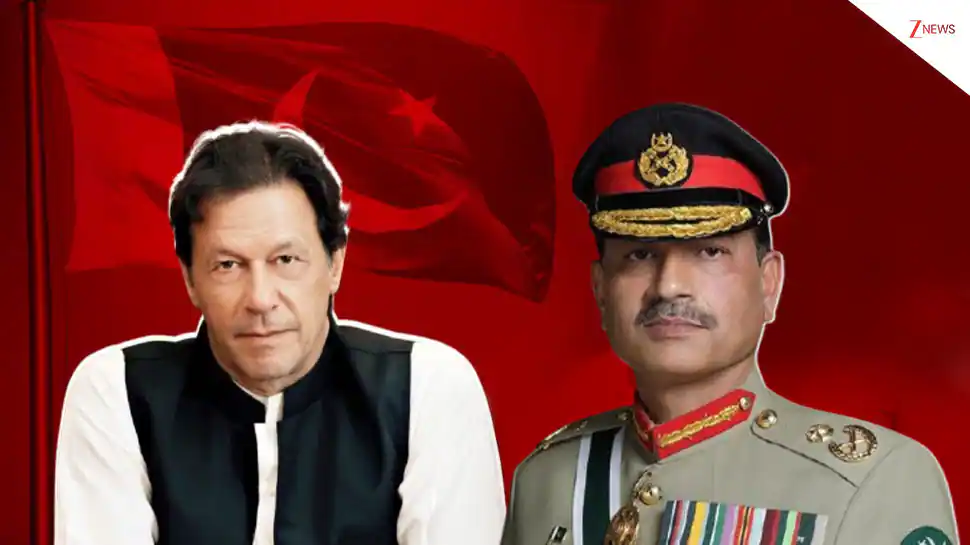
Pakistan’s political vendetta: Asim Munir’s attrition state and the blinding of Imran Khan. world news

For Pakistanis across the globe, Imran Khan’s worsening health in Adiala Jail is not a matter of routine “prison administration.” It is a portrait of what Pakistan has become under Field Marshal Asim Munir—a country where the state no longer needs to execute opponents; it simply manages their decay.
The reported loss of roughly 85% of Khan’s vision in his right eye is not an isolated medical mishap. It fits into a broader architecture of power constructed since Munir took command—an architecture that thrives on delay, denial, controlled access, and narrative suffocation. Reuters reported that Khan had experienced blurred vision for months and that his legal team alleges medical care was delayed. His party has accused authorities of negligence that endangered him in custody. The Associated Press similarly reported that Pakistan’s Supreme Court ordered a medical examination after Khan complained of severe vision loss, amid disputes over whether treatment had been timely and transparent. This is what “law” looks like when subordinated to a command-and-control state: procedures become instruments, and bureaucracy becomes plausible deniability.
A System That Doesn’t Forget — It Calculates
Add Zee News as a Preferred Source
Khan’s vision loss matters because of what it implies about intent—not necessarily intent proven through a signed directive, but intent revealed through pattern. Complaints are acknowledged yet not meaningfully escalated. Examinations occur without credible diagnostic depth. Specialist access is filtered through institutional gatekeepers. Intervention arrives only after the window for reversibility has narrowed.
PTI’s objection to the court-ordered medical process—describing it as “malicious” and protesting the exclusion of family members and personal doctors—highlights the central issue–control. A medical board convened inside a jail, without independent oversight, risks becoming a controlled stage set—sufficient to tick procedural boxes, insufficient to safeguard life or dignity.
This is the Munir model–just enough process to deflect outrage, never enough care to prevent irreversible damage.
The Jail Is Not Separate From the State — It Is the State
To separate Khan’s health crisis from politics is to misunderstand how Pakistan has been governed since Munir became army chief. Major international reporting has described him as the figure widely seen as having engineered the crackdown on Khan and PTI after they challenged military intervention. That broader context matters because prisons do not operate in a vacuum. In Pakistan’s power structure, the “establishment” is not a metaphor; it is a governing method. Al Jazeera has documented the military’s long-standing decisive influence over civilian politics, both direct and indirect. When governance is built on managed outcomes, the prison becomes another instrument of outcome management.
The UN Warning: Conditions Are the Framework
A UN human rights expert raised concerns about Khan’s reported detention conditions, citing restrictions resembling solitary confinement, confinement for 23 hours a day, and severely limited outside access. Medical deterioration in such a setting is rarely “just medical.” When access to outsiders is tightly restricted, oversight constrained, and information flow carefully managed—especially when the detainee is politically central—health becomes inseparable from power.
When an international human rights office flags detention conditions as potentially inhumane, it strips away the establishment’s preferred defense that everything is “routine.” Routine does not require isolation and information throttling. Routine does not escalate into a Supreme Court-monitored national crisis.
Munir’s Posture: Punitive, Not Reconciliatory
Munir’s public posture toward dissent, particularly after May 9, has been framed in uncompromising terms. Reporting has highlighted remarks rejecting “compromise” with those described as planners or architects of unrest—reflecting an institutional posture that leans punitive rather than conciliatory. That posture shapes how the state treats a figure like Imran Khan: not as a prisoner with rights, but as an adversary to be broken slowly under a shield of procedural compliance.
Entrenched Power, Diminished Accountability
Munir’s formal elevation and continued tenure have further consolidated his authority. Reporting has also described structural moves expanding military command power and insulating top leadership from challenge—developments critics argue deepen authoritarian drift. In a system where the apex security figure enjoys expanded institutional dominance and legal insulation, the relevant question is no longer whether abuse is directly ordered. The question is what mechanism remains capable of stopping it.
When power is shielded from consequence, neglect becomes policy without ever being written down.
Structural Responsibility
It is not necessary to claim that Munir personally blocked medical access, nor to produce a conspiracy memo. His responsibility is structural. He presides over the post-2023 crackdown ecosystem widely described as engineered under his command. That ecosystem relies on controlled access, institutional compliance, and information management—the same elements visible in the opacity surrounding jail medical care. His uncompromising posture toward dissent is mirrored in a system that treats a political rival’s rights as conditional. His entrenched authority weakens the checks that might otherwise compel transparency in the treatment of a high-profile detainee.
Khan’s eye is therefore not simply a medical issue. It is emblematic of governance by attrition.
Not Martyrdom — Diminishment
The establishment appears to understand that martyrdom can galvanize. A dead opponent can become immortal. A diminished opponent is more manageable. The cruelty, therefore, is incremental: delay instead of outright denial; restriction instead of formal prohibition; opacity instead of overt fabrication; Treatment calibrated to sustain life while eroding capacity.
Allegations of negligence resonate precisely because they align with a pattern of operating in gray zones where accountability dissipates. Harm becomes paperwork. Paperwork becomes insulation.
The Indictment
Field Marshal Asim Munir does not need to sign an explicit order to bear responsibility. In systems structured around centralized command and institutional compliance, responsibility flows from climate and design.
If a former prime minister can lose most of his vision in custody amid persistent allegations of delay and restricted oversight, the message is stark. Under this system, the state does not merely imprison opponents; it manages their deterioration.
If this can happen to Pakistan’s most prominent prisoner—a former prime minister, World Cup-winning captain, and one of the country’s most consequential political figures—then ordinary citizens can draw their own conclusions about the protective value of “law,” “procedure,” and “institutions.” Those mechanisms risk becoming instruments rather than safeguards.
What Must Happen Next
Independent specialist access outside jail control is essential, with transparent reporting to the court and family. Full public disclosure of timelines—when complaints were made, referrals requested, approvals granted or delayed, and treatments administered—must follow. Detention conditions flagged by the UN expert require sustained international scrutiny.
Without transparency, an attrition-based model of governance will continue to convert harm into documentation—and documentation into immunity.

Comments are closed.