


India’s fintech ecosystem is expanding rapidly, yet early stage startups face a tougher path in building institutional-ready businesses, securing the right banking partnerships and establishing ecosystem trust for sustainable growth
To help early stage fintechs overcome these challenges, PayU has introduced several initiatives like inFINity, a flagship accelerator that offers an opportunity for founders to validate product–market fit, sharpen go-to-market strategies, unlock distribution access and build for institutional scale
Through such initiatives, PayU has supported over 60 startups, while linking selected founders to operators and fintech-focused investors to improve scale readiness
India has the world’s third-largest fintech ecosystem, with a market opportunity projected to exceed $2.1 Tn by 2030. However, this massive potential is shadowed by a sobering reality: innovation alone is no longer a guarantee of survival. While the ecosystem is teeming with creative solutions, 61% of investors cite a lack of Product-Market Fit (PMF) and 48% point to cash flow issues as the primary killers of Indian startups. In the fintech sector specifically, the hurdles are even more specialised.
For many founders, the gap between building a great product and creating an institutional-grade business, one that can stand the test of time and scale without operational overstretch, remains the most challenging phase of their journey.
This transition is further complicated as the Indian fintech landscape becomes increasingly dense, with more than 10,200 startups vying for market share. As the competition intensifies and landscape matures, early stage fintechs require support and guidance to navigate regulation, access scale-grade infrastructure, build distribution, and become capital-ready.
In this milieu, fintech platform PayU intends to give back to the ecosystem by acting as a mentor to the early stage fintech founders by offering the right access, enabling early stage founders to successfully navigate complex roadblocks and help them scale sustainably, thereby contributing to India’s vibrant startup ecosystem. Through numerous initiatives under PayU for Startups, an umbrella programme designed to help early stage startups build, launch, and scale through tailored payment solutions, startup perks, expert guidance, and much more, inFINity has supported 60 startups till date.
Building on this foundation, PayU has announced the latest edition of its flagship accelerator, inFINity 3.0to bridge the gap between product innovation and institutional readiness. The third edition, which is already live, will offer 30 promising founders a compressed, four-week sprint to refine their strategies, access direct capital pathways, and integrate with PayU’s extensive merchant network. Applications to inFINity 3.0 are open till March 15, 2026.
By consolidating mentorship and investor access into a single roof, the programme aims to shrink months of trial-and-error into weeks of execution.
Institutional Readiness With inFINity 3.0
Over its first two editions, inFINity received over 1,000 applications and supported more than 60 startups, including Onfinance, Paytring, Kustodian.life, Assurekit, Finzace and Carepay. Startups gained access to PayU’s merchant network of businesses, secured distribution partnerships, improved market credibility and unlocked ecosystem opportunities such as grants, stalls at national startup events, and commercial integrations.
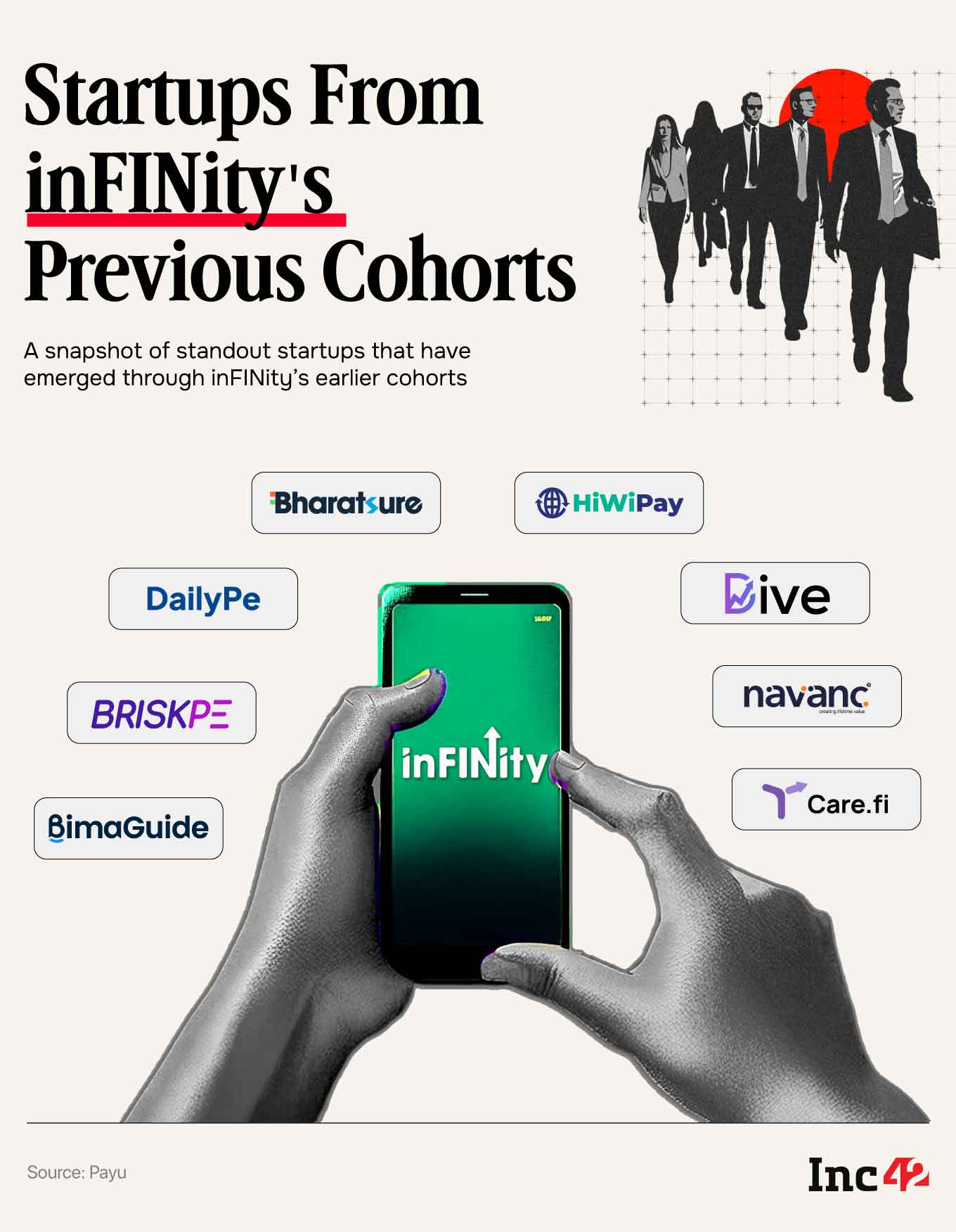
PayU’s inFINity 3.0 represents an evolution from this foundation, with a sharper focus on validating product–market fit, sharpening Go-To-Market strategies, unlocking distribution access, and building for institutional scale. The programme begins with cohort curation led by PayU and supported by Atrium Ventures, ensuring that participating startups show strong fundamentals and long-term scale potential.
Selected founders then enter a four-week accelerator phase working closely with experienced operators and investors to refine go-to-market strategysharpen storytelling and prepare for investor and partnership conversations.
By consolidating learning, mentorship and execution into a defined sprint, inFINity aims to shrink months of trial-and-error into weeks. Founders receive operator-led guidance on pricing, compliance strategy, distribution design and scale economics – areas where early stage fintechs often stumble.
The programme culminates with an in-person Bootcamp and Demo Day in Bengaluru. Designed as a focused environment for learning, exposure and capital access, the event brings together cohort startups, alumni, merchants and fintech-focused investors. The Demo Day enables each startup to engage with multiple venture capital firms in a short span, maximising the probability of follow-on conversations.
More than a traditional accelerator, inFINity functions as a long-term ecosystem for fintech founders. Its primary differentiator is the breadth of access it provides—connecting participants with industry experts, and a peer network of active innovators. This high-trust environment is designed to support founders beyond the initial cohort timeline, offering a sustained community that assists with strategic guidance and acceleration at various stages of growth.
“India’s fintech ecosystem is at an inflection point, with budding founders solving real problems and driving economic impact at scale. Through inFINity, our endeavour is to connect these innovators with the right investors, mentors, and other relevant market forces they need to scale. It’s our way of giving back to the ecosystem that’s reshaping India’s financial future,” said Anirban Mukherjee, CEO, PayU.
Atrium Ventures’ involvement further strengthens the bridge between acceleration and funding. As additional benefits, the selected cohort will also get to unlock up to $10,000 in AWS Cloud Credits per startup (subject to eligibility), alongside exclusive masterclasses from industry stalwarts such as Umang Kumar, cofounder & CEO, Cardekho SEA, and Nitin Jain, cofounder, Ofbusiness.
inFINity 3.0, will focus on fintech segments, including consumer fintech, banking infrastructure, embedded finance, insurance tech, wealth tech and AI.
Operator-Led Community For Early Fintechs
“At PayU, we provide founders the infrastructure to launch on, and a community to scale with. Through our Infinity accelerator, we’re giving fintech founders what they actually need to scale: mentorship from people who’ve built and scaled businesses, peer learning with fellow founders, enterprise-grade infrastructure, and clear paths to capital. It’s about creating a community where startups grow together and strengthen India’s digital economy”, says Vineet Sethi, chief growth and marketing officer, PayU.
To democratise innovation beyond metro hubs, PayU has forged strategic alliances with DPIIT (Startup India) and state bodies in Karnataka and Uttar Pradesh.
PayU’s participation in policy roundtables and its collaboration with Startup India, state governments on investor summits and roadshows have collectively helped build what the company describes as a State-to-Scale pipeline.
A Long-Term Roadmap For Fintech Ecosystem
PayU believes the next wave of breakout companies will emerge from infrastructure-led innovation and embedded financial experiences – models where financial capabilities are integrated into broader customer journeys rather than offered as standalone products.
As the Indian fintech landscape matures, the focus is shifting from pure-play innovation to the creation of sustainable, high-utility financial infrastructure. The Inc42 State of Indian Fintech Report highlights a critical transition toward ‘disciplined growth’ with actual industry revenue expected to settle in the range of $190 Bn to $250 Bn. This trajectory is anchored in the massive expansion of India’s digital user base, which is forecasted to exceed 1.2 Bn internet users and 1.5 Bn smartphone users by the end of the decade, providing a deep-tier foundation for scale.
The outlook for 2026 and beyond suggests that digital lending will remain the primary engine of the ecosystem, capturing over 60% of the overall market opportunity and generating roughly $133 Bn in revenue by 2030.
As demand for digital financial services expands and AI reshapes business models across sectors, fintech innovation is entering a more complex phase. New technologies are lowering entry barriers while simultaneously raising expectations around reliability, compliance, security and scale. For early stage startups, the challenge is no longer just building differentiated products, but building organisations capable of operating in a tightly regulated, high-trust environment.
As India’s fintech ecosystem matures, the role of established, scaled players will become more critical, providing infrastructure, distribution access, regulatory know-how and institutional credibility that young startups typically take years to build. Sustained progress will depend not only on breakthrough ideas, but on how effectively these support structures help promising companies move from innovation to durable scale.

Comments are closed.