
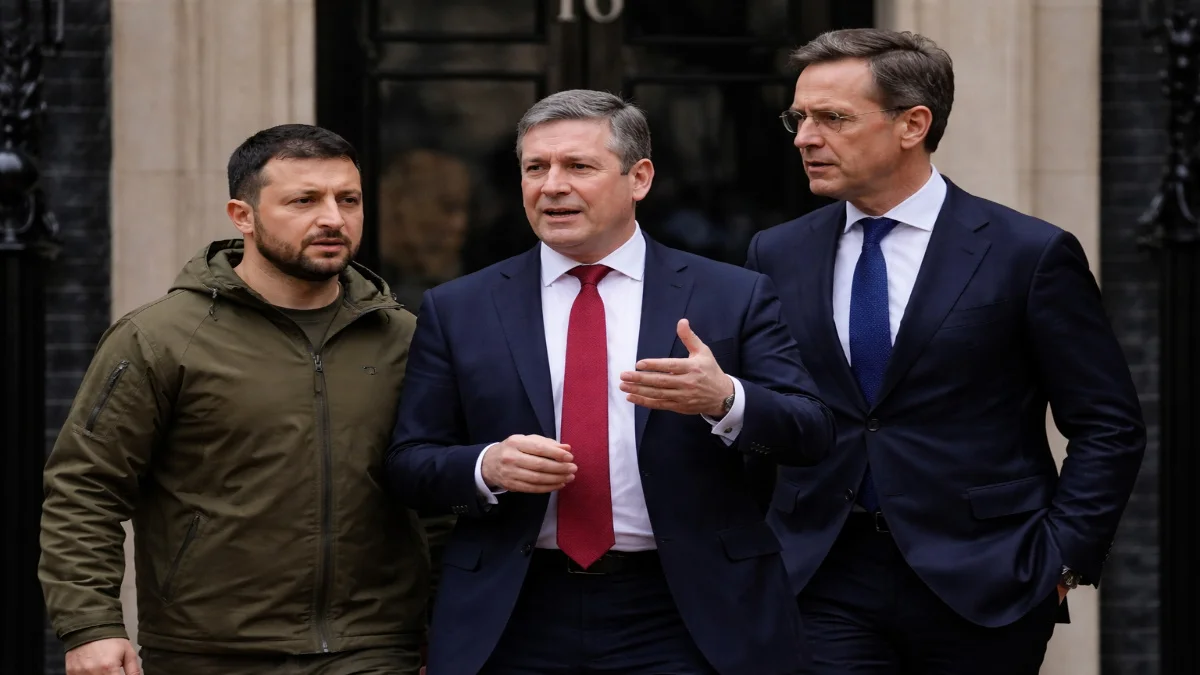

The expected meeting in London, during which President Volodymyr Zelenskyy will be accompanied by Prime Minister Keir Starmer and former Dutch Prime Minister Mark Rutte, will coincide at a time when the so-called localized conflicts have developed into interconnected arenas which define the structure of international law, diplomacy, and security. Where the war in Ukraine continues against the background of growing tension both in Iran and the whole Middle East, the legal and geopolitical contexts governing warfare, sanctions, and state responsibility are being put through an intense test on the fly.
The ban on the use of force, provided in the United Nations Charter, in Article 2(4) is at the center of the conflict in Ukraine as it is one of the most fundamental principles of modern international law. Aggression by Russia in the territory of Ukraine, which has already gained extensive criticism among the world community, is considered an invasion of the sovereignty and territorial integrity of Ukraine. This is not just a political statement, but a legal value, supported by decades of judicial history and state experience, which has been developed since the end of the Second World War.
The right of Ukraine to self-defence is based on Article 51 of the UN Charter providing the right to collective and individual self-defence as a natural one. The military and financial aid that was offered to Kyiv, such as the young UK-Ukraine drone cooperation, can be viewed through this jurisprudential perspective. Other states like the United Kingdom claim that they are engaging in lawful collective self-defence and not illegal intervention.
However, the fast changing status of the advanced technologies, especially unmanned aerial vehicles and warfare with the elements of artificial intelligence, is fraught with complex legal challenges. The emergence of collaborative drone manufacturing programs between the United Kingdom and Ukraine is an indication of a wider change to autonomous and semi-autonomous systems in warfare. The international humanitarian law (IHL) and the Geneva Conventions in particular requires any weapons system to be in line with the principles of distinction, proportionality and necessity. The use of drones be it by Ukraine in its attacks on Russian soil or by Russia in its attacks on Ukrainian cities should be in accordance with these principles regardless of the level of technology.
The subsequent legal ambiguity is the reported increase in drone attacks on Moscow and other locations. Although Ukraine can argue that this type of strikes is a legitimate military response to a warring country, the international law assumes significant restrictions on the capacity to strike civilian infrastructure and civilian population. The use of attacks that target pure civilian objects or result in disproportional damages may be a violation of IHL, and this may be a war crime.
At the same time, the vast use of drones and missiles by Russia in Ukraine, as well as the destruction of civilian infrastructure, in places like Zaporizhzhia, is no less open to scrutiny. Reports of many drones being used and many intercepted highlight the severity of the war as well as the growing use of remote warfare. Independent verification is still necessary but the trend of attacks on urban centers leaves much to be desired as an action against the law of indiscriminate or disproportionate actions.
Another important issue of the London dialogue is sanctions, which are the subject of the international economic law and countermeasures of states. The partial lifting of sanctions on Russian oil by the United States, alleged to stabilise global energy markets due to the Middle East tensions, explains the conflict between the consistency of the law and geopolitical expediency. Sanctions are usually considered legal provided that they are proportionate and aimed at making them comply with the international law. However, this inconsistent implementation can undermine their validity and efficacy as is emphasized by the fact that President Zelenskyy criticized the strategy of softening restrictions as a way to cover further military actions.
Former President Donald Trump presents the issue of another layer of complexity by being involved in the development of peace negotiations. In diplomatic efforts to solve the conflict, there is consistency with the focus of the Charter of the UN that focuses on peaceful resolution of disputes. Nonetheless, the non-progress of the negotiations between Moscow and Kyiv is an example of the criteria of diplomacy when fundamental questions concerning the territorial control, the security assurances, and the political sovereignty of the nations are not completely settled. The international law has been availed with development of peace agreements, yet their actualisation is left to the political application as much as the law.
There are additional legal implications of the war in Ukraine to the larger geopolitical context which is the war with Iran. There have been reports of Russia and Iran cooperating in the development of drone technology, which raises issues of transfer of arms and proliferation. States should also be able to under international law to ensure that arm exportation does not assist in the breach of IHL or even increase conflicts. In case such co-operation is proved to enable illegal attacks, this might create legal and diplomatic consequences.
Moreover, the operation of Ukrainian and British drone specialists to support the states in the Middle East is related to the idea of collective security and defense alliance. Although such acts are not necessarily illegal, they should not engage in hostilities unless it can be on the basis of self-defence or sanctioned by international organisations like the UN Security Council.
The very meeting in London represents a larger attempt by the European leaders to remain focused on Ukraine as the international attention shifts. There is a growing alarm in Europe that a prolonged war can only embolden further efforts by aggressors and this may jeopardize the stability of the region. According to the international law, the long-term assistance to Ukraine is not only the political solidarity but the defence of the legal order established at the end of World War II – the very system of international relations based on the constructs of sovereignty, non-aggression, and collective security.
After all, the overlap between the war in Ukraine and the Middle East crisis reminds us of an unpleasant fact: the international law is being stricter than ever when it comes to it undergoing the stress-test as one of the overlapping crises of great powers. Although legal norms are clear in theory, their application is often influenced by political factors, economic factors and even by strategic interests.
The talks in London are not only concerning military cooperation or policy of sanctions. They are a continuing effort to maintain a rules-based international system in the age of technological change, geopolitical competition and regional disputes, which are becoming more and more mixed up. Both diplomacy and legal accountability as well as strategic alliances will have long term consequences on the way international law is interpreted and administered in the decades to come.

Comments are closed.