
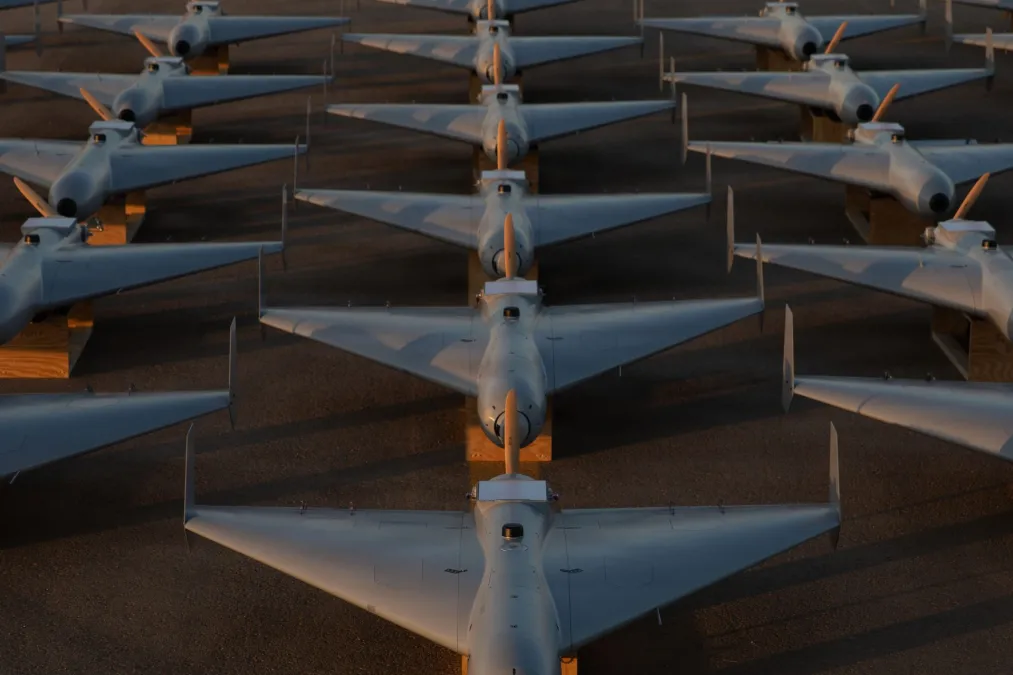

The United States military has acknowledged that it used newly developed, low-cost attack drones modeled on Iran’s own Shahed-136 loitering munition during recent strikes on Iranian-linked targets in the Middle East. The disclosure highlights a notable shift in modern warfare, where relatively inexpensive unmanned systems are becoming central to military strategy.
The strikes were conducted under an operation known as Operation Epic Fury, which began in the early hours of February 28. According to the U.S. Department of Defense, the operation combined traditional precision-guided weapons with a newer category of one-way attack drones designed to hit targets and detonate on impact.
The move marks the first confirmed combat use of a specialized U.S. military unit dedicated to operating such drones.
A New Drone Unit Enters Combat
The drones were deployed by Task Force Scorpion Strike, a unit created specifically to manage one-way attack drone missions. The task force operates under the authority of the United States Central Command (CENTCOM), which oversees American military operations across the Middle East and parts of Central and South Asia.
CENTCOM confirmed that the February 28 mission marked the first time this newly formed task force used its drones in active combat. The broader operation reportedly included coordinated strikes launched from air, land, and sea platforms, with the drones integrated into the overall assault plan.
Task Force Scorpion Strike was only publicly introduced in December. At the time, military officials explained that the unit had been established to operate a system known as the Low-cost Unmanned Combat Attack System, or LUCAS. The program was designed to deliver long-range strike capabilities without the steep price tag associated with conventional cruise missiles.
The rapid transition from formation to battlefield deployment suggests the Pentagon is accelerating efforts to incorporate more affordable unmanned technologies into frontline operations.
Reverse-Engineering an Adversary’s Weapon
Reporting by CNN indicated that the LUCAS drone was developed after U.S. technicians studied and reverse-engineered a captured Iranian Shahed-136 drone. The Shahed-136 has become one of Iran’s most recognizable military exports and has been widely used in conflicts beyond its borders.
The Shahed-136 is classified as a loitering munition, sometimes referred to as a “suicide drone.” Unlike reusable unmanned aerial vehicles, these systems are designed to carry explosives and destroy themselves upon striking a target. They can travel significant distances, circle above potential targets, and then dive into them.
Iran has supplied these drones to regional proxy groups and to Russia, where they have been used extensively in the war in Ukraine. Their relatively low cost and ability to overwhelm air defenses through sheer numbers have made them a prominent feature of modern battlefields.
The U.S. version, LUCAS, closely mirrors the size and general capabilities of the Shahed-136. The drone is reported to measure about 10 feet in length, with a wingspan of roughly eight feet. It is capable of autonomous flight and long-range operations, giving U.S. forces a flexible strike option.
Military officials have said the drones can be launched using multiple methods, including catapults, rocket-assisted takeoff systems, and mobile ground platforms. This adaptability allows deployment from forward positions without the need for large airfields or complex infrastructure.
Cutting Costs on the Battlefield
One of the defining features of the LUCAS program is its cost. Each unit is estimated to cost around $35,000—substantially less than many traditional long-range weapons. For comparison, a single Tomahawk cruise missile can cost approximately $1.3 million.
The dramatic difference in price reflects a broader strategic calculation. In modern conflicts, adversaries often use inexpensive systems to challenge technologically advanced militaries. Responding to low-cost threats with million-dollar munitions can quickly drain resources.
By investing in cheaper, expendable drones, the Pentagon appears to be addressing what military analysts call “cost asymmetry.” Instead of relying solely on high-end missile systems, commanders now have the option of deploying lower-cost strike assets against certain targets.
Officials have not released details on how many LUCAS drones were used during Operation Epic Fury or the specific targets they engaged. However, the Pentagon confirmed that they were integrated into a broader strike package, operating alongside more conventional precision weapons.
Industry Collaboration and Rapid Development
The LUCAS drone was developed in partnership with Arizona-based defense contractor SpektreWorks. The company lists a similar drone model, known as the FLM 136, which has published specifications indicating a range of up to 444 nautical miles and a cruising speed of 74 knots.
While it has not been formally confirmed that the FLM 136 and LUCAS are identical, the similarities in size and performance suggest a close connection between the commercial platform and the operational military system.
The timeline of development has drawn attention. Task Force Scorpion Strike was announced in December, and within months the unit was already conducting combat missions. The speed underscores the urgency with which the U.S. military is adapting to evolving battlefield realities, particularly lessons drawn from conflicts such as the war in Ukraine, where relatively simple drones have had outsized tactical impact.

Comments are closed.