
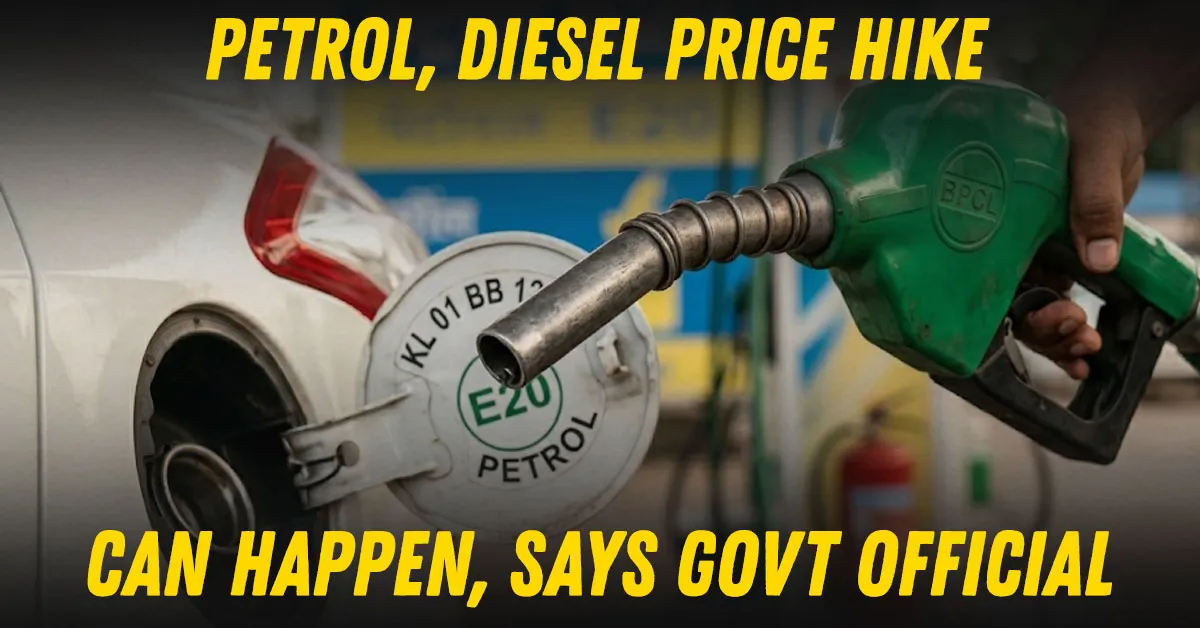

Of late, there have been several rumours on various social media platforms hinting at an upcoming increase in fuel prices sometime soon. Many of these have already been dismissed as fake news. In the latest development, the Economic Times reports that the government hasn’t ruled out the possibility of petrol and diesel prices going up in the near term. Government sources have reportedly told the publication that the possibility of a fuel price hike cannot be ruled out. This is an aftermath of increasing pressure on oil marketing companies from rising crude oil prices in the global market. Losses are reportedly mounting after nearly four years of fuel rates staying still.
International crude oil prices have surged sharply in recent weeks, touching a four-year high of $126 per barrel before easing slightly. Despite the cooling, prices continue to remain above $110 per barrel, which is significantly higher than last year’s average of around $70.
This spike has been triggered by geopolitical tensions in the Middle East. Disruptions in the Strait of Hormuz, one of the world’s most critical oil transit routes, have led to broader supply challenges.
The situation escalated after military actions involving the United States and Israel against Iran, followed by strong retaliation from Tehran. All these have severely impacted global energy flows, as the route handles nearly one-fifth of the world’s oil trade.
Despite the sharp uptrend in global oil prices, retail prices of petrol and diesel have remained stable since early April 2022. This prolonged freeze has created a widening gap between international crude costs and retail prices in India, resulting in mounting losses for oil marketing companies.
Currently, petrol is priced at Rs 94.77 per litre in Delhi, while diesel is retailing at Rs 87.67 per litre.
State-run oil marketing companies are under increasing financial stress due to the aforementioned mismatch. According to government estimates, they are currently incurring losses of around Rs 20 per litre on petrol and nearly Rs 100 per litre on diesel.
Oil companies had previously offset losses with profits earned when crude prices declined. Now, the sustained spike in global crude oil prices has made that strategy less effective. This seems to be forcing them to increase fuel prices.
Earlier, Indian Oil Corporation stated on behalf of the industry that petrol, diesel, and domestic LPG prices would not be increased immediately, despite rising input costs.
However, oil companies have already begun passing on cost increases in other segments. Prices of commercial LPG, industrial diesel, 5-kg LPG cylinders, and jet fuel supplied to international airlines have been increased in line with global trends.
Market analysts have been anticipating a price hike for quite some time now. Earlier estimates suggested an increase of Rs 25 to Rs 28 per litre. Fuel price revisions in India have historically been aligned with political cycles. Following this pattern, we may see the revision being implemented after the elections conclude.
In short, the government and oil companies are now in a tricky situation. If global crude prices remain elevated and supply disruptions persist, continuing without a price hike would deepen financial losses for oil companies. Rolling out a hike could impact inflation and consumer sentiment. For the end consumers, petrol and diesel could get costlier if global crude oil prices do not come down.
Discussions around a possible price hike happen at a time when the Indian government has announced its intention to include flex fuel in its fuel mix. The centre has already issued draft rules for formally including E85 (85% Ethanol blended petrol) and E100 (nearly pure Ethanol) in India’s fuel energy map. The country has also completed the rollout of E20 ( 20% Ethanol blended) petrol. The move toward flex fuel will help in reducing dependence on imported crude oil. Even the E20 program has helped in reducing oil imports significantly.
Source: Economic Times
Comments are closed.