

Unlike heritage cities such as Hoi An or Hue, which have long-established urban identities shaped over centuries, Phu Quoc’s development has largely taken place over the past few decades. As a result, its urban landscape has been shaped primarily by contemporary planning and international design influences rather than historical architecture.
Positioned as an international tourism and resort destination, the island has gradually attracted architectural concepts inspired by multiple cultures. Many of these designs are adapted to the island’s tropical climate, coastal setting, and local lifestyle, contributing to a distinctive urban character.
Phu Quoc is also home to several projects designed by internationally recognized architects and design firms, which have helped shape the image of a modern coastal city with global influences.
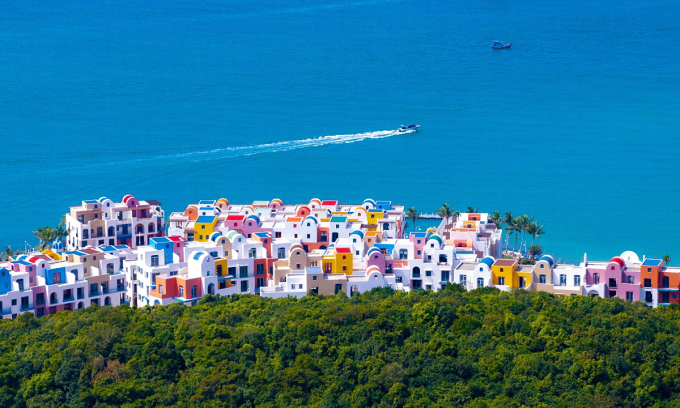
Santo Port on Hon Thom Island, Phu Quoc. Photo courtesy of Sun Group |
Areas such as Sunset Town and Santo Port reflect this architectural approach. Rather than directly replicating international styles, these developments reinterpret them within the local context, creating an urban environment where visitors encounter a variety of cultural references while still experiencing the island’s natural setting.
Elements inspired by Mediterranean coastal towns can be seen in rows of brightly colored buildings descending hillsides toward the sea, recalling landscapes such as Italy’s Amalfi Coast. Architectural motifs referencing classical forms also appear in several structures, including a design inspired by an ancient Roman amphitheater at the departure station of the Hon Thom cable car, as well as a clock tower drawing inspiration from St. Mark’s Campanile.
Sunset Town illustrates how international architectural ideas can be adapted to local conditions. The district draws on the design language of Mediterranean seaside towns, where colorful houses are built along hillsides facing the sea and exposed to sunlight and coastal winds, conditions that are similar to those on Phu Quoc Island.
At the same time, the development incorporates features suited to the local environment. Architectural details such as weathered façades, roof structures designed for tropical rainfall, and extensive greenery are integrated into the area alongside Vietnamese artistic elements.
The district is also known as one of the island’s locations for sunset views. Facing west toward the open sea, it offers unobstructed views as the sun sets over the horizon each evening. From bougainvillea-lined balconies to seaside stone steps, visitors can observe the changing colors of the sky and ocean as daylight fades.
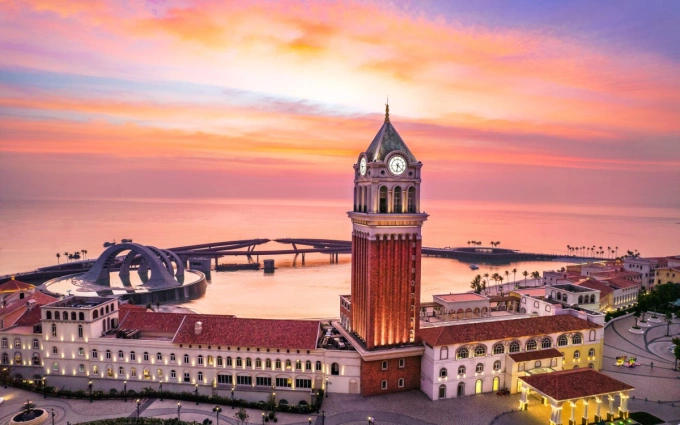 |
Sunset at the main square and Kiss Bridge in Phu Quoc. Photo courtesy of Sun Group |
Around the world, several cities have become platforms for prominent architects to present distinctive architectural concepts through landmark structures. Dubai is widely associated with iconic modern landmarks, while Singapore is known for integrating contemporary architecture with urban planning and landscape design.
In its own development process, Phu Quoc has also begun to incorporate architectural ideas of international scale that are adapted to its coastal environment.
At the center of Sunset Town stands the King of the Sun fountain, created by Frilli Gallery, a sculpture workshop known for classical European marble works.
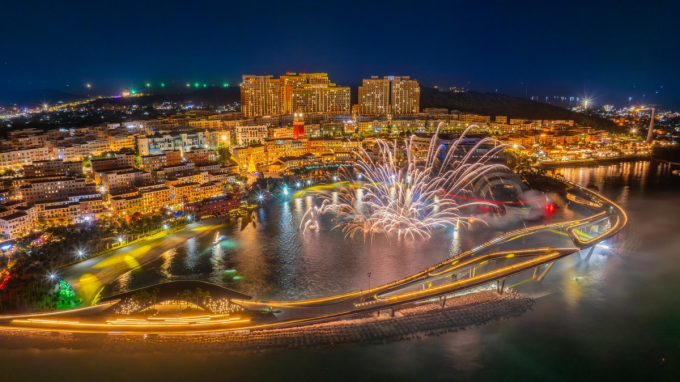 |
A fireworks show at Sunset Town, Phu Quoc. Photo courtesy of Sun Group |
Overlooking the bay is the Kiss Bridge, designed by Italian architect Marco Casamonti.
The structure consists of two branches extending toward each other over the water without touching, forming a symbolic architectural landmark.
Other developments have also contributed to shaping the island’s architectural landscape.
The JW Marriott Phu Quoc Emerald Bay Resort and the Sun Signature Gallery were designed by American architect Bill Bensley, known for design concepts that incorporate narrative elements and fictional histories.
 |
A couple perfoming on Kiss Bridge, Sunset Town, Phu Quoc. Photo courtesy of Sun Group |

Comments are closed.