
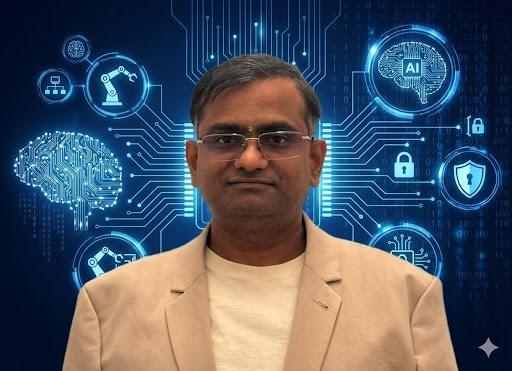
Pioneering Artificial Intelligence and Blockchain–Driven Virtual Teams: Redefining Enterprise IT Transformation at Global Scale

As global enterprises confront rising technology costs, increasingly sophisticated cyber threats, and the operational burden of aging legacy systems, the ability to modernize at scale without disrupting core business operations has become a decisive competitive factor. In this environment, Dr. Sureshkumar Somanathan has emerged as a leading figure in enterprise IT transformation, demonstrating how artificial intelligence, blockchain, and globally distributed virtual teams can deliver measurable financial returns, reduced operational risk, enhanced system resilience, and sustained business agility across industries.
Dr. Somanathan’s work is defined by an outcomes-driven approach that prioritizes business value over experimentation. His transformation initiatives are structured to align advanced technologies with executive and board-level priorities, consistently delivering long-term reductions in total cost of ownership, quantifiable improvements in cybersecurity posture, and stronger regulatory confidence, while maintaining uninterrupted operations in complex, mission-critical environments. By integrating AI-driven decision intelligence, blockchain-enabled governance frameworks, and disciplined execution through virtual teams, he has enabled large organizations to modernize legacy platforms at global scale.
A significant illustration of this sustained impact can be seen in the Australian financial sector, where Dr. Somanathan led a comprehensive mainframe modernization initiative that migrated mission-critical workloads to a secure private cloud architecture. The program generated USD 23.5 million in annual IT cost savings by eliminating high-cost legacy licensing, optimizing infrastructure utilization, and streamlining operations. These efficiencies were structural rather than one-time, strengthening long-term operational resilience. The success of the initiative directly enabled executive approval of a USD 30 million follow-on modernization program, underscoring institutional confidence in the transformation strategy and its long-term business value.
Building on these outcomes, Dr. Somanathan played a central role in a large-scale cloud modernization and security remediation program for a global retail and manufacturing enterprise operating across multiple continents. Entrusted with defining the architectural roadmap, cloud-governance framework, and enterprise-risk-remediation strategy for a USD 50 million IT landscape, he led an organization-wide migration to Microsoft Azure while strengthening security and compliance across diverse regulatory environments. The program delivered a 38 percent year-over-year reduction in IT costs, significantly improved operational efficiency, and a security remediation outcome that avoided more than USD 8 million annually in breach-related costs. By shifting from capital-intensive infrastructure to a flexible operational-expenditure model, the transformation also produced USD 6 million in annual savings through optimized resource utilization and elastic scalability.
Under his leadership, the accompanying security remediation initiative generated an additional USD 23.5 million in annual IT infrastructure savings, representing a 47 percent year-over-year reduction. Automation and streamlined security workflows drove a 23 percent reduction in IT operational support costs, equivalent to USD 3.45 million annually. Improved availability and performance of customer-facing systems contributed to a 20 percent increase in customer satisfaction, translating into USD 4 million annually in avoided customer acquisition costs.
Risk reduction has been an equally defining outcome of Dr. Somanathan’s work in the United States. For a leading U.S.-based financial services organization, he directed a departmental transformation focused on migration to a Virtual Private Cloud while remediating end-of-life infrastructure. Guided by AI-driven decision models for cloud transformation and supported by a blockchain-enabled framework for enterprise-data integrity, the initiative delivered a 29 percent reduction in total departmental IT costs approximately USD 4.93 million annually while achieving measurable cyber-risk reduction of USD 0.28 million per year. By embedding security, compliance, and data integrity into the architecture by design, the program strengthened regulatory alignment and audit readiness without disrupting ongoing operations.
In the healthcare and pharmaceutical sector, where system reliability directly affects patient outcomes, Dr. Somanathan led modernization efforts that enabled sustained 99.98 percent availability for mission-critical healthcare applications. These improvements reduced operational disruptions, strengthened disaster recovery capabilities, and established a scalable and secure foundation for future innovation.
Artificial intelligence has been a central pillar of Dr. Somanathan’s transformation strategy. By embedding AI and data science into operational and security functions, he enabled predictive, data-driven decision-making, improved forecasting accuracy, and faster response to operational and cyber risks. Blockchain principles further reinforced enterprise trust through immutable audit trails, transparent data lineage, and secure information exchange across hybrid and multi-cloud environments.
A defining feature of his leadership has been the effective use of globally distributed virtual teams. Through AI-enabled collaboration platforms, agile delivery frameworks, and standardized governance-models, these teams delivered complex, multi-million-dollar programs across time zones with speed and consistency.
As enterprises worldwide navigate, accelerating digital disruption and regulatory complexity, the transformation model demonstrated by Dr. Sureshkumar Somanathan offers a clear and repeatable path forward one that delivers quantifiable financial value, durable risk reduction, and long-term operational resilience at global scale.

Comments are closed.