

293
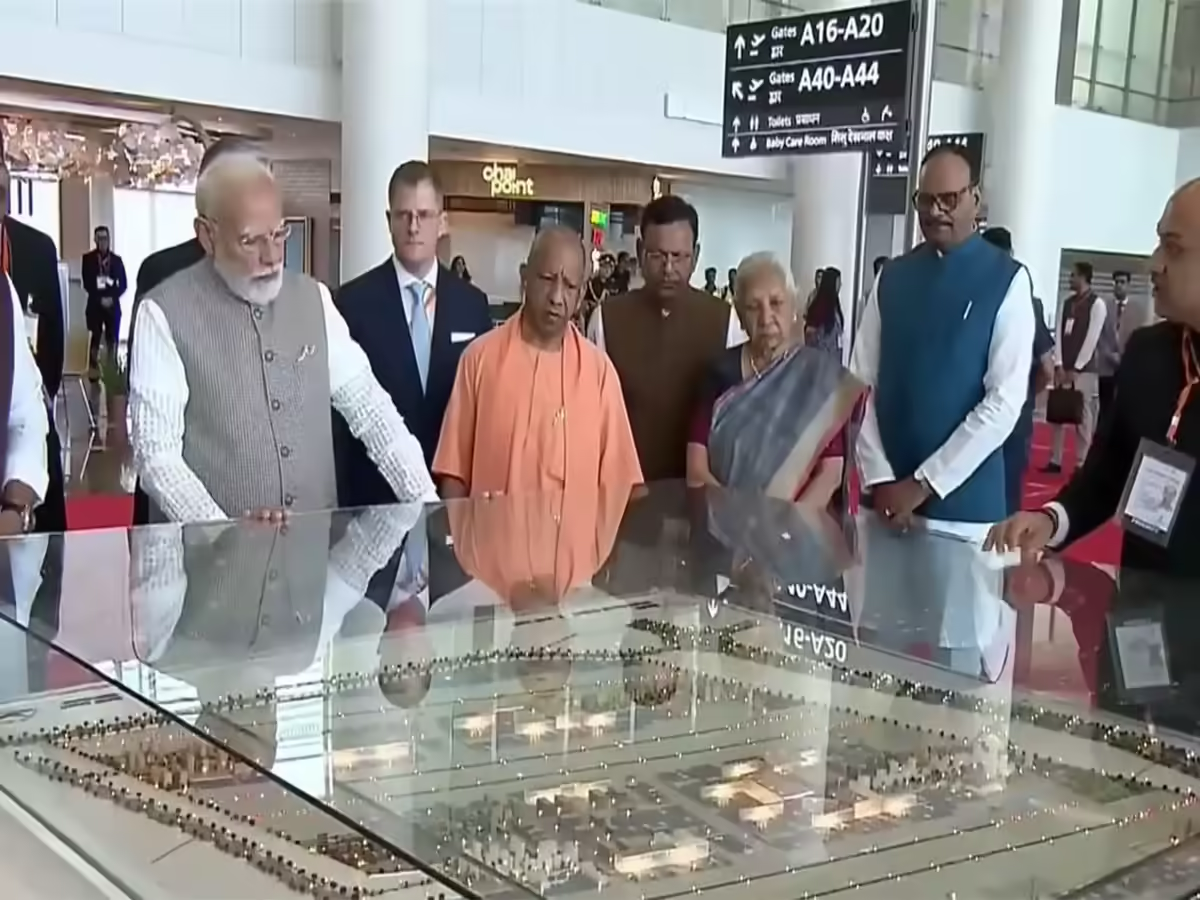
NEW DELHI: Prime Minister Narendra Modi on Saturday inaugurated Phase I of the Noida International Airport at Jewar, describing it as a reflection of “India’s new spirit” and a major step toward accelerating development across Uttar Pradesh and the broader National Capital Region (NCR).
Addressing a large public gathering, the Prime Minister said the airport signals the beginning of a “new chapter” in the vision of Viksit Uttar Pradesh, Viksit Bharat, highlighting its potential to drive economic growth, strengthen connectivity, and generate employment opportunities.
“This airport will act as a catalyst for development. It will open up new avenues for the youth and farmers of western Uttar Pradesh,” Modi said, adding that cities including Agra, Mathura, Ghaziabad, Meerut, and Etawah stand to gain significantly from improved connectivity.
According to the Prime Minister’s Office, the Jewar airport is expected to significantly enhance both regional and international connectivity, reduce congestion at Delhi’s existing airport, and act as a catalyst for economic growth across northern India. With its scale, advanced infrastructure, and focus on sustainability, the Noida International Airport is poised to become a key pillar in India’s aviation expansion and overall economic growth trajectory.
Notably, Phase I of the project has been developed at an estimated cost of Rs 11,200 crore under the Public-Private Partnership (PPP) model. Conceived as a key international gateway, the airport will serve as the second international airport for Delhi-NCR alongside Indira Gandhi International Airport. Both airports are expected to function as part of an integrated aviation network, helping ease congestion while reinforcing Delhi-NCR’s emergence as a major global aviation hub.
During his address, Modi also criticised opposition parties, accusing the Samajwadi Party of turning Noida into “an ATM for loot” and alleging that the airport project remained stalled between 2004 and 2014 under previous governments.
“Today, Uttar Pradesh is emerging as an engine of development under the double-engine government,” he said, attributing the project’s progress and completion to the BJP-led NDA government. Further, PM expressed his gratitude to the farmers who gave up their lands to make this project a reality, noting that agriculture and farming held great importance in the region’s economy. Modi noted that the expansion of modern connectivity will further boost food processing prospects in Western UP, adding, “The agricultural produce from here will now reach global markets more efficiently.”
Emphasizing that airports are not merely amenities but catalysts for progress, the Prime Minister pointed out the remarkable expansion of India’s aviation infrastructure. Highlighting that today, there are more than 160 airports, PM Modi remarked that the Air connectivity is now reaching not just metropolitan cities but also smaller towns. “The current government has made air travel accessible for the common Indian,” asserted Modi, adding that the number of airports in Uttar Pradesh has been increased to seventeen.
Highlighting the impact of the UDAN scheme, the Prime Minister said that the government has consistently strived to ensure that while airports are built, airfares remain within the reach of ordinary families. Noting that more than one crore sixty lakh citizens have travelled by air at affordable rates by booking tickets under the UDAN scheme, Modi remarked, “Recently, the Central Government has further expanded the UDAN scheme with an approval of approximately Rs 29,000 crore, under which 100 new airports and 200 new helipads will be built in smaller cities in the coming years. UP will also benefit immensely from this.”
Addressing a critical gap in India’s aviation ecosystem, the Prime Minister drew attention to the Maintenance, Repair, and Overhaul (MRO) sector, noting that 85 percent of Indian aircraft still have to go abroad for MRO services. PM Modi noted that the government has resolved to make India self-reliant in the MRO sector as well and highlighted that today, the foundation stone of an MRO facility has been laid here at Jewar.
“When ready, it will serve aircraft from India and abroad, generating revenue for the country, keeping our money within India, and creating numerous jobs for the youth,” announced Modi. Notably, the Noida International Airport ranks among India’s largest greenfield airport developments. In its initial phase, it is designed to handle 12 million passengers annually, with the capacity to scale up to 70 million passengers per annum (MPPA) as the project reaches full completion. The airport includes a 3,900-metre runway capable of accommodating wide-body aircraft and is equipped with advanced navigation infrastructure such as the Instrument Landing System (ILS) and state-of-the-art airfield lighting, ensuring seamless, all-weather, round-the-clock operations.
A major feature of the project is its multi-modal cargo hub, which is designed to process over 2.5 lakh metric tonnes annually, with the potential to expand to nearly 18 lakh metric tonnes. The airport complex also includes a 40-Acre Maintenance, Repair, and Overhaul (MRO) facility aimed at bolstering India’s aviation ecosystem. Designed with sustainability at its core, the airport aims to operate as a net-zero emissions facility, incorporating energy-efficient technologies and environmentally responsible practices. Its architectural design blends modern infrastructure with Indian cultural elements, drawing inspiration from traditional ghats and havelis.

Comments are closed.