
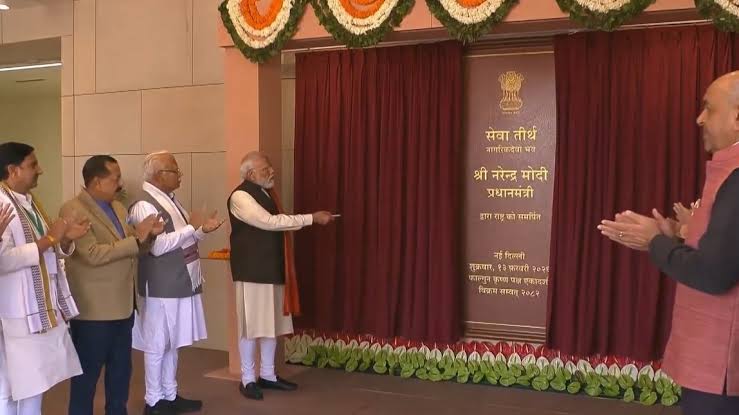

Prime Minister Narendra Modi on Friday inaugurated Seva Teerth, the newly constructed administrative complex that now houses the Prime Minister’s Office (PMO), the National Security Council Secretariat, and the Cabinet Secretariat.
The inauguration marks a significant step in the consolidation of India’s top administrative offices, which were previously operating from different locations across the national capital.
A Unified Governance Hub in New Delhi
Located in New DelhiSeva Teerth has been described by the government as a reflection of “India’s administrative governance architecture” and a symbol of a modern, efficient, and citizen-centric governance ecosystem.
The complex prominently features the motto ‘Nagriko Devo Bhava’ (Citizens akin to God), underscoring a focus on public service and accountability.
Alongside Seva Teerth, the Prime Minister also inaugurated Kartavya Bhavan 1 and 2, which will accommodate several key ministries. The buildings are equipped with:
Digitally integrated office systems
Structured public interface zones
Centralized reception facilities
Smart access control and surveillance systems
Advanced emergency response infrastructure
Designed in accordance with 4-Star GRIHA standards, the complexes incorporate renewable energy systems, water conservation measures, waste management solutions, and high-performance building envelopes to reduce environmental impact while enhancing operational efficiency.
Why February 13 Is Significant
The inauguration date holds historic importance. February 13 marks 95 years since New Delhi was formally inaugurated as India’s capital on February 13, 1931. The choice of date symbolically connects India’s administrative legacy with its evolving governance framework.
Major Decisions Announced from the New PMO
Soon after inaugurating Seva Teerth, Prime Minister Modi began official work from the new office, announcing a series of major policy decisions focused on women, youth, innovation, agriculture, and vulnerable citizens.
1. PM RAHAT Scheme
The government approved the launch of the PM RAHAT Scheme, under which accident victims will receive cashless medical treatment of up to ₹1.5 lakh. The initiative aims to ensure that lack of immediate funds does not prevent life-saving treatment.
2. Expanded Target for Lakhpati Didis
Under the women’s self-help initiative, the government has already surpassed the milestone of 3 crore Lakhpati Didis ahead of its March 2027 target.
The Prime Minister has now set a new goal of 6 crore Lakhpati Didis by March 2029, effectively doubling the scale of the programme and reinforcing economic empowerment for women across India.
3. Agriculture Infrastructure Fund Expansion
To strengthen the agricultural value chain, the government approved doubling the outlay of the Agriculture Infrastructure Fund from ₹1 lakh crore to ₹2 lakh crore. The move is aimed at boosting rural infrastructure, storage, and supply chain efficiency.
4. Startup India FoF 2.0
In a push to support innovation, deep tech, advanced manufacturing, and early-stage enterprises, the Prime Minister approved Startup India Fund of Funds (FoF) 2.0 with a corpus of ₹10,000 crore. The initiative seeks to further strengthen India’s startup ecosystem and technological capabilities.
A New Administrative Chapter
With the inauguration of Seva Teerth and the launch of multiple policy initiatives on the very first day, the government has signaled an emphasis on integrated governance, sustainability, and citizen-focused decision-making.
The consolidation of key secretariats under one roof is expected to improve coordination at the highest levels of administration while reinforcing operational efficiency in policy execution.

Comments are closed.