
Modi’s jibe at Nehru during Somnath temple’s 1,000-year celebrations triggers political storm

A political war has erupted over Prime Minister Narendra Modi’s jibe against Jawaharlal Nehru’s stance on the Somnath temple back in 1951, during his speech at the Somnath Swabhiman Parv in Gujarat, held to mark 1,000 years since Mahmud of Ghazni’s attack on the shrine.
Addressing a large gathering, Modi accused the Congress-led government under Nehru of “whitewashing history” by portraying repeated invasions of the Somnath temple as mere economic loot rather than acts of religious desecration. He argued that post-Independence leaders downplayed the temple’s symbolic importance, and practised appeasement politics, while he hailed Somnath as a ‘symbol of resilience’, noting that its history is not one of defeat but of repeated reconstruction.
Meanwhile, a few days prior to the Somnath Temple event, the BJP released 17 letters written by Nehru in 1951 to Pakistan’s Prime Minister Liaquat Ali Khan and others, claiming that they showed Nehru’s reluctance to support Somnath temple’s reconstruction.
While the Congress dismissed Modi’s claims as attempts to politicise history, the BJP continued its tirade in media interviews that Congress ‘never took pride in our civilizational identities’. A Congress spokesperson in an interview with India Today countered that Nehru supported the temple’s rebuilding but opposed state funding, citing historical correspondence with Dr Rajendra Prasad. And that the BJP was selectively quoting from the letters to suit is narrative.
The Congress also said that the Somnath temple was rebuilt during Nehru’s time and urged BJP not to do politics over the temple.
Modi’s attack
Modi in his speech warned the forces that had opposed the reconstruction of the Somnath temple after independence are “still active among us”, and India needs to be alert, united and powerful to defeat them. Further, he claimed that the “true history of hatred, atrocity and terror was hidden” and, without taking names, attacked the then Congress- led government for “whitewashing the history” that involves multiple attacks on the Somnath temple located on Gujarat’s coast by Mughal invaders.
Also read: PM Modi slams alleged attempts to hide Somnath history, hails Sardar Patel
Modi raked up history saying that after independence, when Sardar Vallabhbhai Patel took the oath of rebuilding the Somnath temple, his path was obstructed, and objections were also raised when India’s first president, Dr Rajendra Prasad, came to Somnath for the inauguration of the reconstructed temple in 1951, the PM pointed out.
“Unfortunately, those forces which had opposed the reconstruction of the Somnath temple are still present in our country, and they are very much active. Instead of swords, conspiracies are being hatched against India through other means,” said Modi.
Row over 17 letters
Last week, BJP had released 17 letters between Nehru and various historical figures related to the Somnath issue. In one letter Nehru allegedly addresses Pakistan PM Liaquat Ali Khan as “Dear nawabzada” in one dated April 21, 1951, where he describes the story of Somnath’s doors as “completely false” to dismissing the temple inauguration as unnecessary “fuss”. The Somnath temple gates issue involves a disputed historical claim that the original gates, allegedly looted by Mahmud of Ghazni in 1026 CE, were recovered by the British in 1842 and brought back to India. While Nehru may be right, his assuring the Pakistani PM is problematic, said reports.
To build up momentum on the issue, BJP MP Sudhanshu Trivedi said on X, “Somnath was plundered by Mahmud Ghazni and Khilji in the past, but in independent India, Pandit Nehru harboured the greatest hatred towards Lord Somnath.
What Nehru said
In another letter penned on August 1, 1951, to chief ministers, Nehru blamed the “pomp and ceremony” of the Somnath temple inauguration for creating a “very bad impression abroad” and weakening India’s secular image. In this letter, he directed that embassies should be instructed not to pay the slightest attention to requests for sacred river water from the Somnath Trust. He formally disapproved of the use of Indus water for the Somnath consecration, conveying through the foreign secretary that the request did not have his approval.
History of hatred
Meanwhile, PM Modi in his speech also highlighted that though the Somnath temple attacks were driven by hatred, attempts were made to project it as simple loot.
“Books were written to cover up the religious motivation, portraying it merely as ordinary loot. The Somnath temple was repeatedly destroyed. If the invasions had been solely for plunder, they would have stopped after the first major loot 1,000 years ago”.
Also read: Congress slams BJP for serving ‘half-truths’ about Nehru on Somnath temple
“But that didn’t happen. The sacred deity of Somnath was desecrated. Repeated attempts were made to alter the very form of the temple. And we were taught that Somnath was destroyed for the sake of loot! The true history of hatred, atrocity and terror was concealed from us,” he added.
No person truly devoted to their religion would support such an extremist ideology. However, those involved in appeasement knelt before such religious extremism, he said.
With elections around the corner in many states, the BJP is raking up Nehru’s letters on the Somnath Temple in every campaign in ever local language possible – be it Tamil, Bengali or Assamese – to drive home that the survival of the Somnath temple, a symbol of Hinduism, is only celebrated by the Modi government, said a report.
What else Modi said
Somnath’s history of 1,000 years is not that of destruction and defeat, but of victory and reconstruction, the PM noted in his speech
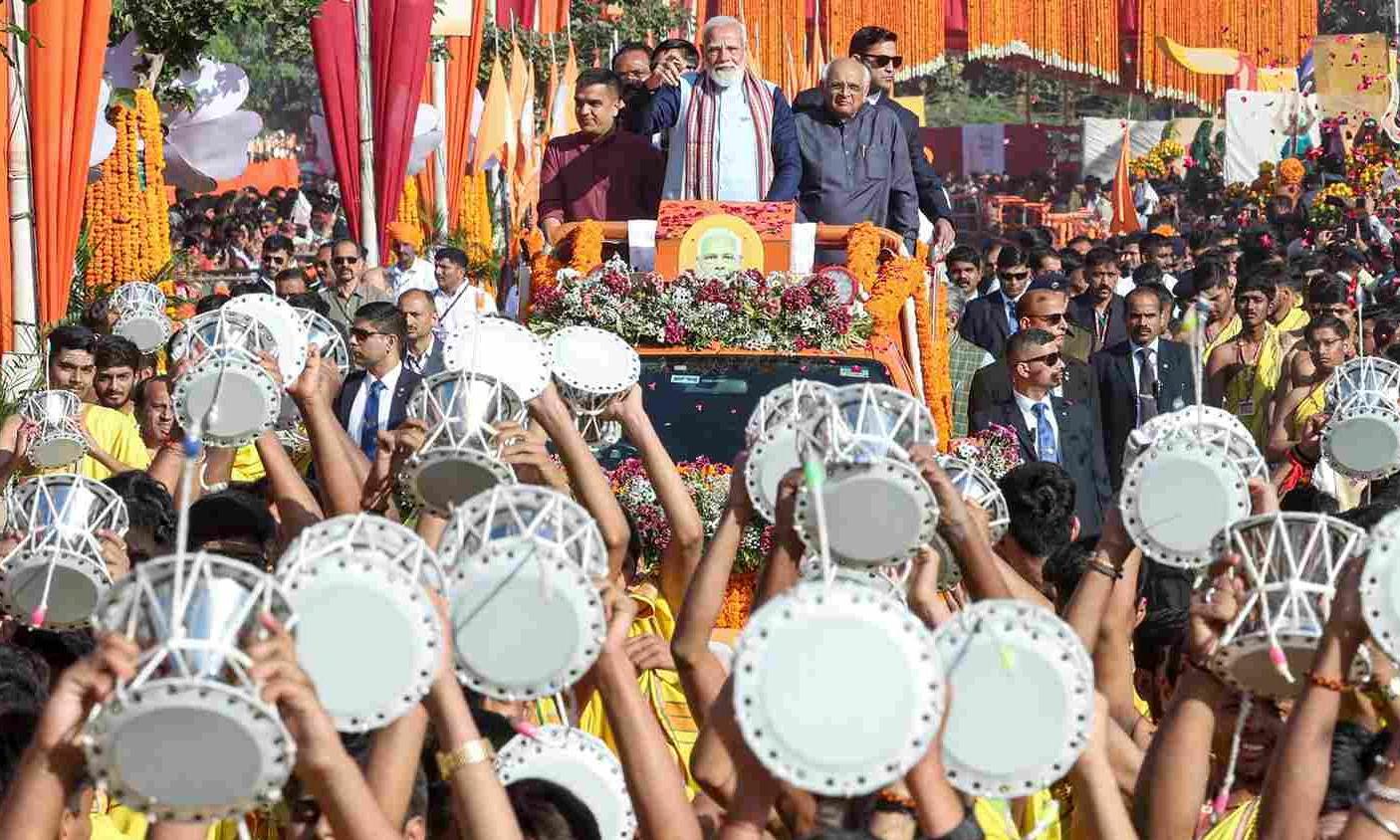
At the ceremony, Modi also led ‘Shaurya Yatra’, a ceremonial procession organised to honour those who laid down their lives defending the Somnath temple. The yatra featured a procession of 108 horses, reflecting valour and sacrifice.
Further, Modi recalled the attacks on the Somnath temple from 1026 by Mahmud of Ghazni to Mughal ruler Aurangzeb in the 17th and 18th centuries.
Mahmud Begda and Aurangzeb even tried to turn the temple into a mosque through the invasion. But, after every attack, the temple was rebuilt by Lord Shiva’s devotees, including Malwa queen Ahilyabai Holkar, he said.
“Civilisations that seek to advance by destroying others ultimately destroy themselves. Pilgrimage sites like Somnath taught us that the path of creation is long, but it is also the lasting path,” Modi said.
“Somnath’s history is about the valour of our ancestors. It is a testament to their sacrifice and dedication,” he noted.
The fundamentalist invaders are now reduced to pages of history, but the Somnath temple flag is still flying high, he added.
Attacks of religious terror
Modi said that just like the temple, foreign invaders tried to destroy India for several centuries, but neither Somnath nor the country bowed down before them. “The invaders thought they had won by destroying the temple, but after 1,000 years, the flag of Somnath is still flying high,” he said, adding that this struggle of 1,000 years has no parallel in world history.
“The invaders kept coming, and attacks of religious terror continued. But in every era, Somnath was rebuilt. Such a struggle spanning centuries, such prolonged resistance and such unwavering faith in one’s culture – it is difficult to find anything comparable in world history,” he said.
Modi noted that many bravehearts like Veer Hamirji Gohil and Vegdaji Bhil sacrificed their lives to protect the Somnath temple from invaders. “But, unfortunately, they were not given their due credit and importance. In fact, some historians and politicians even attempted to whitewash the history of these invasions,” he stressed.

Comments are closed.