
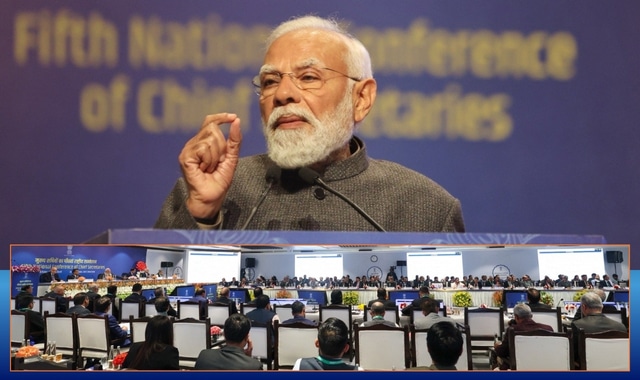

Prime Minister Narendra Modi today chaired the concluding session of the Fifth National Conference of Chief Secretaries in Delhi, emphasising that Viksit Bharat – India’s vision for a developed nation by 2047 – must embody quality, excellence, and self-reliance across governance, service delivery, and manufacturing.
The three-day event, held from December 26 to 28 at Pusa, Delhi, brought together chief secretaries, senior officials from states and union territories, domain experts, and central government officers to foster cooperative federalism and advance human capital development.
In his address, PM Modi described India as having boarded the “Reform Express,” fueled by the energy of its youthful population. Highlighting the country’s demographic edge, he noted that nearly 70% of Indians are in the working-age group, presenting a historic opportunity to accelerate economic growth when aligned with strategic reforms. “Empowering our youth remains the government’s top priority,” he said, underscoring the need for a whole-of-government approach to build knowledge, skills, health, and capabilities as drivers of progress.
The conference’s overarching theme, “Human Capital for Viksit Bharat,” featured in-depth discussions on early childhood education, schooling, skilling, higher education, and sports. PM Modi urged states to map skill demands at local and global levels and foster collaborations between academia and industry to produce high-quality talent. He also stressed the importance of aligning India’s national sports calendar with global standards, calling for early identification and training of young athletes to prepare for hosting the 2036 Olympics. “The next 10 years must be invested in nurturing our sports ecosystem at district levels,” he added, advocating for data-driven promotion of local tournaments.
A key focus was on economic self-reliance, or Aatmanirbharta. PM Modi called for strengthening the “Zero Effect, Zero Defect” commitment, ensuring products have minimal environmental impact while maintaining top-tier quality. He proposed that the Centre and states jointly identify 100 products for domestic manufacturing to cut import dependence and bolster economic resilience. With the upcoming launch of the National Manufacturing Mission (NMM), he directed states to prioritise infrastructure development, ease of doing business reforms, and the provision of land, utilities, and social amenities to attract global companies.
PM Modi also encouraged states to position India as a “Global Services Giant” by expanding beyond traditional sectors into healthcare, education, transport, tourism, professional services, and AI. In agriculture, he advocated a shift to high-value farming, dairy, and fisheries to make India the world’s food basket, including targeted interventions in 100 low-productivity districts under the PM Dhan Dhanya Scheme. Similarly, for education outcomes, states were urged to address gaps in the lowest-performing districts.
Tourism emerged as a major avenue for youth livelihoods, with PM Modi directing states to create roadmaps for at least one world-class destination each, complete with robust ecosystems. He highlighted India’s rich heritage as a pathway to becoming a top global tourist hub.
On cultural preservation, the Prime Minister promoted the Gyan Bharatam Mission for digitising ancient manuscripts, suggesting that states launch dedicated campaigns. Once digitised, AI could synthesise this knowledge for broader use. He also emphasised capacity building in collaboration with the Capacity Building Commission, integrating AI in governance, and prioritising cybersecurity to protect citizens.
In his closing remarks, PM Modi called for every state and union territory to draft 10-year actionable plans with milestones at 1, 2, 5, and 10 years, monitored through technology. He praised the conference as a platform for collective deliberation, suggesting similar events at departmental levels to instil a national perspective.
The event included special sessions on deregulation, technology in governance, agri-tech innovations, tourism development, self-reliance, and post-Left Wing Extremism planning. Discussions underscored time-bound implementation, citizen-centric governance, and data-driven frameworks to ensure inclusive development.
This conference reinforces India’s commitment to transforming human capital into a cornerstone of Viksit Bharat, blending federal partnership with innovative reforms for a prosperous future.

Comments are closed.