
PM Modi’s historic visit to New Zealand: India-New Zealand become strategic partners, aim to double trade by 2030

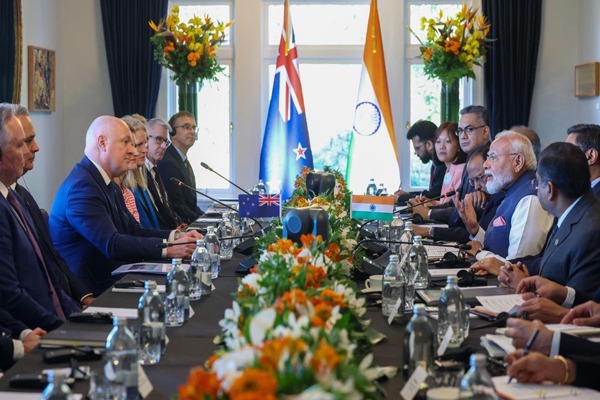
Auckland/New Delhi, 11 July. Prime Minister Narendra Modi has reached New Zealand on an official visit at the invitation of New Zealand Prime Minister Christopher Luxon. This is the first visit by an Indian Prime Minister to New Zealand in the last 40 years, which is being considered a historic milestone in the relations between the two countries. During this tour which started from July 10, Prime Minister Modi was formally welcomed at the Government House. After this he held bilateral talks with Prime Minister Luxon.
The two leaders discussed many important issues including trade, defence, education, security, science, sports and cooperation in the Indo-Pacific region. Prime Minister Modi also addressed New Zealand business leaders and the Indian community and observed sports innovations there. Recalling Prime Minister Luxon’s visit to India in March 2025, the two leaders reviewed the progress of negotiations on a Free Trade Agreement (FTA) and agreements signed in areas such as defence, education, customs, horticulture, forests and sports.
India-New Zealand relations get status of strategic partnership
Keeping in mind the shared democratic values, strong people-to-people ties and common interests in the Indo-Pacific region, India and New Zealand decided to upgrade their bilateral relations to the status of ‘Strategic Partnership’. The two Prime Ministers committed to taking cooperation to new heights in the next four years by approving the ‘India-New Zealand Strategic Partnership: Roadmap to 2030’.
Political and diplomatic cooperation will be strengthened
Both countries agreed to institutionalize regular dialogue and high-level meetings between Prime Ministers, Ministers and senior officials. It was also decided to initiate regular dialogue between the Foreign Ministers and strengthen the annual review mechanism between the Foreign Ministries of the two countries. It was also agreed to increase parliamentary cooperation and exchange of MPs.
Common strategy for defence, maritime security and counter-terrorism
India and New Zealand agreed to further strengthen defense cooperation, increase regular military-to-military contacts and expand cooperation in maritime security. The two countries decided to launch a maritime security dialogue, increase naval exercises and strengthen information sharing arrangements in the Indo-Pacific region. Apart from this, it was also agreed to increase cooperation against cyber security, terrorism, drug trafficking, organized crime and cross-border crimes. A Memorandum of Understanding (MOA) was signed for the formation of an Anti-Terrorism Joint Working Group.
Target to double trade by 2030
Both the countries set a target of increasing bilateral trade to 7 billion New Zealand dollars (about Rs 35 thousand crore) by the year 2030. It was also agreed to quickly implement a balanced and comprehensive Free Trade Agreement (FTA). Several new agreements were welcomed to enhance cooperation in tourism, agriculture, dairy, animal husbandry, horticulture and forestry sectors. The two leaders also stressed on encouraging airlines to start direct non-stop flights between India and New Zealand.
Cooperation will increase in education, science and disaster management
Describing education, research, science, technology and innovation as the important basis of bilateral relations, both the countries agreed to increase cooperation between universities and research institutes. Student exchanges, institutional partnerships and joint research in new technologies will be promoted. An MoU for disaster management cooperation was also signed between the National Disaster Management Authority (NDMA) of India and the National Emergency Management Agency of New Zealand. It was also agreed to further strengthen cooperation under International Solar Alliance, Disaster Resilient Infrastructure and Global Biofuels Alliance.
Shared stance on Indo-Pacific and UN reform
The two leaders reiterated their commitment to a free, open and rules-based Indo-Pacific region. Emphasizing the need for comprehensive reform of the UN Security Council, New Zealand reiterated its support for India’s permanent membership.
Shared concern on global issues
The Prime Ministers expressed concern over rising tensions in the Middle East, the Ukraine conflict and global supply chain challenges. Both the leaders strongly condemned cross-border terrorism, mentioned the terrorist attacks in Pahalgam and New Delhi and stressed the need for strict action against the culprits. At the end of the meeting, both the Prime Ministers directed senior officials to implement the initiatives under the ‘Roadmap to 2030’ in a time-bound manner and ensure regular reviews. Both leaders reiterated their commitment to take the India-New Zealand strategic partnership to new heights by continuing high-level dialogue.

Comments are closed.